How Director Lee Sang-min and Actor Kim Hye-yoon Built the Fear in 'Salmokji'
by Choi SongheePosted : April 19, 2026, 13:36Updated : April 19, 2026, 13:36
Every production holds many perspectives. The same place and time can feel different depending on where a director or actor stands. “Choi Song-hee’s B-Cut” looks beyond the on-screen “A-cut” to the vivid record of what happened off camera. By weaving interviews with directors and actors, it reconstructs the “B-cut” moments that were often more intense than the finished frame. <Editor’s note>
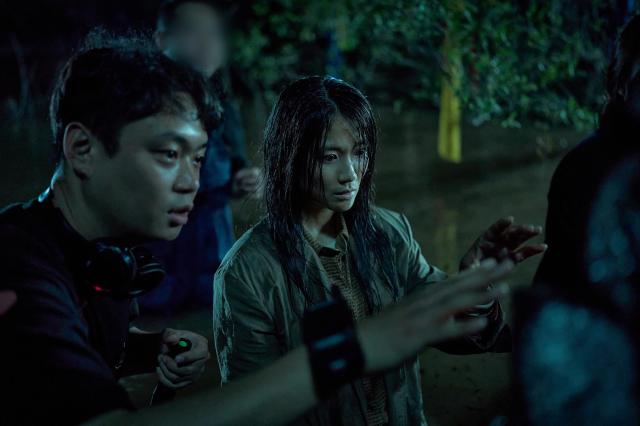
Director Lee Sang-min (left) and actor Kim Hye-yoon from “Salmokji.” [Photo=Showbox]
※This article contains spoilers for the film
The horror film “Salmokji” begins when an unidentified figure appears in a reservoir road-view image. A team returns to the site to film again and encounters something in the black, deep water. Rather than leaning on a simple ghost story or shock tactics, the movie builds dread by stacking small, unexplained signs and the slow sense that people at the water’s edge are being consumed. On screen, the reservoir swallows the characters; off screen, the director and cast closely discussed how to shape that fear.
Director Lee Sang-min and actor Kim Hye-yoon shared a love of the horror genre, but approached the set differently. Lee focused first on sound, devices and the texture of the location. Kim built the emotions of a character who tries to hold on but ultimately begins to crack. Their contrasting instincts, they said, helped make the film’s fear feel more layered.
“Kim Hye-yoon is sincere and exemplary by nature,” Lee said. “Since this is my first film at this scale, she was a real support. She gave a lot of good ideas, and I was grateful that she helped organize difficult ensemble scenes. Her expressiveness is excellent, too. She seemed to know exactly what the right ‘degree’ was. I think we worked together really well.”
“On set, Director Lee has a firm image of the script in his head, but when it comes to acting, he left room for us to freely offer ideas and try things,” Kim said. “He’s the type who likes building scenes through a lot of conversation.”
Their shared genre taste also carried into discussions about equipment and staging. Lee said he regularly watches horror content on YouTube, and that interest fed into the film’s devices.
“I really like horror YouTube,” Lee said. “Watching YouTubers use things like a ghost box, I thought, ‘Someday I have to use that in my movie.’ Usually you just hear static, but if, at a certain spot, words start pouring out, that would be terrifying. Those were elements that scared me even on YouTube, so I tried to blend them into the film.”
“I like horror a lot, too, so I knew about that equipment,” Kim said. “The director also knew ghost boxes well, so we talked about the gear and discussed how to use it. Ha ha.”
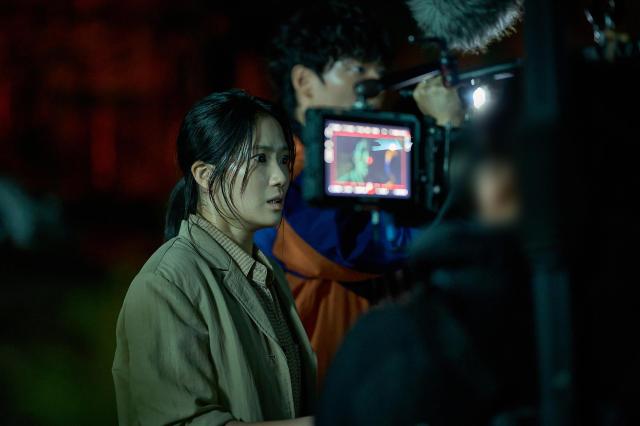
A still image from “Salmokji.” [Photo=Showbox]
Kim plays Su-in, the character who anchors the story. Within the team heading to Salmokji, Su-in must show leadership while carrying an emotional fault line that could collapse first. Kim said she built Su-in around two main ideas: fear of water and guilt.
“When the director and I developed Su-in, we used fear of water — trauma — and guilt as key words,” Kim said. “She’s under huge stress from that, so I thought it would be good if she looked exhausted in every way. A bit worn down, drained, and even when she’s with others, as if she’s lost in different thoughts.”
Lee said he started by researching road-view filming and then assigning roles needed for the work — including a road-view controller, a command lead and a place-view role — before shaping the characters. Su-in became central, he said, because the water ghost must “pull” someone in, requiring a backstory that would drive that movement. While everyone goes to Salmokji for the road-view job, Lee said he wanted each person to have a different private goal, and needed a leader who could make rational judgments but still be fixated on the reservoir. That is why he gave Su-in “guilt” as a defining trait, he said.
Notably, Su-in’s past is not fully explained in the film. Viewers infer it through bits of dialogue and mood. Lee said he chose that approach to keep attention on what happens in the location itself.
“I wanted audiences to focus only on what happens in the film’s ‘space,’” Lee said. “I wanted to unpack the backstory, but no matter how I thought about it, it felt like the flow would drift elsewhere. So I think we only conveyed it through nuance. Su-in had an experience where she almost died in water, and because of that trauma she fears water. She’s assigned to Salmokji for the road-view shoot, and even though she doesn’t want to go, she forces herself. We tried to capture the fear of the space itself and the discomfort of water.”
“When I first got the script, he told me about Su-in’s backstory,” Kim said. “It’s part of the story, but it doesn’t appear in the film, so I tried to compress those emotions and show them to the audience.”
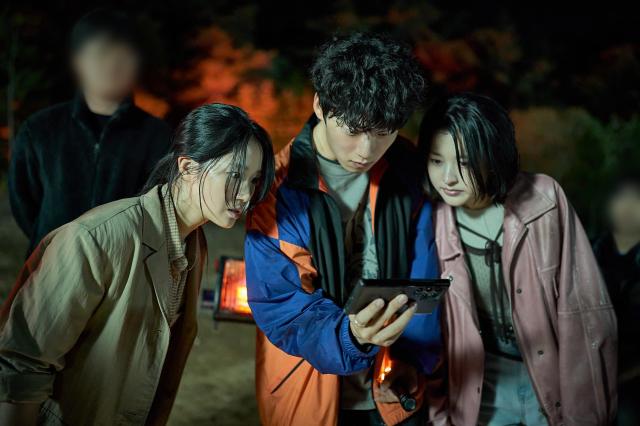
A still image from “Salmokji.” [Photo=Showbox]
Kim said one scene she remembers most strongly is the stone-skipping sequence. As Kyung-jun and Sung-bin toss stones across the water to pass time, the film briefly seems to ease its pace — then quickly turns the familiar rhythm into something unsettling.
“As a horror fan, my favorite scene in this movie is the stone-skipping scene,” Kim said. “It was also the moment that startled me most in the theater. During filming, what comes flying from the other side was CG, so I couldn’t see it with my eyes, but on the big screen it surprised me — and it was really scary.”
Lee said sound was his top priority in shaping that moment. “When should it become quiet? The best moment in a horror movie is when everyone holds their breath,” he said. “I wanted to bring that silence to life. I wanted the sound of the stone flying in, the impact, and the splash to feel sharp. I talked a lot with the sound engineer about how strong the lapping should feel. When you don’t know it’s water, we cut the sound down, and once the camera reveals it’s underwater, we made it feel bigger.”
In the end, the film’s fear was not built through a single method. Lee tightened tension through the arrangement of space, sound and devices, while Kim carried Su-in’s inner collapse under trauma and guilt. Their different approaches to the same reservoir, they said, locked together to create the film’s distinctive chill.
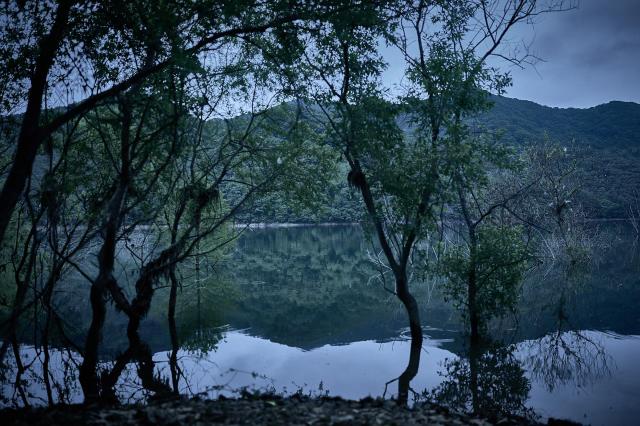
A still image from the film “Salmokji.” [Photo=Film still]