
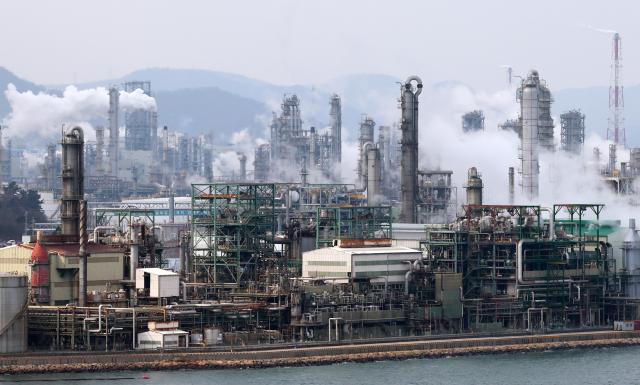
SEOUL, April 14 (AJP) — South Korea’s world-class oil refining industry — long a pillar of its export strength — is fast turning into a structural vulnerability as the Gulf crisis disrupts energy flows and exposes the economy’s deep dependence on imported crude.
Global investment banks are rapidly turning cautious.
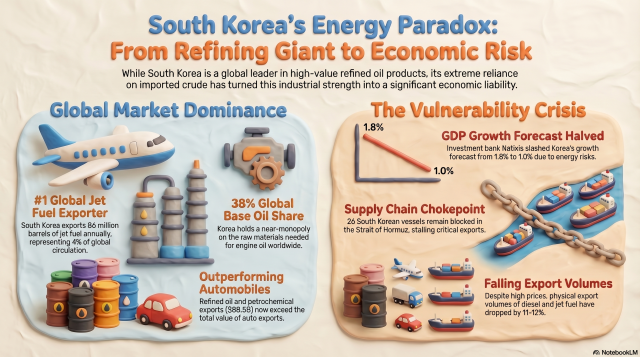
French lender Natixis on Monday slashed its 2026 growth forecast for South Korea to 1 percent from 1.8 percent, marking one of the steepest downgrades so far. The revision follows a broader wave of cuts, including the OECD’s late-March downgrade to 1.7 percent from 2.1 percent.
Natixis singled out Korea’s heavy reliance on imported energy as the key risk, having already flagged the country in March as the most exposed among major economies.
Since the conflict erupted, oil prices have surged by as much as 70 percent from recent lows. West Texas Intermediate is hovering near $96 per barrel, while Dubai crude has climbed above $100. Meanwhile, 26 South Korean vessels remain stranded, unable to pass through the blocked Strait of Hormuz.
The shock cuts deeper in Korea than elsewhere.
The country’s refining model — importing crude, processing it, and exporting high-value petroleum products — has become a double-edged sword. Petrochemicals and refined oil products ranked as the third- and fourth-largest export items last year, trailing only semiconductors and automobiles. Combined, they generated $88.5 billion in exports, surpassing automobiles at $76.5 billion and accounting for 14 percent of total outbound shipments.
Korea’s dominance in refined fuel is as formidable as its leadership in semiconductors.
As of 2025, the country’s four major refiners — SK Energy, GS Caltex, S-OIL and HD Hyundai Oilbank — exported 86 million barrels of jet fuel, accounting for roughly 4 percent of global supply, the largest share worldwide.
“South Korea is one of the top five exporters of petroleum products globally,” said Chang Tae-hun, an associate research fellow at the Korea Energy Economics Institute. “If this disruption persists, the impact on growth will be significant.”
The ripple effects are already global.
Despite being the world’s largest oil producer, the United States remains structurally dependent on Korean refined fuel. Korean shipments accounted for 71 percent of U.S. jet fuel imports last year — equivalent to about 7 percent of total supply. In western regions such as Washington and California, dependence rises to as high as 85 percent of imports.
The imbalance reflects structural differences. While the U.S. dominates crude output following the shale revolution, much of its production is light crude, which yields lower refining margins. South Korea, by contrast, imports heavier Middle Eastern crude — particularly from Saudi Arabia — to produce higher value-added fuels.
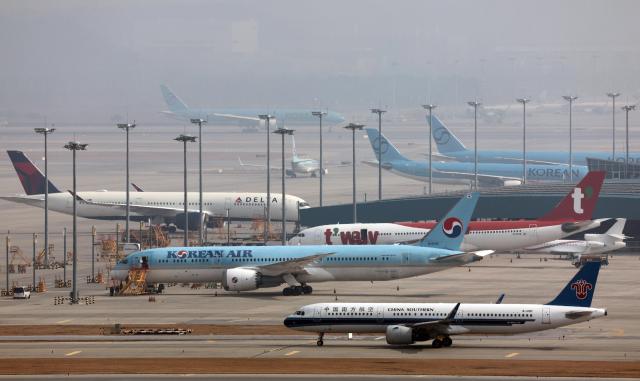
As Korean jet fuel exports stall, the impact is cascading through aviation markets.
Fuel surcharges have surged. Korean Air has seen its maximum surcharge jump from around 99,000 won to over 300,000 won. Delta Air Lines is expected to incur an additional $300 million in fuel costs in the second quarter alone, potentially tipping the carrier into losses.
In the base oil market — a key input for engine lubricants — South Korea holds a dominant 38 percent global market share, supplying roughly 28 million barrels. Any sustained disruption risks forcing cutbacks in industrial operations worldwide.
“Prices have not spiked immediately due to inventories, but once reserves are depleted, increases will be unavoidable,” a domestic refiner said. “This level of volatility is unprecedented.”
The strain is already visible in trade data.
In March, export volumes of petroleum products fell 5 percent for gasoline, 11 percent for diesel and 12 percent for jet fuel. While export value rose 18 percent on higher prices, a prolonged blockade would inevitably drag down both volume and earnings as shipments become physically constrained.
That leaves South Korea increasingly reliant on its remaining export pillars — semiconductors and automobiles.

According to the Ministry of Trade, Industry and Energy, March exports reached a record $86.1 billion despite the Gulf shock. Semiconductor shipments surged more than 150 percent year-on-year to $26.5 billion, accounting for 30 percent of total exports.
Yet even these sectors face mounting risks.
The Bank of Korea warned that the semiconductor cycle could cool if China ramps up production of legacy DRAM and tighter U.S. credit conditions curb Big Tech investment. The auto sector is also under pressure, as BYD overtook global rivals to become the world’s top EV seller in 2025 with more than 2.25 million units sold.
The message from economists is increasingly clear: unless oil-linked industries stabilize, South Korea’s export-driven growth model will remain exposed.
What was once a strategic strength is now a fault line.

Copyright ⓒ Aju Press All rights reserved.
