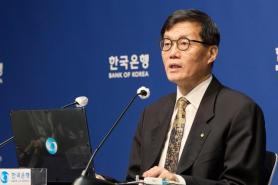
An AJP poll on economists found unanimous expectations for a rate freeze at Thursday’s meeting under newly appointed Governor Shin Hyun-song and newly seated board member Kim Jin-ill. But consensus increasingly shifted toward a rate hike in July as growth and inflation forecasts move higher.
“From the growth and inflation trajectory, the current situation warrants a review of a rate hike,” said Cho Yong-gu, a fixed-income analyst at Shinyoung Securities.
“Rather than an actual rate hike, the upcoming meeting is highly likely to deliver messages hinting at the possibility of future increases.”
Cho pointed to lingering oil-price risks stemming from the Middle East conflict, upward revisions to domestic growth and inflation forecasts, financial stability concerns tied to a weak won and overheating real estate prices in the Seoul metropolitan area as key reasons for maintaining rates while turning more hawkish.
Dissenting voices within the Monetary Policy Board are also expected to grow. About 75 percent of economists surveyed projected that as many as two members could dissent in favor of tighter policy.
Yoon Yeo-sam, chief analyst at Meritz Securities, likewise forecast a freeze this week but said the central bank could begin openly signaling future tightening.
“The committee may address whether oil prices stabilize after the conclusion of the Middle East war and evaluate the impact of the improving semiconductor cycle on growth,” Yoon said.
“A clause implying that the BOK will review the timing of a rate hike to ensure price stability could be inserted.”
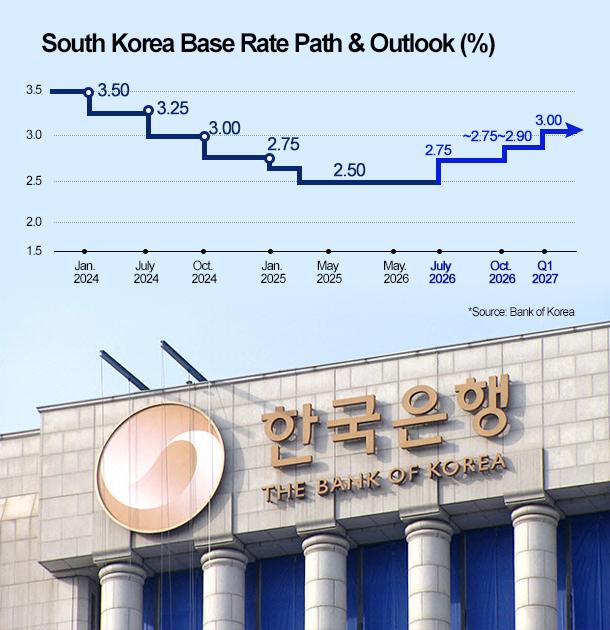
Analysts said South Korea’s unexpectedly strong first-quarter GDP growth of 1.7 percent — nearly double the BOK’s earlier forecast — alongside government relief spending tied to high energy prices has strengthened the case for hawkish dissents within the board.
“Recently, domestic inflationary pressures have been expanding not only due to external factors like exchange rates and rising crude prices but also because consumption and domestic demand are reviving alongside economic recovery,” said Woo Hye-young, analyst at LS Securities.
“Some board members may deem an additional rate hike necessary based on these factors.”
Attention has also centered on Kim Jin-ill, who recently described himself as “half a click above” the BOK’s current policy outlook. Most economists, however, remained skeptical that he would immediately cast a dissenting vote during his first meeting.
“Even former board member Shin Sung-hwan, who was widely considered dovish, followed the consensus during his first monetary policy meeting,” one monetary policy expert said on condition of anonymity. “If Kim voices dissent for a hike, it will likely come in the second half of the year.”
Regarding the second-half rate path, economists increasingly pointed to July as the first likely window for tightening.
Cho projected a 25-basis-point hike in July followed by additional increases in the fourth quarter and early next year. Yoon similarly forecast two hikes — in July and October — lifting the benchmark rate from the current 2.50 percent to 3.00 percent by year-end.
The central bank’s challenge reflects an economy increasingly split between booming AI-linked sectors and mounting inflation risks.
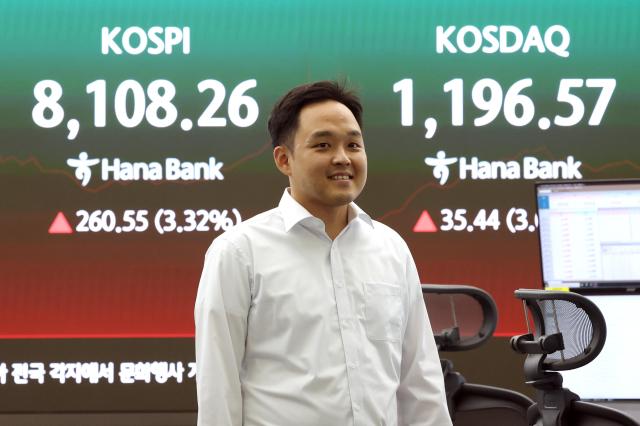
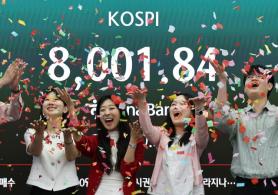
South Korea’s semiconductor-driven AI boom has powered exports, equities and growth expectations sharply higher. The KOSPI has surged 86.2 percent from end-2025 levels to 7,847.7, while the tech-heavy KOSDAQ climbed 25.5 percent, according to weekly financial market data.
At the same time, financial stability concerns have intensified. The won weakened to 1,517.2 per dollar from 1,439 at the end of last year as higher oil prices and imported inflation pressures weighed on sentiment.
Inflation indicators also accelerated. Producer prices jumped 6.9 percent in April from a year earlier, while consumer inflation climbed to 2.6 percent.
Bond markets, however, rallied Tuesday as traders leaned toward a prolonged rate freeze despite the central bank’s increasingly hawkish tone.
By midday, the benchmark 10-year government bond yield had fallen 7.1 basis points to 4.057 percent, while the three-year yield dropped 5.3 basis points to 3.683 percent on expectations that the benchmark rate would remain unchanged until at least the next policy meeting in mid-July.
For now, economists expect the BOK to use Thursday’s meeting primarily to recalibrate market expectations — upgrading growth projections sharply while cautiously preparing investors and households for a gradual return to tightening as the AI boom reshapes South Korea’s economic cycle.
Copyright ⓒ Aju Press All rights reserved.