
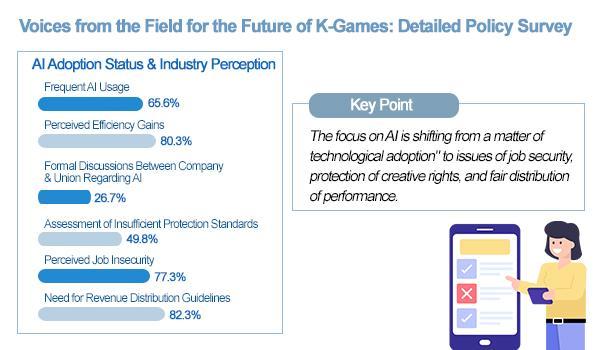
A survey of 1,078 unionized employees at major publishers including Nexon, NC and Netmarble found that 77.3 percent were anxious about their jobs, according to results presented Wednesday at a National Assembly policy forum hosted by the ruling Democratic Party's game industry task force.
The poll, conducted from March 27 to April 10 by the IT branch of the Korean Chemical Textile Food Workers' Union, underscores a growing disconnect between rapid AI adoption and limited institutional response.
While 65.6 percent of respondents said they already use AI tools regularly at work and 80.3 percent acknowledged tangible efficiency gains, only 26.7 percent reported that formal discussions between management and labor had taken place. A majority — 82.3 percent — called for clear guidelines on how AI-driven productivity gains should be shared.
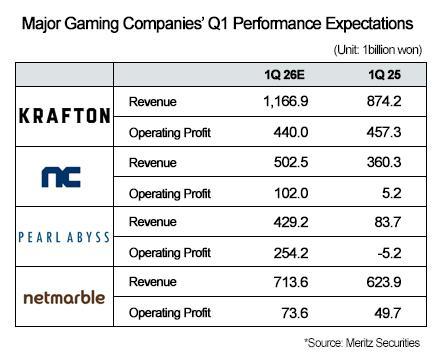
Meritz Securities projected that the combined operating profit of the country's seven largest game publishers would reach about 937.2 billion won ($635.7 million) in the first quarter, exceeding market consensus by 20 percent and surging 64.1 percent from a year earlier. Combined revenue was estimated at 3.57 trillion won, up 33.7 percent.
Still, publishers are aggressively trimming payroll.
NC cut its workforce by 35.1 percent — from about 4,886 to 3,170 — between 2024 and late 2025 through voluntary retirement programs and spinoffs. Krafton accepted about 200 voluntary resignations since last November, while Nexon froze new hiring and reassigned developers in what industry observers describe as indirect restructuring.
Research and development spending has also declined. NC's R&D outlays fell 22.9 percent to 325.1 billion won last year, with Netmarble, Pearl Abyss and Kakao Games also scaling back investment.
Rising labor costs have accelerated the shift toward automation.
Average annual pay at Krafton rose to 129 million won last year from 109 million won in 2024. Pearl Abyss saw its per-capita figure jump to 134.1 million won from 98.5 million won. Similar increases were recorded at NC, Netmarble and Kakao Games.
At the same time, the domestic market is nearing saturation. Total industry revenue grew 3.9 percent to 23.85 trillion won in 2024, only a marginal improvement from 3.4 percent growth in 2023 and a sharp slowdown from the 21.3 percent surge recorded in 2020.
Analysts say the AI-driven shift reflects a broader structural change across the IT sector.
"Front-end interfaces once required large numbers of lower-skilled workers, while back-end systems relied on highly skilled engineers. Now, a client module can be handled by one or two senior engineers supported by AI," said Im Chung-jae, a professor of game software at Keimyung University.
"From a company's standpoint, there is little reason to turn down a tool that delivers faster and more flexible results."
Even so, human creativity remains a critical variable as the industry evolves.
"Games and animation have always been creative domains, so AI's impact is different from live-action production," Im said. "If AI produces flawed results, the issue is no longer the tool itself but the capability of the person designing the system and giving the commands."
As development shifts beyond coding toward planning and creative direction, demand is likely to grow for talent that blends technical expertise with design and humanities-based thinking.

Copyright ⓒ Aju Press All rights reserved.