SEOUL, April 16 (AJP) — As South Korean markets price in a winding down of the Middle East conflict, another front is quietly opening — this time in trade.
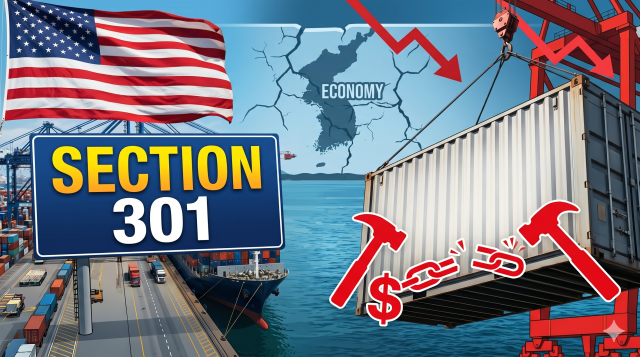
With the KOSPI hitting fresh highs on easing war concerns, attention is shifting to Washington, where a new round of investigations under Section 301 of the Trade Act is gathering pace, raising the risk of fresh tariffs on key trading partners, including South Korea.
Seoul, alongside Japan and China, is among 16 countries targeted in the probe announced March 11 by the Office of the United States Trade Representative.
Those same countries have also been repeatedly singled out by U.S. President Donald Trump for offering limited support during the Gulf conflict despite their heavy reliance on the Strait of Hormuz for energy imports — a linkage that is increasingly shaping Washington’s trade posture.
The Trump administration is turning to Section 301 as a workaround after a Feb. 20 Supreme Court ruling struck down its reciprocal tariff framework, effectively reviving one of its most powerful trade tools.
From war shock to trade pressure
The potential fallout of the Section 301 investigation was initially overshadowed by the Gulf crisis.
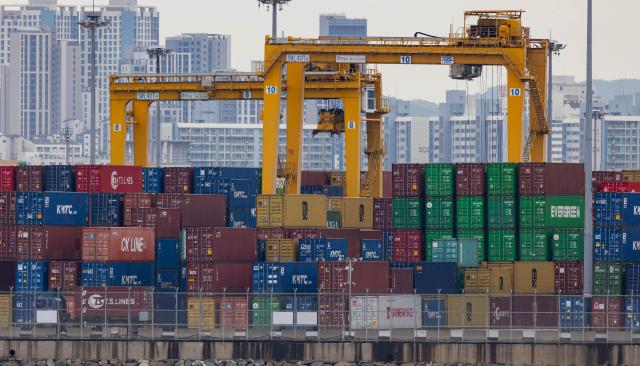
Following the Feb. 28 U.S. strike on Iran and Tehran’s subsequent blockade of the Strait of Hormuz, oil markets were jolted. Dubai crude surged nearly 150 percent, while disruptions to supply chains drove up freight rates and fuel surcharges, feeding directly into the real economy.
With the immediate energy shock beginning to ease, analysts say Washington is likely to revert to trade pressure.
“Tariffs could be back at previous levels by early July,” U.S. Treasury Secretary Scott Bessent said at a Wall Street Journal event this week, citing ongoing Section 301 investigations into what the U.S. deems “unfair” trade practices, including excess profits and oversupply.
South Korea’s persistent trade surplus leaves it structurally exposed.
In autos, Hyundai Motor Group captured a record 11.3 percent share of the U.S. market in 2025, ranking fourth behind General Motors, Toyota and Ford.
The Trump administration had previously imposed a 25 percent tariff on automobiles, later reduced to 15 percent after Seoul pledged large-scale investment under the “Special Act on Investment in the U.S.” Even so, Hyundai’s first-quarter operating profit fell 32 percent on-year to 2.46 trillion won, reflecting the end of a near tariff-free environment.
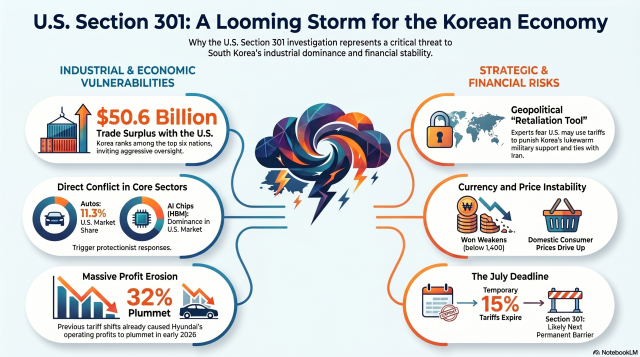
Semiconductors present another point of friction. U.S. tech firms, particularly in artificial intelligence, rely heavily on chips from Samsung Electronics and SK hynix, while U.S.-based Micron Technology has lagged behind in high-value segments such as high-bandwidth memory.
Non-tariff barriers remain a persistent source of tension. For years, Seoul restricted exports of high-precision 1:5,000-scale maps to foreign firms, citing national security concerns and the need to protect domestic platforms such as Naver and Kakao. Conditional approval for exports to Google was only granted in late February. Washington has also flagged issues such as network usage fees as potential barriers.
Section 301 as a “permanent tool”
Economists say the likelihood of tariffs under Section 301 is high.
“The U.S. has been maintaining a temporary 15 percent tariff under Section 122, but that expires in July,” said Kang In-soo, an economics professor at Sookmyung Women’s University. “Raising Section 301 suggests they intend to impose tariffs in some form even after that.”
Section 122 allows tariffs of up to 15 percent for 150 days. By contrast, Section 301 offers a more durable legal basis.
“Unlike the IEEPA framework used previously, Section 301 is a permanent tool with stronger legal footing,” said Jang Sang-sik of the Korea International Trade Association, reinforcing expectations of a more sustained tariff regime.
The Korea Institute for International Economic Policy also warned of broad-based damage, noting the lack of precedent for applying Section 301 measures to a close U.S. ally.
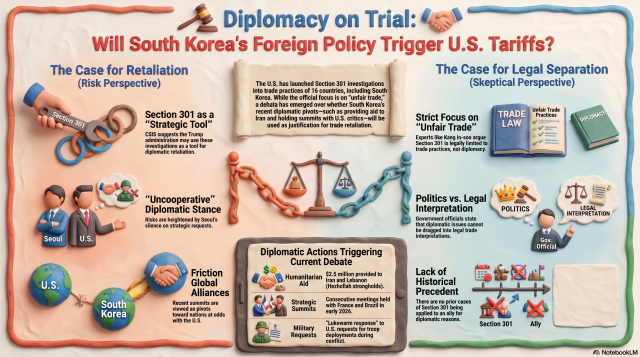
Some analysts see geopolitical factors compounding the risk.
Seoul remained cautious when Washington called for naval support to secure tanker routes through the Strait of Hormuz, saying no formal request had been received. At the same time, South Korea engaged in a series of diplomatic exchanges with countries such as Brazil and France, while extending $2.5 million in humanitarian aid to Iran and Lebanon.
The Center for Strategic and International Studies (CSIS) recently described Section 301 as a “strategic tool,” suggesting it could be used as a form of calibrated retaliation.
Still, others caution against over-interpreting the linkage.
“Section 301 is grounded in claims of unfair trade practices,” Kang said. “It is unlikely that the U.S. would formally tie tariff measures to Korea’s diplomatic positioning.”
For South Korea, the concern is less about whether pressure will come than when.
With the won already under strain from prolonged energy shocks and trading above 1,400 per dollar for more than six months, additional tariffs could further weaken the currency and fuel inflation.
“If large-scale outward investment continues, it could erode Korea’s capacity to stabilize the exchange rate,” Kang said.
As the Gulf conflict moves toward de-escalation, markets may be looking past the next risk.
But for Korea’s export-driven economy, the end of one crisis may simply mark the beginning of another.
Copyright ⓒ Aju Press All rights reserved.