SEOUL, April 20 (AJP) - Diesel prices are approaching 2,000 Korean won (about US$1.36) per liter after gasoline's already crossed that threshold amid surging fuel prices due to supply disruptions amid the prolonged conflict in the Middle East. If this trend continues, the average diesel price nationwide is likely to breach that level within days.
As the prospect of talks between the U.S. and Iran looms, it remains uncertain when the Strait of Hormuz, a critical chokepoint for roughly one-fifth of the world's oil supply, will reopen, one of the key factors affecting domestic fuel prices.
According to Opinet, a website providing information on oil prices operated by the Korea National Oil Corporation, the average diesel price stood at 1,995.65 won per liter on Sunday, up 0.38 won from the previous day.
Diesel rose by about 1 won a day on average last week, suggesting it could break the 2,000-won threshold this week, which would mark the first time in about four years since 2022 when prices surged in the aftermath of Russia's war in Ukraine.
In some parts of Seoul as well as the country's southern resort island of Jeju and North Chungcheong Province, diesel prices have already exceeded 2,000 won.
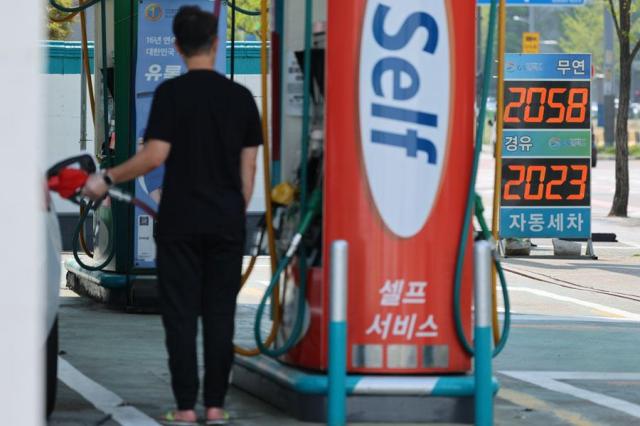
Gasoline, which is typically more expensive than diesel, has been above 2,000 won per liter for days. Its average price stood at 2,002.02 won on Sunday, up 0.51 won from the previous day. The national average crossed 2,000 won last Thursday for the first time in four years, and has remained above that level since.
Fuel prices are expected to rise further as uncertainty grows, with U.S.-Iran negotiations that had appeared to be progressing now back in doubt. Iran's Islamic Revolutionary Guard Corps (IRGC) said the strait has been closed again since last Saturday, contradicting a statement by Foreign Minister Abbas Araghchi, who said, "In line with the ceasefire in Lebanon, the passage for all commercial vessels through the Strait of Hormuz is declared completely open for the remaining period of the ceasefire on the coordinated route."
Tensions have further escalated as about 10 tankers that transited the strait when it briefly reopened are now reported to have come under attack following Iran's reclosure of the waterway.
Amid mounting uncertainty over the Middle East conflict, the government is pursuing efforts to diversify its crude imports while closely monitoring developments in the strait, which accounts for 61 percent of South Korea's crude supply. Seven tankers belonging to South Korean refiners are reportedly stranded in the strait.
As the prospect of talks between the U.S. and Iran looms, it remains uncertain when the Strait of Hormuz, a critical chokepoint for roughly one-fifth of the world's oil supply, will reopen, one of the key factors affecting domestic fuel prices.
According to Opinet, a website providing information on oil prices operated by the Korea National Oil Corporation, the average diesel price stood at 1,995.65 won per liter on Sunday, up 0.38 won from the previous day.
Diesel rose by about 1 won a day on average last week, suggesting it could break the 2,000-won threshold this week, which would mark the first time in about four years since 2022 when prices surged in the aftermath of Russia's war in Ukraine.
In some parts of Seoul as well as the country's southern resort island of Jeju and North Chungcheong Province, diesel prices have already exceeded 2,000 won.
Gasoline, which is typically more expensive than diesel, has been above 2,000 won per liter for days. Its average price stood at 2,002.02 won on Sunday, up 0.51 won from the previous day. The national average crossed 2,000 won last Thursday for the first time in four years, and has remained above that level since.
Fuel prices are expected to rise further as uncertainty grows, with U.S.-Iran negotiations that had appeared to be progressing now back in doubt. Iran's Islamic Revolutionary Guard Corps (IRGC) said the strait has been closed again since last Saturday, contradicting a statement by Foreign Minister Abbas Araghchi, who said, "In line with the ceasefire in Lebanon, the passage for all commercial vessels through the Strait of Hormuz is declared completely open for the remaining period of the ceasefire on the coordinated route."
Tensions have further escalated as about 10 tankers that transited the strait when it briefly reopened are now reported to have come under attack following Iran's reclosure of the waterway.
Amid mounting uncertainty over the Middle East conflict, the government is pursuing efforts to diversify its crude imports while closely monitoring developments in the strait, which accounts for 61 percent of South Korea's crude supply. Seven tankers belonging to South Korean refiners are reportedly stranded in the strait.
Copyright ⓒ Aju Press All rights reserved.