
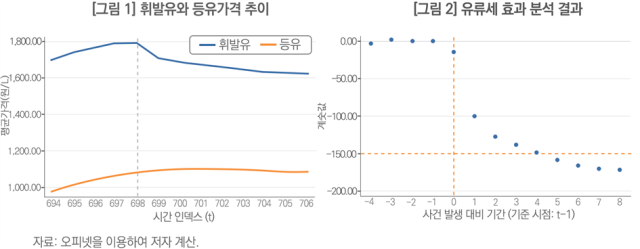
In an emergency brief released Tuesday by KDI’s Middle East war response task force, the institute estimated the first round of the price cap reduced March consumer inflation by 0.4 to 0.8 percentage points.
KDI said the timing of the cap’s impact varied depending on how quickly international crude prices feed into retail gas station prices. Under longer assumed lags, the initial effect was smaller and then grew over time. In its analysis of the fuel-tax cut, KDI said most of the reduction was passed through to lower gasoline prices, reflecting a structural feature in which the gasoline supply curve is close to flat.
Based on the fourth week of March, the final week the first cap was applied, KDI estimated the price-cut effect at about 460 won per liter for regular gasoline, 916 won for automotive diesel and 552 won for indoor kerosene. It projected that the fuel-tax cut, expected to be reflected more fully starting in April, would lower inflation by about 0.2 percentage points.
KDI said disruptions in the global energy supply chain drove the oil-price surge and could add downside pressure to the broader economy. Given South Korea’s high trade openness and heavy reliance on energy imports, an oil shock can quickly raise firms’ production costs and constrain households’ real income and consumption, potentially slowing growth.
Still, KDI said its review of consumption trends in March after the outbreak of the Middle East war found no statistically significant slowdown. Comparing credit card spending in January through March with the same period over the past three years, total card spending remained broadly in line with past levels even after the war began.
KDI also detected a slight decline in overall mobility as high oil prices persisted. The total number of mobile movers, a proxy tied to broad economic activity including consumption and production, gradually edged down after the war’s outbreak, showing a modest decrease.
As support measures expand to address high oil prices, KDI said policymakers should closely examine energy spending patterns by household type. Using the National Data Policy Committee’s analysis of the past three years of household trend surveys, KDI said the share of energy spending relative to current income for the lowest income quintile (bottom 20%) was more than three times that of the highest quintile, suggesting low-income households may feel oil shocks more strongly.
In a summer-only analysis of the relationship between Dubai crude prices and energy spending shares, KDI said the share of housing and utility costs rose significantly more in the first quintile than in the fifth, while the share of transportation fuel costs increased significantly more in the second and third quintiles than in the fifth. The results suggest low-income households are more exposed through cooling and cooking energy, while the second and third quintiles, with higher shares of working households, are more exposed through vehicle fuel costs.
KDI said if high oil prices persist, the summer burden of housing and utility costs could rise disproportionately for low-income households, underscoring the need for tailored energy support by household characteristics.
Senior Research Fellow Lee Young-wook said, “We need to close blind spots in support for damage from high oil prices and establish an energy support system tailored to household characteristics.” He added that, considering the heavier summer housing and utility burden for low-income households, authorities should review measures such as distributing heat-wave necessities through the Just Dream Center and providing emergency energy support linked to heat-wave alerts.
* This article has been translated by AI.
Copyright ⓒ Aju Press All rights reserved.