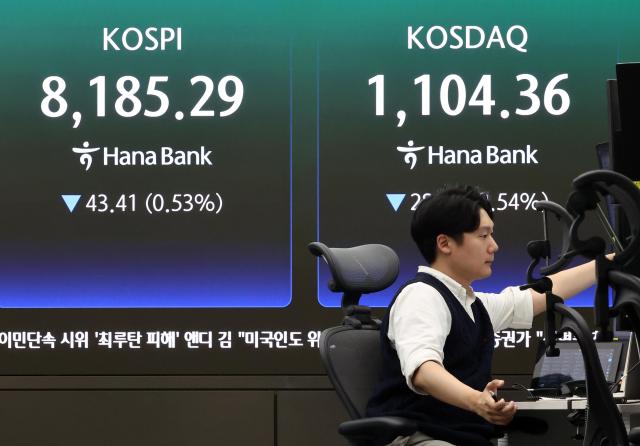
While the benchmark KOSPI recovered most of its intraday losses near the close on institutional interpretations of a "healthy" rate hike, government bond prices collapsed, ending sharply lower as monetary tightening was seen as almost certain.
The index finished at 8,185.29, down 0.53 percent, while the tech-heavy KOSDAQ tumbled 2.54 percent to close at 1,104.36. The KOSPI plunged more than 4 percent during intraday trading, briefly breaching the psychologically critical 8,000 threshold, while the KOSDAQ widened its losses by shedding over 5.7 percent to hit an intraday low of 1,068.
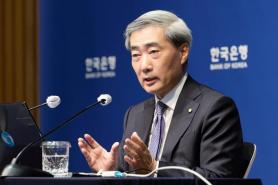
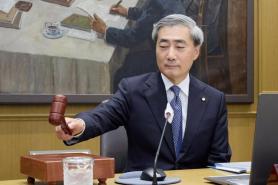
Market losses were sharply exacerbated after BOK governor Shin Hyun-song hinted at consecutive rate hikes during a press conference following its monetary policy meeting. Adding to the hawkish momentum, the central bank's newly released six-month dot plot revealed that the benchmark rate could peak at 3.25 percent, a significant leap from the current 2.5 percent.
"The direction ahead is crystal clear," Shin said, taking a firm stance when pressed on the timeline for monetary tightening, adding, "The remaining issue now is simply when, how fast, and how far we will raise rates."
The KOSPI managed to claw back much of its steeper losses near the close, driven by upbeat projections for the artificial intelligence (AI)-driven semiconductor sector, led by chip giants Samsung Electronics and SK hynix, which posted combined operating profits of over 90 trillion won (US$59.9 billion).
The KOSDAQ, with less exposure to major semiconductor stocks and weaker corporate earnings, failed to mount a meaningful recovery before the close.
Stock markets are highly sensitive to interest-rate expectations because higher rates raise borrowing costs for both companies and consumers, potentially slowing corporate earnings growth. Rising rates also make safer assets such as bank deposits and bonds more attractive, prompting investors to shift money out of equities and into fixed-income and foreign exchange markets.
In the fixed-income market, South Korean government bond yields surged across the board. The yield on the benchmark three-year government bond advanced 5.5 basis points to close at 3.766 percent, while the ten-year note jumped 4.5 basis points to finish at 4.147 percent. Both benchmark yields touched their highest levels in approximately 15 years, reaching milestones not seen since August 2011, when the eurozone sovereign debt crisis and the credit rating downgrade of the U.S. convulsed global markets.
A bond is essentially a fixed-rate contract, meaning expectations of higher interest rates make existing lower-yield bonds less attractive. As investors sell those bonds in favor of newer, higher-yielding ones, bond prices fall and yields rise.
The three-year government bond yield is particularly sensitive to expectations for the BOK's policy path over the next few years. That is why even hawkish signals from the BOK can trigger sharp moves in short-term yields, as seen in the surge in the three-year note.
Market observers also noted that Shin's stern warning about the country's outstanding margin trading balance, which stood at 36.7 trillion won, up a sharp 34 percent since the beginning of the year, helped cool overheated market sentiment. Margin balances track the amount of capital or shares borrowed by retail investors from brokerages for leveraged trading.
"The capital losses from highly leveraged, debt-fueled trading are ultimately borne by market participants who do not carry debt," Shin said. "This behavior distorts the normal economic demand curve."
Copyright ⓒ Aju Press All rights reserved.