
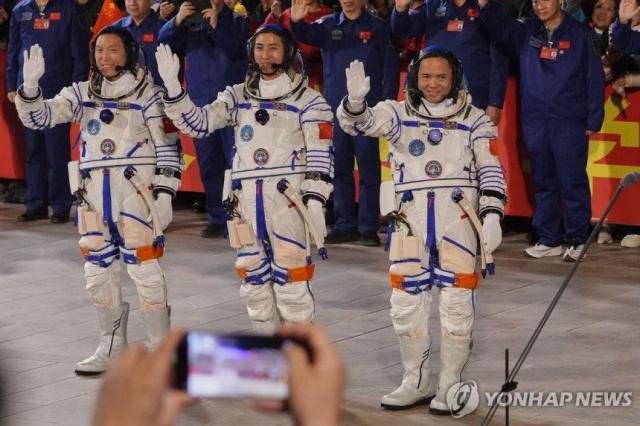
Chinese astronauts aboard the Shenzhou 21 spacecraft have returned to Earth after completing a 210-day mission. This achievement is significant beyond a mere successful space flight. It set a record for the longest single team stay by Chinese astronauts and included successful spacewalks, scientific experiments, and maintenance tasks for the space station. Most importantly, this mission demonstrates that China's ambitions for a 'space rise' are no longer just declarations but a reality.
Space is a domain that reflects a nation's overall capabilities. Without a combination of economic strength, scientific and technological prowess, manufacturing competitiveness, educational standards, and long-term national strategy, space development is unattainable. Launching a single rocket involves thousands of companies and tens of thousands of researchers. Building a space station and sustaining a presence in space for hundreds of days is a testament to the strength of an entire national system.
China has consistently demonstrated this over the past two decades. In 2003, Yang Liwei's Shenzhou 5 mission made China the third country to achieve human spaceflight, following the United States and Russia. Since then, it has progressively achieved goals such as the Chang'e lunar exploration program, the Tianwen Mars mission, and the construction of its own space station, Tiangong.
Notably, consistency is more important than speed. China's space strategy has remained stable despite changes in government. It has pursued national projects with a long-term vision, looking 20 to 30 years ahead rather than focusing on short-term results. The record of 210 days in space is not an overnight achievement but the result of decades of accumulated technology, personnel, and capital.
In contrast, South Korea remains in a position of catching up in the space sector, despite having world-class technology in semiconductors, shipbuilding, and batteries. The successful launch of the Nuri rocket is a significant achievement, but the country still lacks an independent space station and experience in human spaceflight. Lunar exploration is also in its early stages.
Space is not a distant future concern. Today, it is a critical battleground for security, economy, and industrial competitiveness. Just as nations that dominated the seas led the world in the past, those that secure a foothold in space are likely to shape the new order of the future.
The Shenzhou 21 mission is not merely a scientific achievement; it is a pivotal event in the ongoing US-China power competition.
Similar to the space race between the United States and the Soviet Union during the Cold War, the US and China are now engaged in a new competition for space dominance. The United States is advancing its Artemis program to establish a lunar base and explore Mars, while China is investing heavily to achieve a crewed lunar landing around 2030.
Interestingly, the areas of competition extend beyond simple space exploration. Satellite communications, space internet, reconnaissance satellites, space resource development, and space-based AI systems are all interconnected with future industries.
Modern warfare has reached a point where it cannot be conducted without space. GPS, satellite communications, and reconnaissance satellite information have become central to military power. In the Russia-Ukraine conflict, civilian satellite networks have altered the course of events. Space has transitioned from a scientist's laboratory to a critical infrastructure for national security.
The Korean Peninsula is no exception. North Korea is already making significant efforts to secure military reconnaissance satellites. China, the United States, and Japan are all expanding their space capabilities. The security environment in Northeast Asia is now directly linked to the competition in space technology.
Economically, the global space industry is projected to grow into a multi-trillion dollar market within the next few decades. Reusable launch vehicles, satellite communications, space tourism, and space resource development are likely to become new growth drivers.
If South Korea falls behind in the space race, it will not only face a technological gap but also find itself at a disadvantage in future industrial leadership and security capabilities. The competition in space ultimately reflects a competition in national strength.
However, there is no need to fear China's rise. Instead, we should learn from it. China's strengths lie not just in technology but in its long-term strategy and talent development. It consistently cultivates a large number of STEM graduates and pursues national goals with unwavering commitment, positioning the space industry as a core component of its future growth strategy.
South Korea has clear tasks ahead. First, a sustained national space strategy is needed, regardless of changes in government. Second, an ecosystem for the space industry must be established, allowing large corporations, startups, research institutions, and universities to grow together. Third, there must be bold investment in talent development, as the space industry ultimately relies on human resources. Fourth, a future industrial strategy that combines space and AI should be developed, as space data and artificial intelligence will become new sources of national competitiveness.
The 210 days spent in space is not just a number; it represents the total time China has prepared for the future. Space cannot be conquered overnight. The same applies to technology, industry, and national competitiveness.
China is already heading toward the moon, while the United States is preparing for Mars. In this context, what future will South Korea choose? The true meaning of the space rise is not just about rockets but about a nation's vision. What we need now is neither envy nor fear, but a long-term strategy and unwavering execution toward the future.
The most significant message left by the Chinese astronauts after their 210-day mission is surprisingly simple: the future belongs not to those who wait, but to those who prepare.
* This article has been translated by AI.
Copyright ⓒ Aju Press All rights reserved.