Legal Troubles and Nomination Fights Distort Elections, Editorial Says
by HAN Joon ho Posted : April 23, 2026, 10:15Updated : April 23, 2026, 10:15
As elections near, politics should offer voters a plan for the future — how to revive local economies, create jobs for young people, and address structural challenges such as low birthrates and an aging society. Voters go to the polls to choose a better life. Yet campaigns repeatedly veer off course. Policy and vision get pushed aside as nomination disputes, trial schedules, criminal-record controversies and intraparty conflict dominate the headlines, making elections look less like a democratic festival than a contest of legal liabilities.
Recently, across both ruling and opposition parties, questions about candidates’ past records, court histories and ethics have surfaced one after another during nomination processes for by-elections and local elections. Party leaders and local organizations have clashed over whether certain figures should run, and protests — including hunger strikes and public criticism — have followed disputes over primary results.
For some candidates, legal controversy becomes a campaign-long label. Others make opponents’ legal problems a central line of attack. While the public wants a forward-looking agenda, politics often seems more practiced at relitigating the past.
A party nomination is not merely an internal personnel decision. It is a letter of recommendation to the public — a political pledge that a candidate can be trusted with legislative and administrative authority and budget oversight. Parties therefore must scrutinize not only expertise but also respect for the law, ethics and community reputation. If vetting is loosened simply because a candidate seems electable, a party is effectively abandoning its public responsibility.
A deeper problem is that the standard applied to the law shifts by political camp. When an ally is investigated, it is called political persecution; when an opponent faces the same, it is framed as justice. A party may excuse its own candidate’s criminal record as a past mistake while treating an opponent’s flaws as disqualifying. Political advantage, not legal principle, comes first. Repeated selective appeals to the rule of law ultimately leave the public trusting neither side.
The presumption of innocence must be respected; allegations should not be treated as fact before a trial ends. But that principle does not amount to political immunity. Candidates for public office are held to higher ethical standards than private citizens and have a duty to explain themselves to the public regardless of court outcomes. At the same time, a climate that delivers political death sentences based on suspicion alone should also be avoided.
Investigative and judicial authorities also bear responsibility. It is unhealthy that, every election season, the pace of investigations, timing of indictments and court schedules become targets of political interpretation. Law enforcement should proceed only on evidence and procedure. Once agencies are suspected of being swayed by political calendars, their authority and credibility are damaged. The law should be a safeguard for democracy, not a political weapon.
Internal party democracy must also function. When candidates join primaries but refuse to accept results — turning to street protests, hunger strikes and public denunciations — it only exhausts voters. Parties that cannot follow their own rules have little credibility when they speak of governing. Factional clashes and principle-free strategic nominations, repeated each cycle, are a major driver of public disgust with politics.
Voters, too, weaken politics when they adopt an “anything goes if it’s our side” attitude. Elections are not pep rallies; they are the process of choosing officials with public responsibilities. Competence and vision should be weighed alongside ethics and respect for the law. A vote is not a shield for a faction but the power to shape a community’s future.
Elections determine who holds power, but the rule of law is the order that sustains the state. Power can change hands, but the authority of the law must not be shaken. When politics tries to stand above the law, democracy is reduced to a competition for privilege. This election, the contest should be remembered not for legal risk and nomination turmoil but for principles and accountability — starting with the simplest one: no one is above the law.
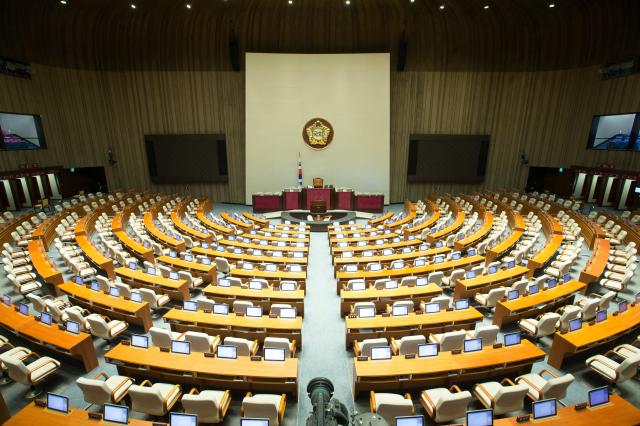
The National Assembly plenary chamber. (Photo provided by the National Assembly)