
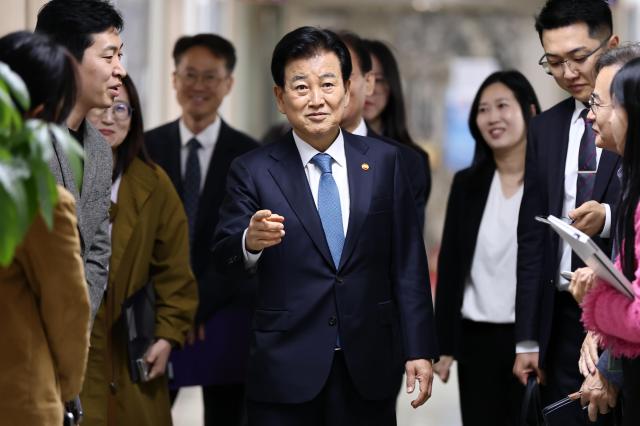
The mention of a uranium enrichment facility in North Korea's Guseong by Minister of Unification Jeong Dong-young has plunged South Korean politics back into a security debate. Opposition parties have accused the government of leaking classified information and called for Jeong's dismissal, while the ruling party has countered that the information was already public and that the criticism is politically motivated. However, as is often the case with national security issues, facts take precedence over emotions, and national interests outweigh party politics. A closer examination of the matter reveals a more complex middle ground rather than a simple black-and-white scenario.
First, it is essential to confirm whether the name "Guseong" was first disclosed to the world by Minister Jeong. The answer is no. The area around Guseong, located in North Pyongan Province, along with the nearby Banghyeon Aircraft Factory and Banghyeon base, has long been discussed as a suspected site for uranium enrichment by international security research institutions and U.S. think tanks.
In 2016, the Institute for Science and International Security (ISIS) suggested that the Banghyeon Aircraft Factory area could potentially house an early small-scale centrifuge research and development facility, estimating it could accommodate around 200 to 300 centrifuges. Subsequently, international media, including Reuters, treated this region as a potential hub for North Korea's nuclear development.
In 2024, Bruce Bennett, a researcher at the RAND Corporation, mentioned in an interview with Radio Free Asia the possibility of a large underground facility in the Guseong Yongdeok-dong area being linked to uranium enrichment. In 2025 and 2026, researchers from the Center for Strategic and International Studies (CSIS) continued to raise concerns about the expansion of North Korea's undisclosed nuclear facilities through satellite imagery analysis. In other words, the name Guseong itself cannot be definitively classified as entirely new secret information.
In this regard, Minister Jeong's claims do have some factual basis. His assertion that "this name has been mentioned in U.S. research institutions, congressional reports, and media for over a decade, so why has it suddenly become classified?" is not entirely incorrect. In fact, President Lee Jae-myung also defended the issue, stating that it was already known through various research reports and media.
However, what is crucial here is not just the existence of the information but who said it, from what position, and in what context. An analysis by a private research institution based on satellite images, defector testimonies, and public data categorizing a site as "suspected" carries a different weight than a sitting Minister of Unification mentioning a specific location in a public forum or the National Assembly.
Just because information is publicly available does not automatically make every statement safe. Conversely, it is excessive to immediately label any public trace as "leaking U.S. secrets." In fact, military intelligence authorities have made a different assessment. The Defense Intelligence Agency has stated that the specific location of North Korea's uranium enrichment facilities is classified as a joint secret between South Korea and the U.S. This indicates that publicly available information and actual allied-level information classification can differ significantly. Even if the same name is mentioned, the official confirmation from the government is an entirely different matter.
Therefore, Minister Jeong's remarks cannot be conclusively labeled as "an unprecedented leak of classified information," but they also cannot be dismissed as "completely harmless public statements." Ultimately, the essence of this controversy lies more in the pathological structure of South Korean politics than in the information itself. We have become too accustomed to consuming security issues as weapons of party politics rather than from the perspective of national interest. Conservatives easily label the progressive government's approach to North Korea as a security risk, while progressives quickly dismiss conservative criticisms as Cold War tactics. In the process, the truly important questions vanish: How advanced is North Korea's nuclear capability? How will South Korea-U.S. intelligence cooperation be maintained? What should be the strategy for simultaneously deterring North Korea's nuclear threat and engaging in dialogue? The essence is lost, leaving only slogans.
Minister Jeong's metaphor that "the moon is the urgency of the North Korean nuclear issue, and the finger is the controversy over the name" holds some persuasive power in this context. North Korea's uranium enrichment capability is not just a matter of Yongbyon. The capacity for nuclear material production is steadily advancing across multiple sites, including Gangseon, Yongbyon, Banghyeon, and suspected facilities in Guseong.
The International Atomic Energy Agency (IAEA) has consistently expressed concerns about undeclared enrichment facilities in Yongbyon and Gangseon, while U.S. satellite intelligence agencies continue to track the expansion of new suspected facilities. The real threat lies not in whether a name was mentioned but in the fact that North Korea's nuclear capabilities are growing into a reality.
This conflict is not unique to South Korea. The boundary between public and classified information has always been at the center of political clashes in major countries worldwide. A prominent example is the 2003 U.S. controversy over weapons of mass destruction (WMD) in Iraq. The U.S. claimed that Saddam Hussein possessed WMDs and went to war based on satellite images, intelligence reports, and testimonies from defectors. However, no actual WMDs were found after the war. Information became a weapon of politics, and the cost was the U.S.'s credibility and chaos in the Middle East. The government of Tony Blair in the U.K. justified its involvement in Iraq with a document claiming that Iraq could use WMDs within 45 minutes, but much of this was later revealed to be exaggerated or inaccurate.
The politicization of information may benefit a regime in the short term, but it ultimately undermines the nation's trust capital in the long run.
Israel has also seen clashes between the Prime Minister and opposition whenever assessments from Mossad and military intelligence regarding the potential strike on Iranian nuclear facilities leak to the media. During Netanyahu's tenure, the Iranian nuclear threat was both a security issue and an electoral strategy. However, Israeli security experts have consistently warned that national security is not a party asset but an asset for the entire nation.
Japan thoroughly separates publicly available information from classified information at the alliance level regarding North Korean missile and nuclear facility issues. Germany has strengthened parliamentary oversight and multi-layered verification to prevent the misuse of intelligence assessments as political propaganda since the Cold War.
All these examples lead to the same conclusion: trust comes from restraint, not speed.
South Korea must learn this lesson. First, there must be a strengthened pre-release information review process for public statements made by high-ranking officials at the ministerial level and above. Even if the information is public, if it intersects with South Korea-U.S. joint secrets, coordination with the Ministry of National Defense, the Ministry of Foreign Affairs, and intelligence authorities is necessary. Second, the National Assembly should also undergo a minimum verification process to distinguish between public and classified information when raising security issues. Third, when problems arise, the government should not simply rebut claims as "political tactics" but calmly explain to the public what constitutes public information and what falls into unverifiable areas. Fourth, the media should prioritize presenting the layers of facts over partisan framing.
Most importantly, security should be addressed in a language of responsibility rather than excitement. The Book of Proverbs states, "The wise man listens and adds to his learning, and the discerning man acquires wise counsel." National security must also begin with listening. Listening to the facts, to the signals from allies, and to the concerns of others. Politics that shouts without listening ultimately tires the nation.
Minister Jeong's remarks about Guseong have become a test of the level of South Korean politics, transcending whether a minister made a gaffe. Will we consume this as yet another partisan battle, or will we use it as an opportunity to establish mature standards for national security? The real danger is not only North Korea's nuclear facilities but also internal divisions and reckless language that could pose a greater threat.
National interests are not protected by shouting. They are safeguarded through restraint, trust, and dignity. Security is greater than political tactics, and truth lasts longer than anger. That is the ultimate strength that protects a nation.
* This article has been translated by AI.
Copyright ⓒ Aju Press All rights reserved.