
SEOUL, April 24 (AJP) - A research team at the Korea Advanced Institute of Science and Technology has developed a high-efficiency Direct Air Capture (DAC) technology inspired by electric vehicle battery manufacturing processes, placing them among the top four finalists in a global carbon removal competition. The development addresses the high costs and low efficiency currently hindering the commercialization of technologies that remove carbon dioxide directly from the atmosphere, the research institute said Friday.
The research team, led by Professor Koh Dong-yeon of the Department of Chemical and Biomolecular Engineering, was selected as one of four finalists in the 2026 Carbon Removal Challenge. The competition is hosted by OpenAir, a global non-profit organization dedicated to advancing carbon removal solutions. Out of approximately 40 teams from 30 universities worldwide, KAIST was chosen alongside the University of Michigan, Rutgers University, and a joint team from Cornell, Princeton, and Columbia.
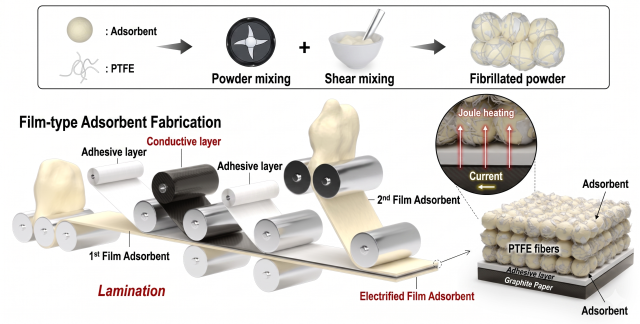
To overcome the limitations of existing DAC methods, the researchers applied a dry fabrication process typically used for battery electrodes. This solvent-free method involves pressing powders into solid films, allowing carbon-absorbing materials to be packed more densely. The process increased the adsorbent content to 97 weight percent, significantly improving the volume of carbon dioxide captured compared to traditional methods that use liquid-based coatings.
The team also improved the regeneration process, which involves releasing the captured carbon for storage or use. By implementing Joule heating—a method that generates heat instantly by passing electricity through a conductor—the system can reach required temperatures within one minute. Additionally, by integrating a water-cooling system inspired by electric vehicle thermal management, the team reduced cooling times by approximately 60 percent, increasing overall productivity.
"This achievement recognizes both the innovativeness and the practical applicability of our carbon capture technology," Professor Koh Dong-yeon said. "We plan to actively pursue the commercialization and expansion of this technology through global cooperation in the future."
The South Korean team has been invited to present their technology to experts and investors at the Carbon Unbound 2026 conference in New York on May 20, 2026. The research was led by doctoral student Park In-jun, with contributions from a team of students and researchers, including Park In-hwan, Lee Min-hyung, and Karoline L. Hebisch.
Copyright ⓒ Aju Press All rights reserved.
![[BIFF 2026] Shuhua: Screen Debut, More Excitement than Nerves... Honored to Participate in My First Film Festival](https://image.ajunews.com/images/site/ajupress/v2/img/v2/ajp_noimg.png)