
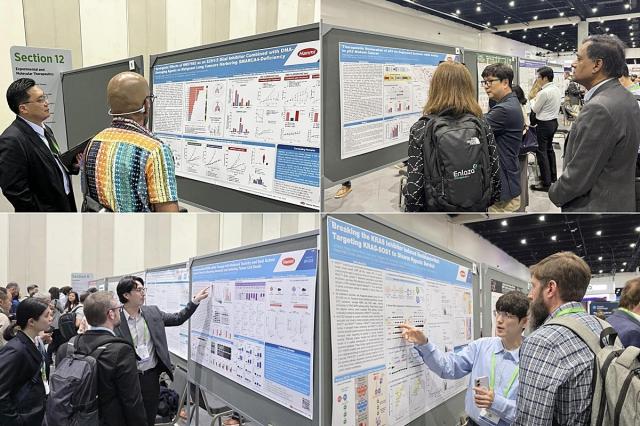
Hanmi Pharmaceutical said it has unveiled a cancer drug pipeline built on a range of next-generation modalities, underscoring its growing body of oncology research.
The company said on April 28 that it presented nine research findings covering eight new drug candidates at the American Association for Cancer Research meeting, AACR 2026, held April 17-22 (local time) in San Diego.
Hanmi noted that recent technology-licensing deals by global drugmakers show antibody-drug conjugates and bispecific antibodies emerging as key investment targets.
Hanmi said its AACR presentations were organized around three areas: targeted therapies that selectively modulate proteins highly expressed in cancer cells; targeted therapies based on next-generation modalities; and immuno-oncology candidates designed to activate immune cells and trigger antitumor responses.
In targeted oncology, the company disclosed an EZH1/2 dual inhibitor (HM97662), a selective HER2 inhibitor (HM100714) and an inhibitor of SOS1-KRAS interaction (HM101207).
Hanmi also highlighted an EP300 selective degrader developed using its targeted protein degradation platform. The company said the candidate showed lower toxicity and stronger anticancer efficacy than existing inhibitors, suggesting a potential new treatment approach.
In immuno-oncology, Hanmi presented research on STING mRNA and p53 mRNA cancer drug candidates, as well as multispecific antibody-based programs led by Beijing Hanmi Pharmaceutical: a 4-1BB x PD-L1 bispecific antibody (BH3120) and a B7H3 x PD-L1 bispecific antibody-drug conjugate (BH4601).
Hanmi said animal models showed tumor-growth suppression after intravenous and intramuscular administration. It also reported increased immune cells and anticancer activity in so-called “immune-cold” tumors that do not respond to existing immunotherapies. The company said it confirmed a dual mechanism that both activates immunity and suppresses cancer-cell proliferation while maintaining survival of normal cells.
Hanmi said BH3120 uses its “Pentambody” bispecific antibody platform, enabling one antibody to bind two different targets and combine targeted anticancer treatment with immune-cell activation.
The company said BH4601 is a bispecific antibody-drug conjugate that targets B7H3 and PD-L1 at the same time, and it presented a mechanism aimed at reducing resistance and activating immunity across a range of solid tumors.
Choi In-young, head of Hanmi Pharmaceutical’s R&D Center, said the company’s next-generation modality-focused oncology pipeline demonstrated its research and development competitiveness.
“We will continue to expand future growth engines through technology convergence and R&D,” Choi said.
* This article has been translated by AI.
Copyright ⓒ Aju Press All rights reserved.