
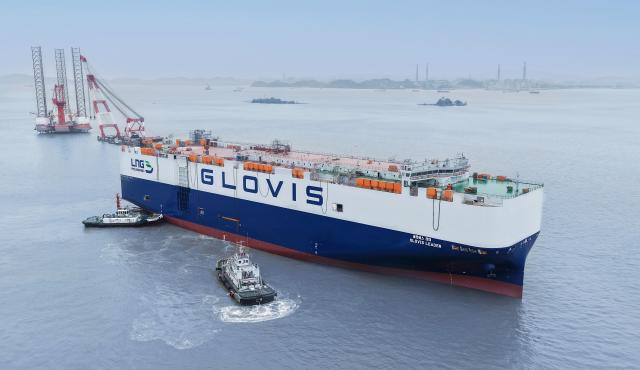
Hyundai Glovis has introduced what it called the world’s largest pure car and truck carrier, aiming to strengthen its position in the global finished-vehicle ocean transport market.
The company said 29일 it will deploy the 10,800-vehicle PCTC, the Glovis Leader, for finished-vehicle shipping. A naming ceremony was held 28일 at the GSI shipyard in Guangzhou, China, attended by Hyundai Glovis CEO Lee Kyoo-bok and other officials.
The vessel is 230 meters long and 40 meters wide, with a weight of 102,590 tons. It has 14 cargo decks, with total loading space roughly equivalent to 28 soccer fields. Based on compact cars, it can carry up to 10,800 vehicles. Hyundai Glovis said it is the first global car carrier operator to introduce a PCTC with capacity exceeding 10,000 vehicles, and that the ship is currently the largest PCTC in the world.
The ship is equipped with a liquefied natural gas dual-fuel propulsion engine and can use shore power facilities, known as AMP, which the company said will help it respond to tightening environmental rules such as the European Union’s carbon emissions trading system.
AMP supplies electricity from land to a ship while it is docked. Without it, vessels typically run onboard generators using bunker C fuel to power equipment such as refrigeration, emitting sulfur oxides, nitrogen oxides and fine dust. Using shore power can sharply reduce those emissions. Hyundai Glovis said the PCTC will be rotated across global routes.
Hyundai Glovis said it plans to expand its operating PCTC fleet to 128 vessels by 2030, including the newly introduced ship. It also aims to increase the number of finished vehicles it transports by sea to 5 million a year by 2030, from 3.4 million, and to handle more than about 20% of global finished-vehicle ocean cargo volume.
The company has also stepped up efforts to secure cargo from non-affiliated customers. Last year, it signed ocean transport contracts with multiple automakers in Europe, North America and China. With China’s vehicle exports rising, non-affiliate revenue has increased to about 53%, surpassing affiliate revenue, it said.
Industry officials said Hyundai Glovis’ continued addition of PCTCs could help ease a global shortage of car-carrier capacity.
In recent years, a surge in vehicle export volumes from the Far East has prolonged the capacity shortage. Geopolitical risks around the Middle East and the Red Sea have also pushed many PCTCs onto longer detours, extending transit times and worsening the shortage.
A Hyundai Glovis official said the company will continue to strengthen its competitiveness in finished-vehicle ocean transport and provide stable supply-chain services to global shippers.
* This article has been translated by AI.
Copyright ⓒ Aju Press All rights reserved.