
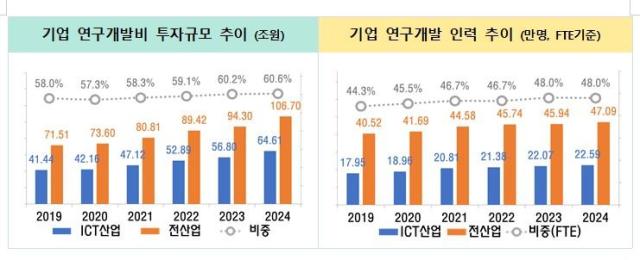
Korean information and communications technology (ICT) companies sharply increased research and development spending last year, led by semiconductors and artificial intelligence, government data showed. The gains, however, were concentrated in private funding while government and public support remained flat.
According to the “2024 ICT Corporate R&D Statistics” released Tuesday by the Ministry of Science and ICT and the Institute for Information & Communications Technology Planning & Evaluation (IITP), ICT R&D investment in 2024 totaled 64.6 trillion won, up 13.8% (7.8 trillion won) from a year earlier. It was the largest increase in six years and accounted for 60.6% of total industrial R&D spending of 106.7 trillion won.
Private and foreign funding reached 62.4 trillion won, or 96.6% of the total, driving the rise. Government and public funding totaled 2.2 trillion won, or 3.4%, showing little change.
By sector, ICT and broadcasting equipment makers—centered on semiconductors—spent 59.5 trillion won, or 92.1% of the total. Software development and production companies invested 4.2 trillion won, or 6.4%.
By company size, large firms invested 53.5 trillion won, up 16.3% from the previous year, leading overall growth. Small and midsize companies spent 2.5 trillion won, up 11.9%, while venture companies posted a 0.3% decline in growth rate.
By research stage, 45.2 trillion won (70%) went to development research, followed by applied research at 10.9 trillion won (16.8%) and basic research at 8.5 trillion won (13.2%). Basic research rose 19%, outpacing applied research growth of 16.1%.
ICT R&D staffing also increased. The sector employed 225,900 R&D workers, up 5,200 (2.4%) from a year earlier, representing 48.0% of total industrial R&D personnel.
Equipment makers accounted for 161,000 workers (71.2%), while software development and production employed 57,000 (25.1%). The ministry said the software field generates relatively high employment compared with investment levels.
The share of advanced-degree researchers continued to rise. Master’s and doctoral researchers totaled 71,000 (33.2%), narrowing the gap with bachelor’s degree holders at 133,000 (62.2%). Female researchers numbered 36,000 (17.1%), continuing a steady increase since 2020.
Park Tae-wan, director general for ICT Industry Policy at the ministry, said, “It is a meaningful result that private-sector-led ICT R&D investment expanded despite domestic and external uncertainties.” He added, “We will reflect this in future investment planning and budget allocation to strengthen synergy between the government and the private sector.”
* This article has been translated by AI.
Copyright ⓒ Aju Press All rights reserved.