
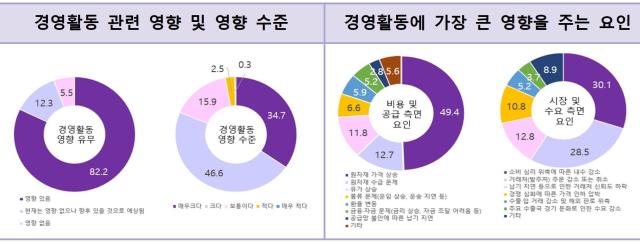
According to a survey released Thursday by the Women’s Economic Research Institute under the Women’s Enterprise Comprehensive Support Center, 82.2% of women-owned firms said their business activities are currently being affected. Including those expecting an impact (12.3%), 94.5% said they are feeling risks tied to the Middle East situation.
Among firms reporting an impact, 97.2% said the severity was “moderate or higher,” underscoring heightened concern in the field.
On the cost and supply side, the most-cited factor was rising raw material prices (49.4%), followed by raw material supply disruptions (12.7%) and higher oil prices (11.8%). On the market and demand side, firms pointed to weaker domestic demand due to subdued consumer sentiment (30.1%) and fewer or canceled orders from clients (28.5%).
Profitability indicators also worsened, with 89.5% of women-owned firms expecting sales to decline.
For direct support, respondents most often requested emergency management stabilization funds (45.3%) and broader financial support (42.6%). For indirect support, they sought help easing difficulties related to laws, institutions and regulations (38.9%) and consulting on business strategy and crisis response (38.5%).
Separately, the number of small and medium-sized enterprises reporting damage linked to the Middle East war has been rising weekly. As of April 29, the Ministry of SMEs and Startups said it had received 733 reports. Of those, 547 were classified as “damage and difficulties,” up 51 from the previous week; 116 were “concerns,” up 3; and 70 were “not applicable,” up 2.
Park Chang-sook, chair of the Women’s Enterprise Comprehensive Support Center, said the survey shows how external risks tied to the Middle East are destabilizing the business environment for women-owned firms. She urged the government to move quickly with emergency stabilization funding and easing of financial regulations to build an effective safety net.
* This article has been translated by AI.
Copyright ⓒ Aju Press All rights reserved.