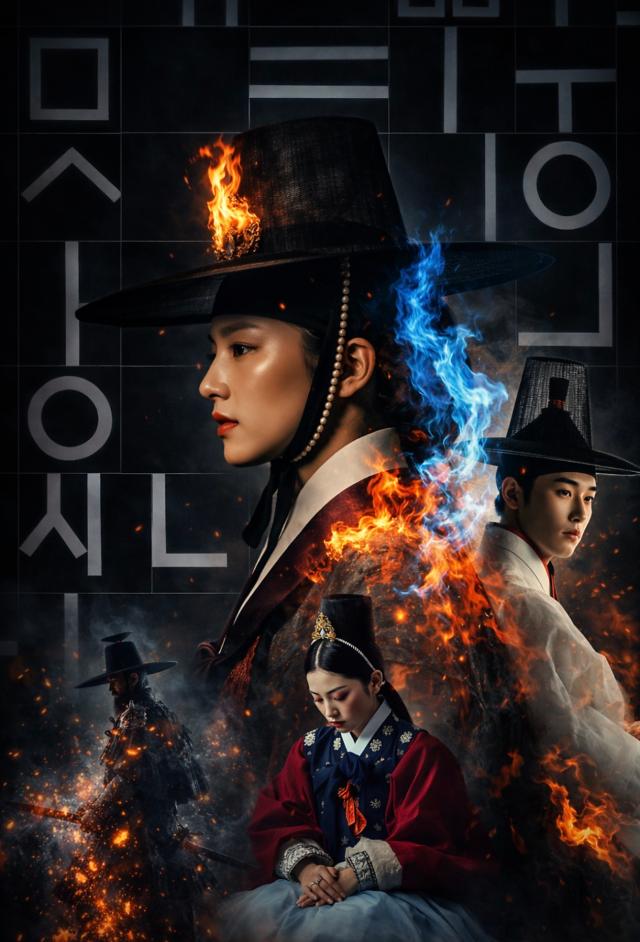
Novelist Ye Sun-young Reimagines Queen Soheon in the 1426 Great Hanseong Fire
by HAN Joon ho Posted : May 1, 2026, 11:18Updated : May 1, 2026, 11:18
Ye Sun-young is a writer who moved from the front lines of record-keeping to the work of fiction. As a reporter, he spent years chasing events and verifying facts, documenting the surface of history. In that process, he says, he found another truth: Records are never complete, and many people disappear without ever being written down. His fiction begins in that gap.
Between the lines of the Annals, beneath the numbers in statistics, and in the margins of history books are people who existed but were not preserved.
His novel, 『Hanseong Great Fire, Queen Soheon』, is an attempt to call them back. Blending a reporter’s cool eye with a novelist’s imagination, Ye’s prose goes beyond reenactment to restore the dignity of those left unrecorded. He also reflects on how human presence expands and is marginalized in today’s digital civilization, reading the past’s revolution in writing and the present’s technological revolution as part of a single continuum.
History can leave only numbers and erase people. In 1426, the eighth year of King Sejong’s reign, flames that began in central Hanseong burned for three days and nights and engulfed the city. About 2,000 homes were destroyed and hundreds of lives were lost, recorded as the largest urban disaster of the early Joseon period. The record is blunt: “Thousands of homes destroyed, hundreds dead.” No names. No faces. Only figures. The lives and suffering inside those numbers vanish from history, in part because most commoners at the time could not read or write and had no way to record themselves.
The novel also frames the fire against a “power vacuum.” Sejong and Crown Prince Munjong were away from Hanseong on a hunt in the Hoengseong area of Gangwon Province. With the top rulers absent, the disaster became not only a fire but a crisis of governance. In a capital without the king and crown prince, the chain of command wavered, the flames spread faster, and the response was delayed. The Hanseong fire is presented as a case in which physical conditions and political conditions combined to magnify destruction.
In that vacuum, authority shifts. In Joseon’s system, the queen was not meant to step to the political forefront. But in a crisis, boundaries can break, and power concentrates in whoever can direct events. Ye places Queen Soheon at the center. Pregnant, she is portrayed not as someone to be evacuated but as a decision-maker. As ministers panic, she asks, “Are we putting out the fire now, or are we protecting the country?” She decides: “The people’s homes can be rebuilt, but if the royal ancestral shrine and the altars of state fall, the country has nowhere to stand.” The choice is harsh, but the novel presents it as the language of statecraft.
Ye then turns to what she confronts beyond the flames: a procession of unnamed deaths. Many people vanish in the fire, and none are recorded. He reconstructs the scene with restraint and sympathy.
“Under the burning roof tiles, the crying stopped, and no one remembered who the crying belonged to,” he writes. Elsewhere: “If you live without a name, and die without a name left behind, where does that life remain?” The lines are not only description but a question about existence.
After the fire subsides, the queen is left alone. “I never once called their names,” she says. The confession underscores the limits of power: Before lives that cannot be protected and people who cannot be recorded, authority becomes helpless.
Only then, the novel suggests, does she face the tragedy of a “society without letters.” The experience does not end as an incident; it accumulates. The story jumps ahead 18 years after the fire, following what builds in palace archives, the Hall of Worthies, and Sejong’s thinking. At the center of that accumulation is the queen’s silence — a question that does not disappear: “Why can the people not leave even a single name behind?”
Ye restores that question as dialogue. “Your Majesty, people without writing are like the wind. Even if they pass by, there is no trace, and even if they disappear, they are not remembered,” the queen says. In another scene: “A death that cannot leave a name is like dying twice.” The novel acknowledges these lines are not in the official record, but presents them as language that most honestly reveals the era’s reality.
Hunminjeongeum is reread through that lens. It is not reduced to the king’s achievement alone, but framed as an answer to those who could not be recorded — a civilizational decision to bring nameless people into history.
The 18 years between the 1426 fire and the 1446 promulgation are not treated as mere time. They are years in which questions accumulate, pain turns into reflection, and reflection condenses into resolve.
Writing is power, but also a tool of liberation. Hangul is described as the first tool that allowed commoners to record themselves — to write their names, appeal injustices and leave traces of their lives. In that sense, Hangul becomes not only a system of knowledge but a means of existence. Ye’s interpretation is bold, the article says, but persuasive, building a consistent narrative by adding literary imagination atop the facts of the Annals and historical sources.
The Hanseong Great Fire is not only an event of flames, the article argues, but an event that asks what it means to exist. 『Hanseong Great Fire, Queen Soheon』 is presented as a literary response: The fire burned the city, but left a question. That question led to letters, and letters made people exist again.
A society without writing cannot record people. People who are not recorded are, in effect, treated as if they did not exist. In that view, Hangul is not merely characters but a civilization that allowed people to be born again in the record. The article ends by posing a present-day question: Who is being recorded, and who is still not?
■ Who was Queen Soheon
Queen Soheon was the primary queen consort of King Sejong, the fourth king of Joseon. She was from the Cheongsong Sim clan and is known as the daughter of Sim On. The article describes her as more than the highest-ranking figure of the inner court, portraying her as a key person who helped lay the foundation for Joseon’s peak alongside Sejong. It says she showed calm restraint but firm judgment in national crises, and that her decisions and sense of responsibility in emergencies such as the Hanseong Great Fire are viewed as a model of political leadership. It also says she understood and supported Sejong’s scholarship and policies, and is interpreted as providing an important spiritual foundation behind the civilizational achievement of creating Hangul. She gave birth to eight princes and two princesses, stabilizing royal succession, and is remembered as a queen with deep compassion for the people and a strong sense of moral responsibility.