
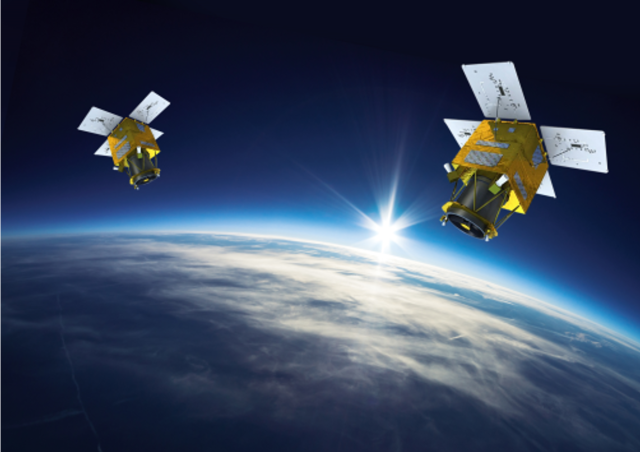
Next-Generation Mid-Sized Satellite 2, an Earth-observation satellite designed for land monitoring and disaster response, has successfully entered orbit and begun preparations for its mission.
According to Yonhap News Agency on Saturday, the satellite was launched at 4 p.m. from Vandenberg Space Force Base in California aboard a SpaceX Falcon 9 rocket and was placed into orbit as planned. The Korea AeroSpace Administration said the satellite separated normally from the launch vehicle about 60 minutes after liftoff and made its first contact about 15 minutes later with the Svalbard ground station in Norway, confirming the spacecraft’s systems were in normal condition.
The satellite will observe Earth from a sun-synchronous orbit at an altitude of about 498 kilometers. SpaceX also said the satellite separation and separation of additional payloads proceeded normally.
Built on a standard 534-kilogram-class platform, the satellite has ground-imaging capability with 0.5-meter resolution in black-and-white and 2-meter resolution in color. Officials said key components of the satellite bus and payload were independently developed with domestic technology, improving technological self-reliance. Korea Aerospace Industries led the development.
The satellite had been scheduled for launch in 2022 on a Russian rocket, but the timeline was delayed by about four years due to the Russia-Ukraine war before Saturday’s successful launch.
The Korea AeroSpace Administration called the launch a milestone symbolizing a shift toward a private-sector-led space industry and said it strengthens the foundation for independently securing high-resolution land and disaster-monitoring data. The Ministry of Land, Infrastructure and Transport said simultaneous operation of Land Satellite 1 and 2 is expected to expand capabilities for geospatial information services.
Oh Tae-seok, administrator of the Korea AeroSpace Administration, said, “The successful launch of Next-Generation Mid-Sized Satellite 2 is an important milestone that opens the era of a private-sector-led NewSpace.” He added that by mounting high-resolution black-and-white and color optical cameras on a 500-kilogram-class standard platform and independently securing ultra-precise imagery needed for land and disaster management on the Korean Peninsula, the launch “greatly strengthened” the localization of satellite technology and the industry’s competitiveness.
Also aboard the rocket was BusanSat, a CubeSat developed with participation from the city of Busan, the Korea Astronomy and Space Science Institute and Nara Space Technology, among others.
* This article has been translated by AI.
Copyright ⓒ Aju Press All rights reserved.