SEOUL, May 25 (AJP) - Samsung Electronics’ tentative wage agreement is nearing ratification with near-record union turnout, crystallizing a new dilemma in the AI era: how far semiconductor giants can go in sharing windfall profits before it begins to strain investment capacity, deepen social divisions and unsettle global competitors.
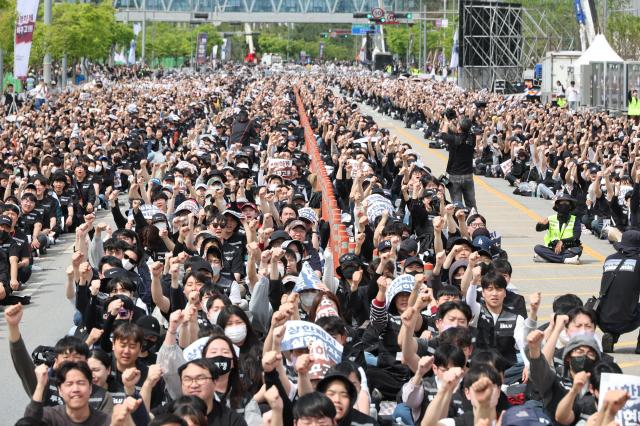
The deal can avert an immediate strike that threatened to disrupt the memory supercycle underpinning South Korea’s exports and stock rally.
But the agreement’s centerpiece — a fixed stock-based profit-sharing structure tied directly to operating profit — is now reverberating far beyond Samsung’s Suwon campuses, unsettling shareholders, stirring resentment across Samsung affiliates and increasingly drawing attention from rival chipmakers abroad, particularly TSMC in Taiwan.
As of Sunday afternoon, turnout for the union ratification vote had exceeded 84.6 percent, according to industry sources, with approval widely expected when voting concludes Wednesday. The unusually strong participation reflects how profoundly the agreement could reshape compensation expectations across Asia’s semiconductor sector.
At the heart of the controversy is Samsung’s newly introduced “special management performance bonus,” which guarantees employees stock compensation equivalent to 10.5 percent of a business division’s operating profit.
While performance-linked bonuses are common globally, industry analysts say institutionalizing a fixed percentage inside a labor agreement marks a sharp departure from prevailing international practices, where boards typically retain discretion to balance compensation against strategic investment needs.
Foreign brokerages have already begun flagging concerns. Citi analyst Peter Lee warned of “downside risks to earnings due to bonus-related provisions amid escalating labor strikes,” lowering operating profit projections for Samsung Electronics.
The timing is especially sensitive. AI-driven demand has triggered one of the most capital-intensive cycles in semiconductor history. TSMC plans as much as $56 billion in capital expenditure this year, while Micron Technology has pledged more than $25 billion for fiscal 2026 in addition to a $100 billion long-term megafab investment in New York. Samsung itself has earmarked more than 110 trillion won ($81 billion) for research, development and facility expansion this year alone.
Analysts caution that locking in fixed double-digit profit-sharing formulas could eventually constrain Samsung’s flexibility in funding next-generation high-bandwidth memory (HBM), advanced packaging and foundry expansion at a time when competition against TSMC, Micron and SK hynix is intensifying.
Unlike traditional industrial cycles, the AI infrastructure race increasingly rewards companies capable of reinvesting enormous sums with speed and consistency.
The ripple effects are no longer confined to South Korea.
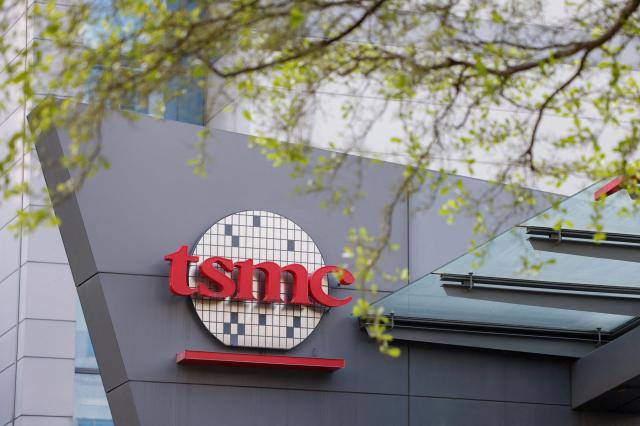
The turbulence inside Samsung’s semiconductor complex in Suwon is now reverberating through Hsinchu, Taiwan’s chipmaking hub. Employees at TSMC — the world’s most critical contract chip manufacturer supplying firms from Nvidia and Apple to Tesla — have grown increasingly vocal over their own compensation structure after reports emerged that performance bonuses could be reduced to offset the mounting costs of building 12 overseas fabrication plants.
Despite TSMC posting a 58 percent year-on-year jump in first-quarter net profit, frustration has reportedly spread across anonymous employee forums.
According to Taiwan’s Liberty Times, workers explicitly referenced Samsung’s labor negotiations while criticizing TSMC management. Some posts complained that “the company changes everything on a whim,” while others openly discussed the possibility of collective action, writing: “It’s time we strike too,” and “May 27 will be the real turning point.”
For decades, Asian semiconductor champions largely maintained an implicit social contract: workers accepted grueling hours and hierarchical cultures in exchange for stability, prestige and gradual prosperity.
Samsung’s new fixed-profit-sharing model threatens to reset those expectations. Workers across the sector are increasingly asking why extraordinary AI profits should remain concentrated at the corporate level while employees shoulder intense workloads and geopolitical uncertainty.
At the same time, investors and executives fear the opposite risk — that institutionalized profit-sharing could gradually erode the massive capital discipline required to sustain semiconductor leadership.
The agreement is also exposing widening internal fissures inside Samsung Group itself.
Under the proposed structure, employees in Samsung Electronics’ memory business could receive roughly 600 million won ($438,000) in annual bonuses if operating profit reaches 300 trillion won, including both the new stock-based incentive and existing excess profit-sharing payments.
Even loss-making non-memory semiconductor divisions such as System LSI and foundry operations would reportedly receive more than 200 million won in combined bonuses through shared Device Solutions division funding pools.
That has triggered growing frustration across Samsung affiliates including Samsung Display, Samsung SDI and Samsung Electro-Mechanics, where employees complain of widening disparities despite their own operational contributions.
Internal discontent has become severe enough that employees increasingly use the self-deprecating nickname “Samsung huja” — implying second-tier Samsung workers — to describe themselves.
The contrast is stark even within the conglomerate. Samsung Display recorded a 6.2 percent wage increase this year, Samsung Electro-Mechanics 5.9 percent and Samsung SDI 4 percent, while their bonus formulas remain tied to the older Economic Value Added (EVA) framework instead of operating profit.
The spillover is beginning to reshape labor expectations across the broader Samsung empire. Samsung Display’s union plans to negotiate an alternative compensation structure later this year, while Samsung Electro-Mechanics is reviewing whether to shift its OPI formula toward either EVA-based 20 percent calculations or operating profit-linked 10 percent formulas similar to Samsung Electronics.
Industry observers warn the agreement could embolden labor activism across major Korean corporations. Samsung Biologics unions are already engaged in strike action, while Samsung C&T reportedly raised planned wage increases to avoid similar disruptions.
The social implications extend far beyond Samsung.
According to Leaders Index, employees at South Korea’s top 211 companies earned an average annual compensation package of 102.8 million won last year including bonuses. Across all Korean businesses, the average worker earned about 50.61 million won annually, according to the Korea Enterprises Federation.
Under Samsung’s new structure, some semiconductor employees could effectively receive compensation equivalent to the annual salaries of more than a dozen ordinary workers in a single year.
The widening divide reflects how the AI boom is concentrating extraordinary wealth into a narrow segment of strategic industries. What was once primarily a technological race is increasingly becoming a political and social challenge as governments, unions and corporations struggle to redefine compensation norms during the transition into the AI economy.
For Samsung, the immediate crisis may have been contained. Production lines continue operating, investors have avoided the shock of an 18-day strike and the AI memory cycle remains intact for now.
But the agreement may ultimately prove to be more than a labor settlement. It could become an early test case for how democracies, corporations and workers negotiate the distribution of AI-era wealth — and whether the race for technological supremacy can coexist with mounting demands for economic equity without weakening the enormous reinvestment needed to sustain the boom itself.

Copyright ⓒ Aju Press All rights reserved.