
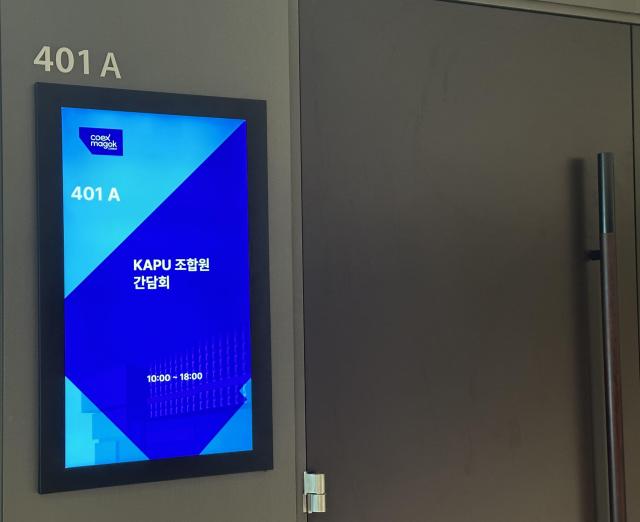
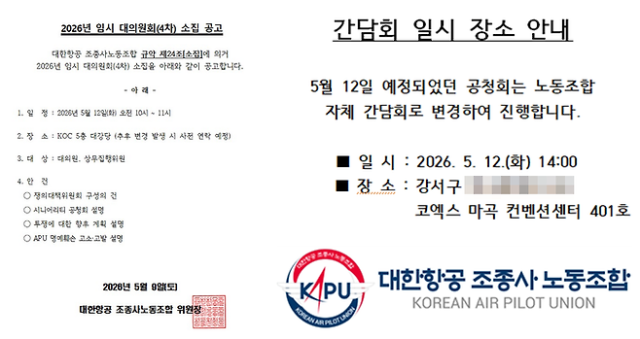
The Korean Air Pilots’ Union held a closed-door meeting in Seoul on Tuesday, bringing together about 200 members to discuss how pilot seniority should be managed after the merger, according to union officials.
“This meeting was not convened to call for a strike,” a KAL pilot told AJP during a brief break in the meeting. “But the seniority issue is not only part of the buildup toward a possible strike, but also one of the most fundamental reasons behind it.”
Although the two airlines have cleared major regulatory hurdles for their business combination, several structural issues remain unresolved. One of the most sensitive is the seniority system, which affects pilots’ order of promotion, pay structure and career progression.
According to the Korean Air pilots’ union, it held 12 rounds of renewed talks with management over about five months from last October, but the negotiations eventually broke down.
The main point of contention is the criteria for promotion from first officer to captain.
Korean Air first officers must meet requirements under the company’s Flight Operations Administration Manual, or FOAM, before becoming eligible for captain upgrade screening. These include five years after appointment as a first officer, 2,500 to 3,000 flight hours after joining the company and at least 350 landings.
Korean Air also requires at least 1,000 flight hours at the hiring stage for first officers, while its probationary and training periods are known to be relatively longer. By contrast, Asiana Airlines is said to require around 300 flight hours for first officer recruitment and to have a shorter probationary period.
The Korean Air pilots’ union argues that because the two carriers have operated under different recruitment, training and promotion standards, simply merging seniority based on entry dates or military discharge dates could push back the promotion order of existing Korean Air first officers.
Asiana pilots, however, have disputed the union’s claims, saying the concerns are overstated. They argue that among some 800 Asiana first officers, only three to four have yet to meet requirements such as the required number of landings, and that those pilots are already undergoing the necessary procedures before promotion.
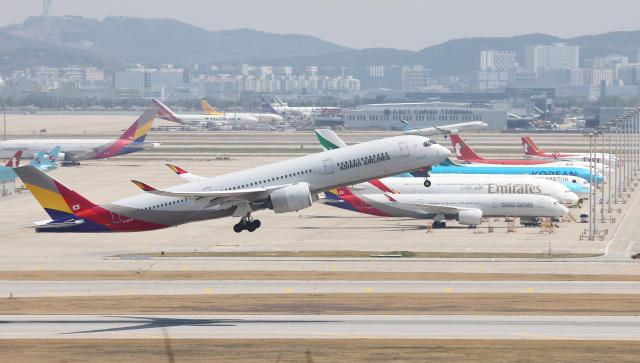
The Korean Air pilots’ union passed a strike vote at its regular general meeting last month, with 57.6 percent of all members voting in favor of industrial action. Since then, the union has been discussing possible response scenarios, including a strike.
However, a full-scale strike remains difficult under the current essential services agreement, as the aviation industry is classified as an essential public service. Even during a strike, airlines are required to maintain a certain level of operations.
The key issue is how the number of essential workers is calculated. Pilots do not work on a fixed daily schedule, but rotate between flights, rest periods, standby duty, training and other assignments. Under the current method, if the required workforce is calculated based on the airline’s entire monthly flight schedule, the figure may include not only pilots actively operating flights but also those on legally required rest, standby duty or post-long-haul rest.
The union argues that this significantly reduces the number of pilots who can take part in industrial action, weakening the practical impact of a strike. If the essential workforce is instead calculated based on actual daily flight operations, the number of pilots required to maintain minimum operations would be lower, allowing more pilots to join a strike and increasing the union’s leverage.
With Korean Air and Asiana Airlines seeking to complete their integration as early as the end of this year, tensions between the unions and management are expected to intensify.
The Korean Air pilots’ union is expected to seek the right to take industrial action through a labor relations commission mediation process. Before that, however, it appears to be pushing for revisions to the essential services agreement as part of efforts to make any potential strike more effective.

Copyright ⓒ Aju Press All rights reserved.
