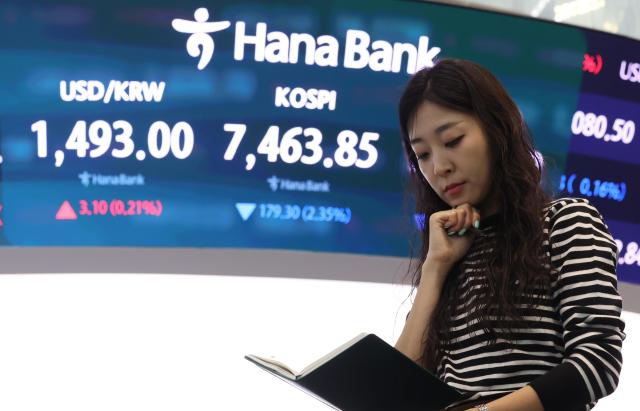
SEOUL, May 13 (AJP) - South Korean shares extended losses for a second straight session Wednesday as fears of a monthlong strike at Samsung Electronics rattled investor sentiment after marathon government-mediated labor talks collapsed overnight.
As of 10:20 a.m., the benchmark KOSPI was down 0.4 percent at 7,613.11 after briefly falling as low as 7,402. The junior KOSDAQ slipped 0.9 percent to 1,169.16.
The decline followed an exceptionally volatile session Tuesday, when the KOSPI briefly surged to 7,999.67 before reversing sharply to close more than 5 percent lower after remarks by presidential policy chief Kim Yong-beom on a possible national “AI dividend” unsettled investors in South Korea’s semiconductor-heavy market. Kim suggested that part of the massive tax revenues and profits generated from the AI boom should be redistributed more broadly to the public.
The sharp swings underscored how heavily South Korea’s equity rally has become concentrated in a handful of AI-linked semiconductor stocks. As investor funds increasingly pile into a small group of beneficiaries, market volatility in Seoul has outpaced that of U.S. equities.
While the U.S. VIX index — often referred to as Wall Street’s fear gauge — has remained in the low 20s near historical norms, Korea’s VKOSPI has surged above 70, its highest level since market turmoil triggered by the U.S.-Iran conflict. Aggressive momentum trading and growing fear-of-missing-out buying have further amplified volatility in Seoul.
According to corporate tracker CEO Score, the combined market capitalization of companies listed on the KOSPI, KOSDAQ and KONEX exchanges has surged 172.9 percent since President Lee Jae Myung took office 11 months ago, climbing from 2,597 trillion won ($1.9 trillion) in June 2025 to 7,088 trillion won as of Monday.
Much of the gain has been driven by Samsung Electronics and SK hynix, which together accounted for more than 56 percent of the total increase in market value. The two chipmakers now represent roughly 42.4 percent of South Korea’s total stock market capitalization, highlighting the market’s growing dependence on AI-related semiconductor demand.
That concentration intensified Wednesday’s selloff. Samsung Electronics fell 5.02 percent to 265,000 won in morning trading, while SK hynix slipped 1.63 percent to 1,805,000 won.
The South Korean government and Samsung Electronics management simultaneously ratcheted up pressure on the labor union ahead of next week’s planned monthlong strike after negotiations over a profit-linked bonus system broke down early Wednesday.
“A strike must never happen under any circumstances,” Deputy Prime Minister and Finance Minister Koo Yun-cheol wrote on X on Wednesday, pledging to continue mediation efforts to keep negotiations alive.
Samsung Electronics, which had largely remained restrained in public comments over union activity, issued its strongest statement yet expressing “deep regret” over the union’s decision to declare negotiations deadlocked after a 17-hour mediation session at the National Labor Relations Commission in Sejong ended around 3 a.m.
Among other major stocks, Hyundai Motor rose 2.32 percent to 661,000 won, while Hyundai Mobis jumped 5.66 percent to 579,000 won. HD Hyundai Heavy Industries gained 1.70 percent to 719,000 won.
Battery shares also weakened. LG Energy Solution fell 0.79 percent to 439,500 won, while Samsung SDI dropped 2.38 percent to 614,000 won.
Defense and industrial shares traded mixed, with Hanwha Aerospace edging down 0.47 percent to 1,278,000 won and Doosan Enerbility sliding 3.42 percent to 121,300 won. Financial stocks were mostly lower, with Samsung Life Insurance falling 1.0 percent to 296,500 won and KB Financial Group slipping 0.13 percent to 153,400 won.
The Korean won weakened slightly to 1,493.80 per dollar from the previous session’s close of 1,489.90 won.
Overnight on Wall Street, major U.S. indexes closed mixed as stronger-than-expected inflation data pushed Treasury yields higher and triggered profit-taking in technology shares. The Dow Jones Industrial Average rose 0.11 percent, while the Nasdaq Composite fell 0.71 percent and the S&P 500 slipped 0.16 percent.
U.S. consumer prices in April came in slightly above expectations, with headline inflation at 3.8 percent and core inflation at 2.8 percent. The data pushed the benchmark 10-year Treasury yield above 4.46 percent, increasing pressure on richly valued AI and semiconductor stocks.
Oil prices also climbed after hopes for a breakthrough in U.S.-Iran negotiations weakened, with U.S. crude futures settling above $102 a barrel and adding to broader inflation concerns.
Elsewhere in Asia, major stock markets traded lower as investors turned cautious ahead of the summit between U.S. President Donald Trump and Chinese President Xi Jinping set to open in Beijing on Thursday, while also monitoring geopolitical tensions in the Middle East.
Japan’s Nikkei 225 was trading at 62,600.17, down 0.23 percent, while China’s Shanghai Composite Index fell 0.48 percent to 4,194.29. Hong Kong’s Hang Seng Index was also trading lower at 26,322.38, down 0.097 percent.

Copyright ⓒ Aju Press All rights reserved.