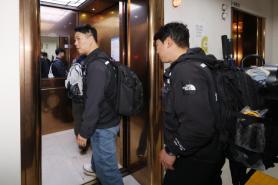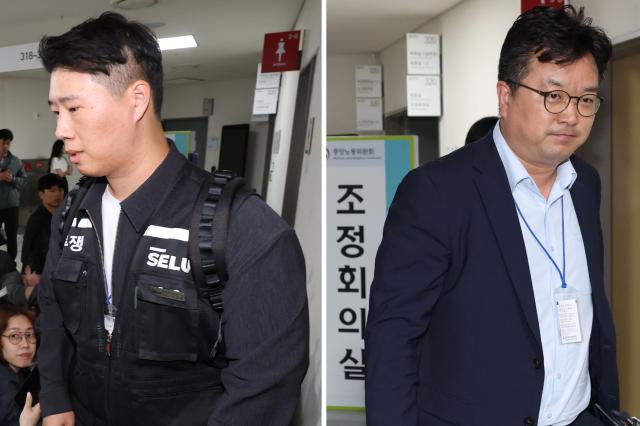
SEOUL, May 13 (AJP) - The South Korean government and Samsung Electronics management ratcheted up pressure on the labor union ahead of a planned monthlong strike next week after marathon government-mediated talks over a profit-linked bonus system collapsed early Wednesday.
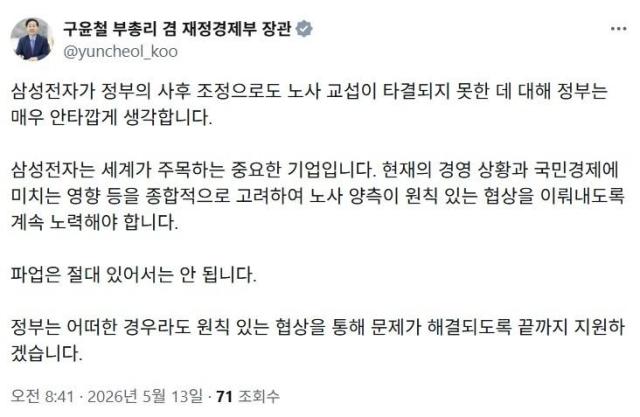
“A strike must never happen under any circumstances,” Deputy Prime Minister and Finance Minister Koo Yun-cheol wrote on X on Wednesday, pledging to continue mediation to keep the dialogue momentum alive.
Samsung Electronics, which so far has stayed muted over the union activities issued a strongest-yet statement expressing “deep regret” over the union’s decision to declare negotiations deadlocked after a 17-hour mediation session at the National Labor Relations Commission in Sejong ended around 3 a.m.
“It is deeply regrettable that the government’s post-mediation efforts were nullified by the union’s declaration of a breakdown,” the company said. “The union’s decision is causing significant concern and anxiety not only for the company but also for employees awaiting a settlement, as well as shareholders and the public.”
The National Samsung Electronics Union (NSEU) announced the talks had “finally broken down,” rejecting the latest mediation proposal as a step backward from previous discussions.
According to Samsung, the government attempted to facilitate compromise by presenting multiple proposals based on the positions of both labor and management, but the union ultimately walked away from the negotiations.
Samsung also accused the union of insisting on a rigid institutionalization of the bonus system while rejecting management’s proposal for a more flexible compensation structure tied to business performance.
The core dispute centers on the union’s demand to formalize a compensation scheme allocating 15 percent of operating profit to employee bonuses and abolish the existing bonus ceiling. Management wants to maintain the current Excess Profit Incentive (OPI) framework, which caps bonuses at 50 percent of monthly salary.
“The company will continue efforts to prevent the worst-case scenario through sincere dialogue until the end,” Samsung said, while thanking government officials and mediators involved in the process.
The government has also intensified calls for compromise amid concerns over the broader economic fallout of a strike at the country’s largest corporation.
Koo said earlier this week that Samsung’s record earnings were tied not only to corporate efforts but also to public infrastructure investment and the support of hundreds of subcontractors across the semiconductor supply chain.
The union has warned it could launch a full-scale strike as early as May 21 if negotiations remain stalled.
While the government has legal authority to invoke emergency arbitration that could suspend industrial action for up to 30 days, officials at the labor commission said the measure is not currently under active review.
Samsung Electronics shares that been rallying around historic highs fell 2.4 percent upon the breakdown news Wednesday.

Copyright ⓒ Aju Press All rights reserved.