
At the same time, the institute warned inflation risks were intensifying from both demand and supply pressures and called for flexible monetary policy, including the possibility of interest rate hikes should inflation expectations become unstable.
“Should the possibility of persistently high inflation increase, rates would need to rise,” KDI said in its revised economic outlook, while adding that uncertainty remains too high to determine the timing of any potential move.
Its latest outlook marks a sharp 0.6 percentage-point upgrade from the institute’s February forecast issued before the outbreak of the Middle East conflict and reflects stronger-than-expected first-quarter growth, when the economy expanded 1.7 percent from the previous quarter.
The state-run think tank raised its inflation forecast for this year by 0.6 percentage point, warning that rising global oil prices and recovering domestic demand were adding upward pressure on consumer prices.
“The Korean economy has continued its recovery trend as growth expanded at a relatively strong pace, driven by the semiconductor boom and expanding domestic demand,” the KDI said.
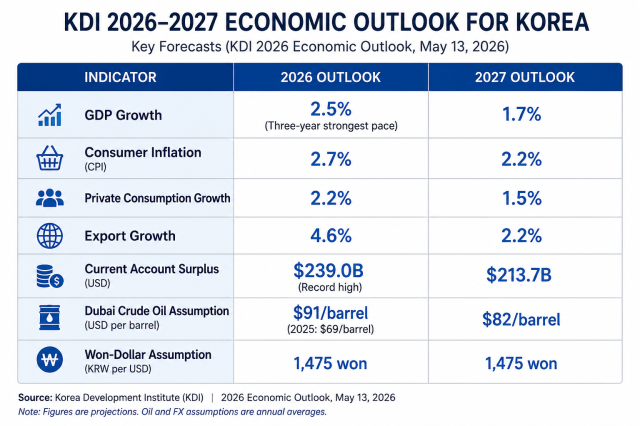
The KDI expects the economy to grow 1.7 percent in 2027, while describing both this year and next year as an expansionary phase because growth is projected to exceed the country’s estimated potential growth rate.
Still, the recovery remains heavily skewed toward semiconductors.
According to the KDI, semiconductor exports accounted for more than half of the upward revision in this year’s growth outlook.
“Compared with the negative impact from the Middle East war, the positive effect from semiconductor exports was larger,” Jung Kyu-chul, head of KDI’s macroeconomic and financial policy division, said during a briefing in Sejong.
“Out of the 0.6 percentage-point upward revision, semiconductors contributed more than 0.3 percentage point.”
Jung estimated the Middle East war shaved roughly 0.5 percentage point off growth, while supplementary budget spending added about 0.2 percentage point.
He added that surging semiconductor demand and supply shortages had sharply lifted chip prices, suggesting growth could improve further if production capacity expands more quickly.
The KDI, however, warned that prolonged high oil prices could derail the outlook.
The institute assumes Dubai crude will average $91 per barrel this year before easing to $82 next year, compared with $69 last year, while the won-dollar exchange rate is assumed to remain near the current 1,475 won level.
The think tank projected exports would rise 4.6 percent this year on robust semiconductor demand before moderating to 2.2 percent next year, while the current account surplus is expected to reach a record $239 billion this year.
Private consumption is forecast to increase 2.2 percent this year and 1.5 percent next year despite inflationary pressures from the Middle East conflict, supported by improving income conditions and government stimulus measures.
Jung added that rising stock prices were also likely to support consumption through wealth effects.
The KDI also projected employment would continue improving moderately, with the number of employed persons increasing by 170,000 in both this year and next year despite demographic changes.
The institute additionally urged the government to focus fiscal spending on boosting potential growth and supporting vulnerable households while improving spending efficiency. It specifically called for reforms to basic pensions and local education subsidies, which are projected to exceed 100 trillion won next year.
Copyright ⓒ Aju Press All rights reserved.
