
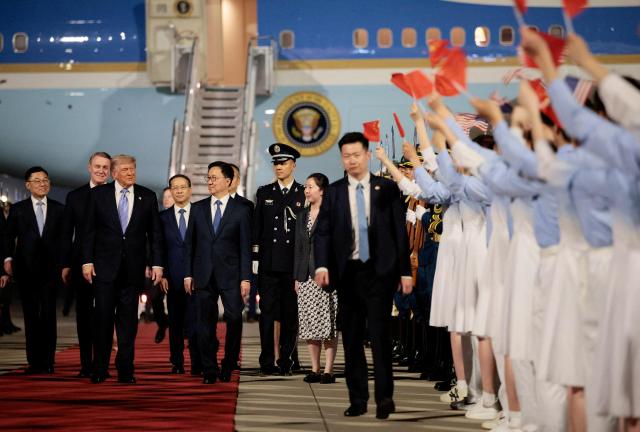
While both sides are expected to emphasize symbolism and stability in public, the summit is emerging as a transactional negotiation over tariffs, semiconductors, energy security and Taiwan, with a heavyweight U.S. business delegation underscoring how corporate America remains deeply tied to China despite escalating geopolitical rivalry.
Trump on Wednesday evening arrived in Beijing seeking Chinese cooperation on multiple fronts: easing pressure on American farmers through larger agricultural purchases, stabilizing supply chains for rare earth minerals, and leveraging Beijing’s influence over Iran to reopen the Strait of Hormuz, a critical artery for global oil shipments.
Xi is expected to push for tariff relief, softer export controls on advanced semiconductors and reduced U.S. military support for Taiwan.
The summit comes at a delicate moment for both leaders.
Trump enters Beijing amid criticism over the economic fallout from the Iran conflict and rising questions about America’s strategic overstretch. Xi faces mounting pressure from China’s slowing economy, weak domestic demand and worsening deflationary pressure. Analysts say both leaders need visible wins without appearing to concede too much strategically.
Still, beneath the ceremonial choreography lies a more fundamental rivalry.
Washington increasingly sees China’s industrial strategy and export-driven manufacturing dominance as a long-term threat to U.S. economic security.
A report released this week by the U.S. Chamber of Commerce and Rhodium Group described China’s policy direction as an “industrial policy of everything,” warning that Beijing’s state-backed expansion into sectors ranging from AI to raw materials is narrowing the room for Western competitors.
Tariffs are expected to dominate much of the negotiations.
Although portions of Trump’s sweeping tariff regime have been challenged in U.S. courts, the administration is preparing additional trade actions linked to forced labor and industrial production concerns tied to China. Beijing is expected to press hard for lower tariff barriers, though Washington faces political constraints in appearing softer toward its biggest strategic competitor.
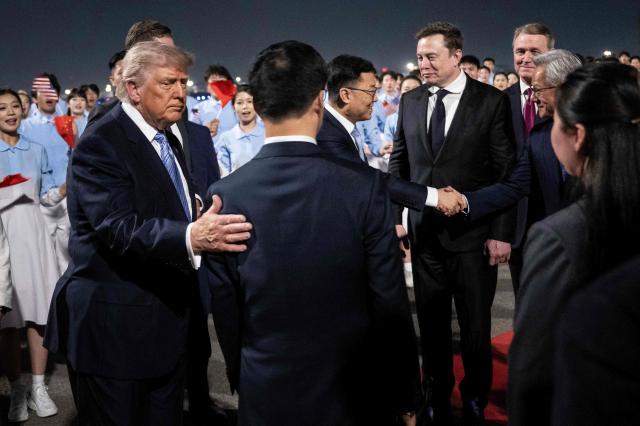
Xi is reportedly seeking broader access to advanced U.S. chips after Washington partially loosened restrictions on exports of Nvidia’s H200 processors while continuing to block the company’s top-tier Blackwell systems. U.S. officials, meanwhile, remain concerned about China’s advances in AI, military-civil fusion technologies and rare earth export controls that have exposed vulnerabilities in American supply chains.
Taiwan remains the summit’s most politically sensitive fault line.
Chinese officials are expected to push Trump to shift Washington’s longstanding position from “not supporting” Taiwanese independence toward explicitly “opposing” it — a wording change that would signal a major diplomatic concession to Beijing. Trump has also indicated willingness to discuss a multibillion-dollar U.S. arms package for Taiwan during talks with Xi.
The composition of the U.S. delegation accompanying Trump highlights the business stakes surrounding the summit.
More than a dozen top executives traveled to Beijing, including Tesla and SpaceX CEO Elon Musk, Apple CEO Tim Cook, Nvidia CEO Jensen Huang, BlackRock Chairman Larry Fink, Boeing CEO Kelly Ortberg and Goldman Sachs CEO David Solomon.
The lineup reflects how deeply intertwined U.S. corporations remain with the Chinese market despite years of “decoupling” rhetoric.
For technology firms such as Nvidia, Qualcomm, Micron and Apple, China remains a critical manufacturing base and consumer market. Boeing is seeking to revive aircraft sales to Chinese airlines after years of trade tensions and regulatory freezes, while financial firms including BlackRock, Citi and Goldman Sachs continue to pursue long-term expansion in China’s capital markets.
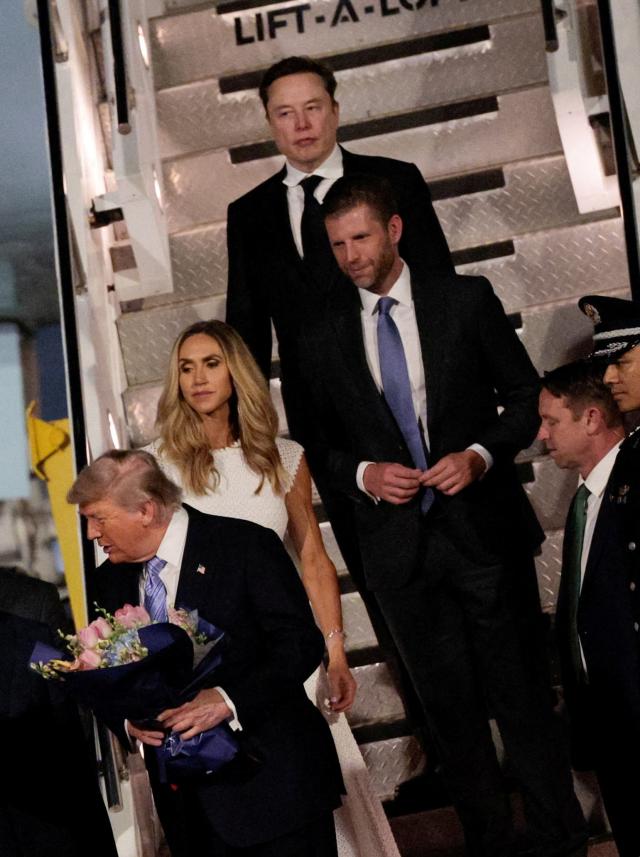
Tesla’s Shanghai Gigafactory remains one of the company’s most important production hubs, while Musk has maintained unusually close ties with Chinese officials compared with many U.S. executives. His attendance signals that Beijing still views select American corporate leaders as potential stabilizers in an otherwise deteriorating bilateral relationship.
The delegation also reveals Washington’s competing priorities.
Alongside national security concerns over semiconductors and strategic industries, the administration is simultaneously seeking export deals, investment opportunities and supply-chain stability. Analysts say the summit illustrates the contradiction at the heart of current U.S.-China policy: intensifying strategic rivalry paired with continued economic interdependence.
For Seoul and other Asian economies caught between the two powers, the outcome could have direct implications for semiconductors, energy prices, shipping routes and regional security architecture.
Korea’s export-heavy economy remains particularly exposed to any changes in U.S.-China trade policy, Taiwan tensions or disruptions in the Strait of Hormuz, through which much of Asia’s imported crude oil passes.
Copyright ⓒ Aju Press All rights reserved.
