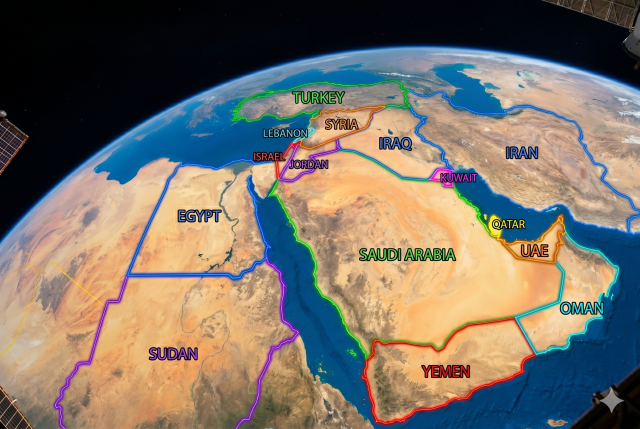
The Middle East is moving again — not slowly, but with the dangerous speed that often precedes a historic geopolitical realignment. What began as another confrontation between Iran and Israel is no longer confined to missile strikes, proxy warfare, or retaliatory operations. It is becoming a wider struggle over the future architecture of the Middle East itself: who will control the sea lanes, who will shape the post-oil order, and which civilization will define the political grammar of the region in the age of artificial intelligence, energy transition, and strategic fragmentation.
Against that backdrop, the revelation that Benjamin Netanyahu secretly visited the United Arab Emirates during the war may prove to be one of the most consequential diplomatic developments of the year.
According to reports emerging from the region, Netanyahu met privately with UAE President Mohamed bin Zayed Al Nahyan in the oasis city of Al Ain near the Omani border. Intelligence and military coordination reportedly accompanied the visit, including multiple trips by senior Israeli intelligence officials. In ordinary times, such revelations would already be significant. In wartime, they become historic.
The visit signals something far deeper than tactical cooperation. It suggests that the quiet strategic alignment between Israel and key Sunni Arab states is evolving into a structured security framework — one built not merely on diplomacy, but on shared survival.
For years, the Abraham Accords were viewed primarily as a normalization project: trade, tourism, technology, investment, and symbolic reconciliation between Israel and several Arab states. Yet wars have a way of stripping diplomacy down to its essential core. Under pressure, nations reveal whom they truly trust.
The current regional crisis is accelerating precisely that process.
The emerging alignment now extends beyond Israel and the Gulf monarchies. Saudi Arabia and Pakistan have already deepened military cooperation through their Strategic Mutual Defense Agreement. Discussions regarding potential participation by Türkiye and Qatar suggest that a broader Islamic security architecture may be quietly taking shape.
Some Indian analysts have begun referring to the possibility as an “Arab NATO.” The phrase may sound exaggerated today, yet history often begins as exaggeration before becoming reality.
What makes the moment extraordinary is not merely the military dimension. Historically rival powers — Saudi Arabia and Türkiye among them — are now discovering common strategic interests under the shadow of expanding regional instability. The shared concerns are unmistakable: Iranian influence, maritime insecurity, economic vulnerability, militant spillovers, and the fear that prolonged war could permanently destabilize the energy arteries of the world economy.
The recent tensions between Iran and Kuwait underscore how rapidly the conflict risks spreading across the Gulf. Kuwaiti authorities announced the detention of Iranian Revolutionary Guard personnel allegedly attempting infiltration operations near strategically sensitive islands. Tehran denied the accusations while simultaneously warning that it reserved the right to retaliate.
Such episodes matter because geography matters.
The Persian Gulf is not simply a regional waterway. It is one of the central nervous systems of global civilization. The Strait of Hormuz remains indispensable to energy flows, maritime insurance markets, shipping logistics, inflation trajectories, and ultimately the stability of financial systems from New York to Singapore.
That is why the present conflict cannot be understood solely through the narrow lens of religion or ideology. It is fundamentally about the future balance of power across Eurasia.
Yet amid this dangerous escalation, another possibility is quietly emerging — one that may ultimately offer a more durable foundation for peace than military victory alone.
That possibility may be called the Noah Covenant.
The Abraham Accords opened the door to political normalization between Israel and parts of the Arab world. But the deeper civilizational challenge of the Middle East cannot be solved merely through transactional diplomacy. The region requires a broader philosophical framework capable of transcending sectarian divisions without erasing historical identities.
In Jewish tradition, the Noahide Covenant represents one of humanity’s oldest universal moral agreements. Unlike covenants tied to a single tribe or nation, it is understood as a covenant made with all humankind after the Flood. It establishes the minimum principles necessary for civilization itself: justice, restraint, human dignity, lawful order, and the rejection of chaos.
Its symbolic power is profound because the three great monotheistic traditions — Judaism, Christianity, and Islam — all recognize Noah as a foundational patriarch of humanity.
That matters enormously in today’s Middle East.
Modern geopolitics often forgets that beneath contemporary rivalries lies a deeper civilizational memory. Arabs and Jews trace spiritual ancestry to Abraham. Persians, despite their distinct imperial and cultural identity, remain deeply woven into the historical fabric of the broader Middle Eastern civilization. Even Iran, frequently portrayed only as a revolutionary state, still carries the consciousness of an ancient imperial civilization shaped by thousands of years of history along the Silk Road.
This is one reason outside powers have repeatedly misunderstood Iran. The United States, powerful though it is, remains historically young compared with Persia’s civilizational depth. Strategic cultures shaped over millennia do not behave according to short-term military logic alone.
Iran understands endurance.
Israel understands existential survival.
The Gulf monarchies understand vulnerability.
Türkiye understands imperial memory.
And Pakistan understands the strategic realities of balancing multiple civilizational worlds simultaneously.
The future stability of the Middle East may therefore depend less on decisive military triumph and more on whether these powers can gradually construct a new regional compact based on coexistence, deterrence, and mutual survival.
This is where the concept of an Arab NATO becomes strategically important.
If such a framework emerges — whether formally or informally — it would likely evolve beyond military cooperation. It could become a broader platform integrating energy security, artificial intelligence infrastructure, maritime defense, logistics corridors, cyber defense, and strategic investment.
Saudi Arabia and the UAE are already investing aggressively in AI, smart cities, semiconductor ecosystems, and post-oil economic transformation. Türkiye possesses significant military-industrial capacity and geopolitical reach. Pakistan is both a nuclear power and a bridge between South Asia, China, and the Islamic world. Egypt controls the Suez Canal, one of the most vital arteries of global commerce.
Combined, these states could form a stabilizing strategic axis capable of reshaping the wider Middle East.
And this is precisely where President Donald Trump may still envision an opportunity.
Trump has long approached Middle Eastern diplomacy through unconventional transactional frameworks rather than ideological grand strategy. The Abraham Accords themselves reflected that instinct. Yet the next stage may require something larger: not merely normalization between governments, but a broader architecture of regional coexistence anchored in shared security and economic interdependence.
In that sense, the real successor to the Abraham Accords may ultimately become a Noah Covenant — a civilizational understanding that recognizes that endless sectarian war cannot produce a sustainable future for any side.
For South Korea, these developments carry enormous implications.
Korea should not view the Middle East merely as a source of oil or construction contracts. The region is rapidly becoming one of the principal theaters where energy, technology, logistics, AI infrastructure, and geopolitical competition intersect. Korea possesses world-class strengths in semiconductors, shipbuilding, nuclear energy, defense technology, and digital infrastructure. It also maintains unusually balanced relationships across the region, including with Israel, Saudi Arabia, the UAE, and Türkiye.
That diplomatic balance gives Seoul a potentially important role.
In the coming decade, Korea could emerge not only as an economic partner but also as a strategic bridge connecting East Asian technological capacity with Middle Eastern transformation.
The Middle East today stands at a crossroads between escalation and reinvention. Wars destroy cities. But they also expose strategic realities that peacetime diplomacy often conceals.
The deeper question is no longer who can win the next battle.
It is who can build the next order.
And increasingly, the outlines of that future may lie not only in weapons or alliances, but in a broader search for a civilizational covenant capable of allowing ancient rivals to survive together in a rapidly changing world.
Copyright ⓒ Aju Press All rights reserved.