
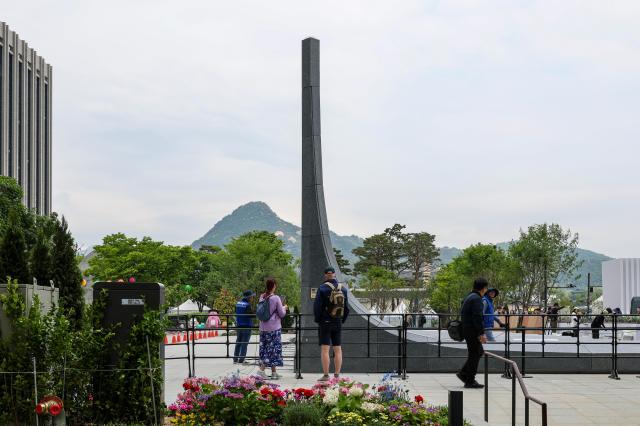
The Seoul Metropolitan Government on Tuesday officially opened the “Garden of Gratitude” at Gwanghwamun Square, a memorial space dedicated to the 22 United Nations member states that fought alongside South Korea during the 1950-53 Korean War, unveiling a politically charged landmark that has already sparked debate over symbolism, history and the use of public space.
What city officials had hoped would become a signature international memorial tied to Seoul Mayor Oh Se-hoon’s reelection campaign ahead of next month’s local elections has instead evolved into another political flashpoint, with ruling party lawmakers accusing the conservative mayor of distorting the historical identity of Gwanghwamun Square amid lingering political tensions following former President Yoon Suk Yeol’s impeachment.
Located west of the King Sejong statue in central Seoul, the memorial consists of 23 stone pillars — representing South Korea and the 22 nations that participated in the U.N. Command during the war — arranged from north to south in the order each country arrived on the Korean Peninsula. The United States, the first nation to deploy troops, stands at the southernmost end.
Each pillar rises 6.25 meters high, symbolizing June 25, the date the Korean War began in 1950. National flags are attached to the structures, while lighting installations atop the pillars illuminate the night sky after dark.
The memorial complex also includes an underground exhibition space called “Freedom Hall,” featuring multimedia displays on the Korean War, the sacrifices of foreign veterans and South Korea’s postwar transformation.
Around 170 people attended Tuesday’s completion ceremony, including ambassadors from participating nations, Korean War veterans and veterans’ organization officials. Acting Seoul Mayor Kim Sung-bo presided over the event alongside representatives from the allied countries.
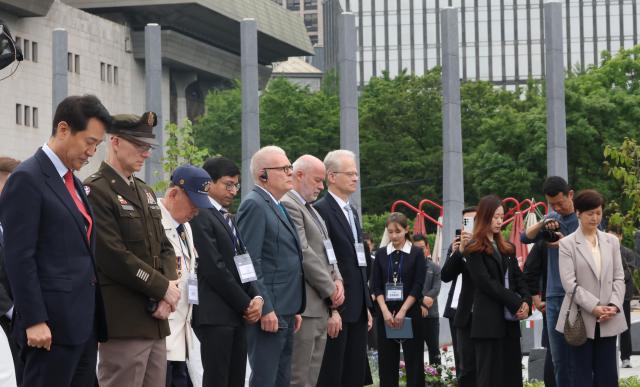
Several pillars were produced using stones donated by participating nations including the Netherlands, Greece, Belgium and Germany. Seoul officials said additional donated stones from countries such as Australia and Türkiye will be incorporated later this year. QR codes attached to each pillar provide visitors with information about each country’s wartime contribution.
Beginning at 8 p.m. each evening, beams of light projected from the top of the structures illuminate the sky for 10 minutes every half hour until 11 p.m.
Inside Freedom Hall, visitors can explore AI-restored wartime photographs, interactive exhibits and a live video connection to Times Square.
Yet despite the city’s emphasis on remembrance and international solidarity, the project has become entangled in political controversy, particularly over the design and symbolism of the above-ground pillars.
Critics argue the structures resemble rifles used during military honor guard ceremonies, making them incompatible with Gwanghwamun Square’s long-standing identity as a site associated with democratic protests and civic movements.
Oh strongly rejected the criticism. “It is not a sculpture symbolizing guns,” he told AJP.
“It represents an honor guard ceremony commemorating the memory and sacrifice of 22 countries that voluntarily came to defend South Korea and liberal democracy at a time when the country’s per capita income was below $100,” he said.
The mayor also denied accusations that the opening timing was politically motivated ahead of the June 3 local elections.
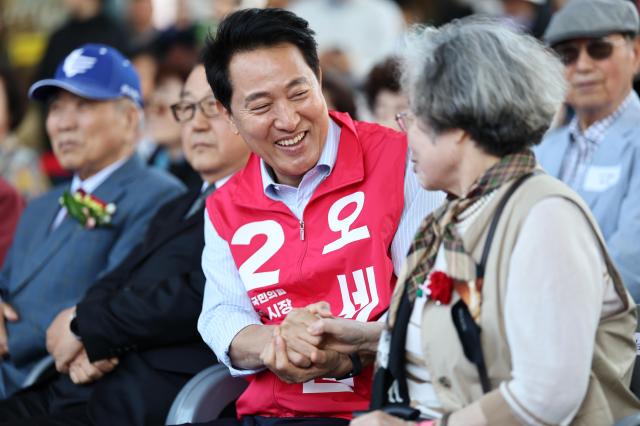
Oh expressed confidence the site would evolve into both a memorial space and a tourist destination for visitors from allied nations.
“Many citizens will visit this place and remember the Korean War,” Oh said. “Tourists from the United States, Australia, Britain, Germany and other participating countries will also come to the Garden of Gratitude.”
Rep. Koh Dong-jin of the People Power Party also dismissed accusations that the opening was politically motivated.
“It does not make sense to conclude this was an election-driven move when an incumbent mayor would have little reason to deliberately invite unnecessary controversy just before an election,” Koh said.
“This has become a largely unproductive political dispute,” he added.
Opposition politicians, however, voiced far harsher criticism.
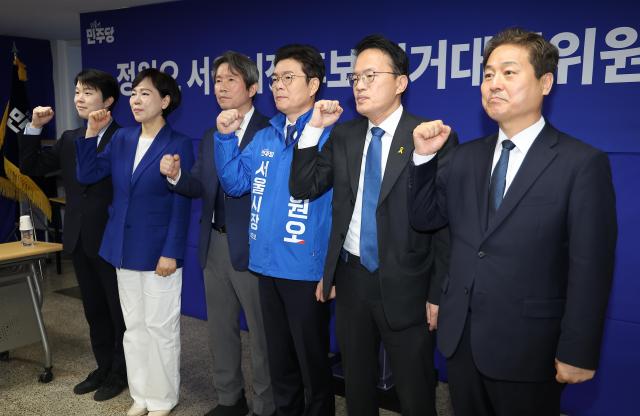
Rep. Kim Won-i of the ruling Democratic Party of Korea (DPK), who previously served as Seoul’s vice mayor for political affairs, argued the installation fundamentally misunderstands the historical identity of Gwanghwamun Square.
“This is something that should never have been done,” Kim said.
“The current Seoul Metropolitan Council building served as the National Assembly during the April 19 Revolution, and this entire area is historically associated with democracy and civic resistance.”
“Gwanghwamun Square symbolizes freedom, democracy and peace,” he continued.
Rep. Park Joo-min of the DPK also attacked the project, calling it an example of what he described as Mayor Oh’s disregard for public opinion.
“Despite public opposition, he pushed the project forward. There is already a similar monument with a comparable purpose at the War Memorial of Korea in Yongsan.”
Copyright ⓒ Aju Press All rights reserved.
