
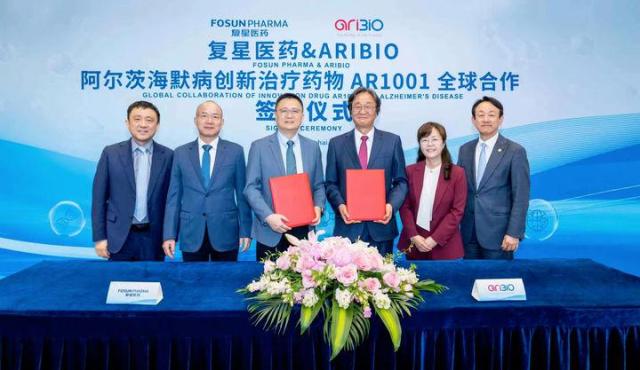
Aribio has successfully secured a global licensing agreement worth approximately 7 trillion won ($4.7 billion) for its oral Alzheimer's treatment, AR1001, with China's Puxing Pharmaceuticals. This marks the largest technology transfer deal in South Korea's dementia treatment sector, with expectations for domestic companies to thrive in a market projected to exceed 70 trillion won by 2030.
On May 14, Aribio announced its exclusive licensing agreement with Puxing Pharmaceuticals, which encompasses the development, approval, production, and commercialization of AR1001. The deal covers global market rights excluding South Korea, the Middle East, and Latin America.
Upon signing the agreement, Aribio received an upfront payment of $60 million (approximately 90 billion won). Additionally, the company will receive $80 million upon the announcement of top-line results from Phase 3 clinical trials, totaling $140 million (about 210 billion won) in upfront payments. Further milestone payments will be available during the approval and commercialization phases, along with royalties of up to 20%.
AR1001 is an oral Alzheimer's treatment classified as a PDE-5 inhibitor, characterized by its multi-target mechanism rather than a single target. It aims to inhibit amyloid and tau pathology while also reducing neuroinflammation, improving cerebral blood flow, and protecting nerve cells.
Currently, a global Phase 3 clinical trial involving approximately 1,500 participants is nearing completion in the U.S., Europe, China, and South Korea, with top-line results expected to be released in the second half of this year.
An Aribio representative stated, "So far, clinical trials have confirmed safety, blood-brain barrier penetration capability, and potential cognitive function improvement in early patient groups."
This agreement is noteworthy in light of the rapidly growing Alzheimer's treatment market. The global market has entered a commercialization phase following the introduction of anti-amyloid antibody treatments such as Eisai and Biogen's Leqembi and Eli Lilly's Donanemab. However, these drugs have faced criticism due to their intravenous administration, safety controversies, and limited efficacy.
As a result, there is increasing anticipation for new oral medications with convenient dosing and complex mechanisms. Market research firms project that the global Alzheimer's treatment market, currently valued at around 20 trillion won, will expand to over 70 trillion won by 2030.
Jung Jae-jun, co-CEO of Aribio, remarked, "This agreement is a testament to the competitiveness of Korean biotech in the global new drug market, going beyond mere technology transfer."
* This article has been translated by AI.
Copyright ⓒ Aju Press All rights reserved.