As the Tariff War Recedes, Artificial Intelligence and Semiconductors Rise to the Center of Global Power
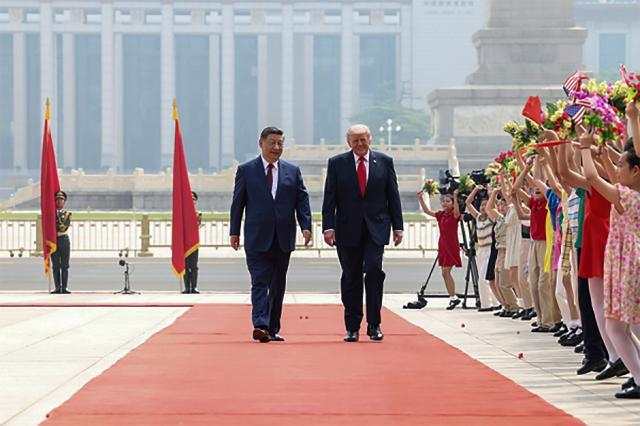
Beijing in May 2026 was not a city of Cold War hostility.
Yet neither was it a city of complete reconciliation.
Beneath the red carpets of the Great Hall of the People and along the quiet stone paths of the Temple of Heaven, one could sense both tension and restraint — the unmistakable weight of two powers attempting to manage the future of the international order.
The summit between President Donald Trump of the United States and President Xi Jinping of China outwardly projected stability and cooperation. But the true substance of the meeting was no longer tariffs. The real center of gravity had shifted decisively toward artificial intelligence and semiconductors.
Global power is no longer defined primarily by oil, steel, automobiles, or low-cost manufacturing. It is increasingly determined by data, computational capacity, advanced semiconductor architecture, and the ability to dominate the infrastructure of artificial intelligence.
One symbolic moment captured this transformation with unusual clarity: the presence of Nvidia chief executive Jensen Huang alongside President Trump during the Beijing visit.
After concluding his Alaska schedule, Trump effectively brought Huang with him into the strategic theater of the summit. This was not merely the inclusion of a corporate executive. It was a declaration that advanced artificial-intelligence chips have now become instruments of national power.
Only a few years ago, the center of U.S.-China confrontation was the tariff war.
During Trump’s first presidency, sweeping tariffs on Chinese goods shook global supply chains and rattled both Chinese manufacturing and American consumers. Washington framed the measures as an attempt to reduce trade imbalances and challenge what it regarded as unfair Chinese trade practices. Beijing responded with retaliatory tariffs of its own. The phrase “tariff war” soon became a defining term of the era.
But within a remarkably short period, the strategic landscape changed.
The central question is no longer who can produce goods more cheaply. It is now who will shape the architecture of the future.
And at the heart of that struggle stand artificial intelligence and semiconductors.
Semiconductors are no longer simply industrial components. In the age of artificial intelligence, they have become a direct expression of national capability. Military systems, cloud computing, autonomous vehicles, robotics, aerospace, biotechnology, financial infrastructure, and advanced communications all depend upon high-performance chips.
In particular, Nvidia’s graphics processing units — once associated primarily with gaming and visual computing — have evolved into what many now call the “oil of the artificial-intelligence era.”
It is therefore no coincidence that Washington’s strongest pressure on China has focused precisely on advanced AI semiconductors.
The United States has restricted exports of its most advanced AI chips, including the H100 and H200 series, while tightening controls on semiconductor equipment and software. American allies have increasingly aligned themselves with these measures. The Dutch lithography giant ASML and major Japanese semiconductor-equipment firms have, to varying degrees, joined the broader strategic effort, significantly limiting China’s access to cutting-edge manufacturing technology.
Yet China has not retreated.
On the contrary, Beijing has elevated semiconductor self-sufficiency to the level of a national survival strategy.
Efforts are accelerating simultaneously across multiple fronts: artificial-intelligence chip development led by Huawei, domestic graphics-processing ecosystems, memory-chip independence, and the expansion of Chinese semiconductor-equipment manufacturing.
The rise of the Chinese artificial-intelligence company DeepSeek has especially attracted global attention.
Despite restrictions on access to America’s most advanced chips, DeepSeek has demonstrated that optimization techniques and highly efficient computational structures can still produce competitive AI performance. That development has challenged a widely held assumption in the West — namely, that Chinese artificial intelligence could not advance meaningfully without unrestricted access to American semiconductor technology.
This reality has created growing strategic anxiety in Washington as well.
Excessive pressure may produce short-term advantages for the United States, but over time, it could accelerate China’s technological independence. History repeatedly shows that technological containment often strengthens the very ecosystems it seeks to weaken.
That is precisely why both sides handled the semiconductor issue with such caution during the Beijing summit.
The United States remains wary of China’s ambitions in military artificial intelligence, yet it also understands that American corporations cannot easily abandon the Chinese market. Companies such as Nvidia, Apple, and Tesla still regard China as indispensable to their global strategies.
China, meanwhile, fully recognizes that sustained economic growth remains difficult without access to advanced Western technology and the broader global financial system.
As a result, the atmosphere surrounding this summit differed fundamentally from earlier tariff confrontations.
The old dispute centered on trade balances and customs duties. The new rivalry concerns the command of future civilization itself.
Behind the diplomatic smiles and carefully choreographed handshakes lies a deeper and quieter struggle: who will control the operating system of the artificial-intelligence age?
Across the United States, competition for AI infrastructure and advanced graphics processors has already become intense. Microsoft, Google, Amazon, and Meta are investing enormous sums into artificial-intelligence data centers and computational networks. Wall Street financial institutions are also pouring unprecedented capital into AI systems.
America still retains commanding advantages in chip design, software ecosystems, and advanced processing architecture.
China, however, is leveraging a different strength: scale.
Supported by vast domestic markets, state-directed investment, and one of the world’s deepest manufacturing bases, China is accelerating its pursuit of technological parity. Provincial governments are spending heavily on AI industrial zones, semiconductor talent recruitment, and domestic equipment development. Beijing, Shanghai, and Shenzhen are rapidly evolving into concentrated hubs of artificial-intelligence and semiconductor innovation.
This is why the AI and semiconductor struggle cannot be understood merely as industrial competition.
It is a contest over the future structure of state power and the shape of the international order itself.
And within this transformation, the tariff war has gradually moved into the background.
Tariffs still matter, certainly. But tariffs belong largely to the industrial logic of an earlier era. The decisive assets of the artificial-intelligence century are data, computational power, advanced chips, and supply-chain control.
The world is moving from an age defined by manufacturing efficiency toward one defined by algorithmic dominance and computational supremacy.
The implications for the global economy are profound.
If Washington and Beijing maintain a workable level of cooperation and commercial exchange in artificial intelligence and semiconductors, the global chip market may regain a measure of stability. But if tensions intensify again, supply-chain fragmentation and technological bloc formation are likely to deepen further.
The world could gradually divide into competing American-centered and China-centered technology spheres.
For South Korea, the challenge is particularly delicate.
South Korea remains one of the world’s leading semiconductor powers, especially in memory chips. Yet it also stands directly between America’s security alliance system and China’s economic gravity. Samsung Electronics and SK hynix must comply with U.S. semiconductor restrictions while simultaneously protecting their production bases and commercial interests in China.
South Korea therefore, faces a historic strategic test.
It can no longer remain merely a manufacturing power. It must evolve into a comprehensive technology state capable of leadership in AI semiconductor design, software ecosystems, power semiconductors, advanced packaging, and next-generation computing architecture.
At the same time, Seoul must preserve the diplomatic sophistication necessary to avoid becoming trapped entirely within either side’s geopolitical orbit.
The Beijing summit of 2026 revealed one reality with unmistakable clarity:
The central axis of global power is no longer tariffs.
It is now artificial intelligence and semiconductors.
And that quiet war has already begun.
Copyright ⓒ Aju Press All rights reserved.