
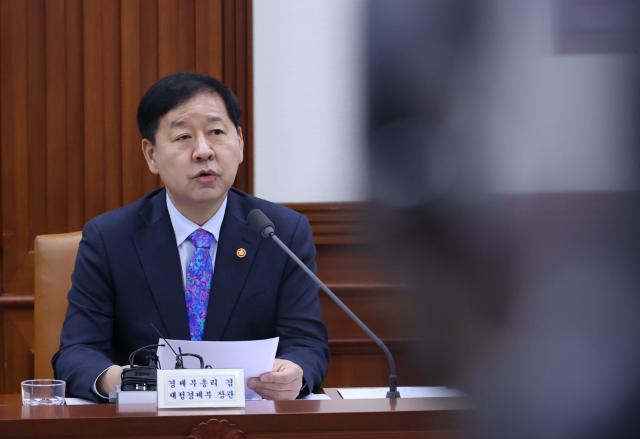
During an emergency economic meeting held at the Government Seoul Building on May 15, Koo reviewed the government's response to the ongoing conflict in the Middle East and assessed the direction of economic policy for the second half of the year.
He noted, "Currently, the supply prices set by refiners are below the announced maximum prices, and retail gas prices are slightly decreasing," expressing gratitude to the refiners and gas station operators for their cooperation with government policies.
The government is committed to a comprehensive response to stabilize prices amid high oil costs. Koo emphasized, "The prolonged conflict in the Middle East is beginning to visibly impact prices and employment in the real economy," and pledged to closely monitor domestic and international conditions to minimize the burden on citizens.
To achieve this, the government will continue implementing measures to stabilize food prices, including applying tariff quotas on imported chicken and pork and expanding the supply of pork in wholesale markets. Starting May 18, the government plans to proceed without delay with the second round of support payments for those affected by high oil prices.
The meeting also included a review of supply chains for essential energy and industrial goods. The status of key items such as syringes, agricultural fertilizers, asphalt, and concrete additives was assessed, and stabilization measures were discussed. The government plans to closely monitor market disruptions, including stockpiling, for items experiencing price increases.
Koo remarked, "The global economy is at a turning point where a new paradigm is beginning," and stressed the need to seize opportunities amid structural changes driven by shifts in trade environments, geopolitical risks, and transitions to AI and green economies.
Based on this understanding, the government is preparing the '2026 Mid-Year Economic Growth Strategy.' Koo stated, "We are developing comprehensive measures that include strengthening economic security, energy transition strategies, boosting potential growth rates, and addressing polarization," with plans to announce these strategies after discussions with relevant ministries at the end of June.
The growth strategy will address supply chain restructuring and energy security in the aftermath of the Middle East conflict, as well as revised growth forecasts and macroeconomic policy directions in response to changing economic conditions.
* This article has been translated by AI.
Copyright ⓒ Aju Press All rights reserved.