
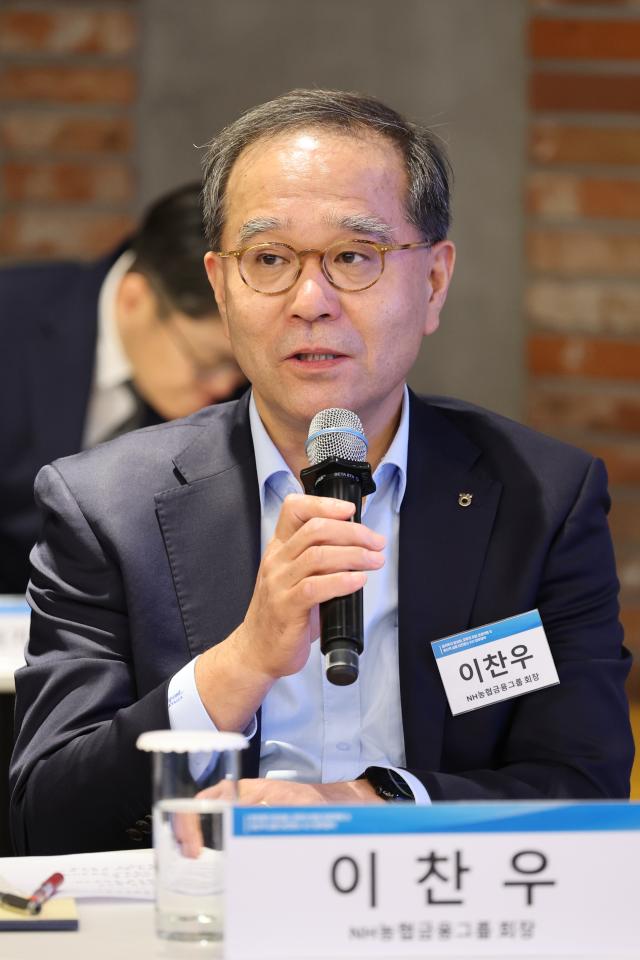
Upon taking office, Lee initiated a comprehensive overhaul, launching a 93 trillion won productive finance strategy, an AI-centered approach, and a complete internal control reform, aiming to shift NH Nonghyup from "managed finance" to "judgment finance." Yet, he faces significant challenges, including the cooperative's unique governance structure, repeated financial incidents, and capital outflow issues. The essence of Lee's leadership lies in the question: Can a bureaucrat skilled in macroeconomic design transform into a financial entrepreneur on the market battlefield?
[Viewing Finance Through a Macro Lens]
Understanding Lee Chan-woo's leadership begins with his perspective. He sees finance not just as an industry managing interest margins but as a tool for national economic resource allocation. His experience with the Ministry of Economy and Finance, the Financial Supervisory Service, and the World Bank has equipped him with the ability to read structures beyond the market. His clear diagnosis is that the Korean financial system can no longer sustain itself on an interest-centric model.
However, the challenge lies in the execution following this diagnosis. While macroeconomic bureaucrats excel at providing direction, a financial company's competitiveness stems from execution. The market does not wait; technology evolves rapidly, and competitors act swiftly.
Immediately after his appointment, Lee chose to visit the field rather than present a grand vision. He inspected the organization by visiting call centers and listening to employees' voices. This symbolic act represents a shift from "finance designed from above" to "finance operating on the ground." However, finance cannot simply be transformed by symbolism; structural changes are necessary.
Ultimately, Lee's first task is to translate his macro vision into actionable strategies. Can he connect macro judgments to actual capital allocation and organizational operations? If he cannot bridge this gap, his leadership will remain confined to policy language.
[Can Productive Finance Transform Beyond Declaration?]The core strategy of Lee's regime is the 93 trillion won productive finance initiative. He defines this not merely as a policy but as a transformation that redefines the role of finance.
This strategy's significance is clear: NH Nonghyup aims to move beyond stable, collateral-based lending and instead allocate capital to industries and technologies. From an entrepreneurial perspective, this represents a clear shift to "judgment finance," as it involves taking risks and investing in the future.
However, the challenge lies in the execution structure. Productive finance is not just about disbursing money; it requires decisions on which industries, which companies, and under what conditions to allocate capital. This process will inevitably involve failures, and finance is an industry that does not tolerate failure. This structural contradiction complicates the implementation of productive finance.
Moreover, NH Nonghyup's governance structure poses a significant challenge. Under the cooperative system, a portion of profits is transferred to the National Agricultural Cooperative Federation, limiting investment capacity. When capital is tied up, strategies cannot be executed. This represents a structural limitation that Lee's leadership must confront.
Therefore, the success of the 93 trillion won productive finance initiative hinges not on the amount but on its "quality." The key lies in how much capital flows into industries, how many new companies are nurtured, and how much long-term value is created.
This strategy is still in its early stages. However, one thing is clear: Lee is attempting to change finance. The question remains whether finance can keep pace with him.
[AI Strategy: Redesigning Decision-Making Structures, Not Just Technology]
Lee's AI strategy differs from that of traditional financial institutions. He views AI not merely as a tool for improving operational efficiency but as a system that expands financial decision-making capabilities. The three key phrases—"hyper-knowledge, hyper-automation, and hyper-personalization"—clearly illustrate this direction.
Notably, the establishment of a green credit judgment system is symbolic. It represents an attempt to incorporate ESG considerations into actual credit judgment processes rather than treating them as mere declarations. This reflects a change in decision-making structures rather than just technology.
However, the reality remains in its infancy. Like most financial institutions, NH Nonghyup primarily utilizes AI for customer service and internal task automation. While necessary, this is not sufficient.
The core of finance in the AI era is "who makes the decisions?" AI can analyze data and assess risks, but the final choice still rests with humans.
Thus, for AI to become a true competitive advantage, it must encompass risk assessment, capital allocation, and internal controls.
Lee understands this direction, but the organization has yet to keep pace with the required speed.
The AI strategy is not merely a technological issue; it is an organizational challenge. The structures of data, authority, and responsibility must change simultaneously.
When this transformation is complete, AI will finally become a "competitiveness" rather than just a "tool" in finance.
[Opportunities and Risks in Expanding Non-Bank Operations]NH Nonghyup's transformation is most evident in its non-bank sector. NH Investment & Securities has achieved record profits, driving group revenue. This is a positive sign.
Shifting from a bank-centric structure to a capital market focus is essential for a financial holding company. Especially in a declining interest rate environment, growth cannot be sustained through interest income alone.
However, the non-bank strategy is still incomplete. The underperformance of insurance subsidiaries and imbalances in revenue structures remain problematic. A concentration of profits in specific subsidiaries poses long-term risks.
An even greater issue is capital efficiency. Due to its governance structure, NH Nonghyup does not fully reinvest profits, limiting the pace of non-bank expansion.
Ultimately, the key to the non-bank strategy is not merely expansion but changing the revenue structure.
A structure that integrates securities, insurance, asset management, and digital finance is necessary. Lee has suggested this direction, but a structural transformation has yet to be achieved.
[Can Internal Controls and Capital Structure Overcome Real-World Barriers?]
The greatest test of Lee's leadership lies in internal controls. A financial incident involving 45 billion won is not just an isolated event; it reveals the organization's structural vulnerabilities.
He has emphasized a zero-tolerance principle and strengthened accountability structures. The introduction of accountability measures and enhanced internal controls are important steps. However, internal controls in finance cannot be completed through systems alone.
The issue lies in culture. When performance pressure and risk aversion operate simultaneously, organizations tend to conceal problems.
If this structure is not changed, incidents will recur.
Another practical barrier is the capital structure. The profit transfer structure to the National Agricultural Cooperative Federation limits investment capacity.
This is not merely a financial issue; it is a fundamental condition for executing strategies.
Ultimately, Lee's leadership converges on two key questions:
First, can he structure internal controls effectively?
Second, can he allocate capital freely?
If these two issues are not resolved, no strategy can be successfully completed.
[SWOT Analysis]Strengths
Lee Chan-woo is a strategic leader who understands both macroeconomics and financial systems. He has clearly defined directions, including the 93 trillion won productive finance initiative, AI strategy, and internal control reforms. His strong insight connects policy and market dynamics.
Weaknesses
Bureaucratic leadership may slow execution speed. Failures in internal controls and capital outflow structures present structural limitations. The non-bank portfolio remains imbalanced.
Opportunities
The expansion of AI finance, industrial finance, and capital markets presents structural opportunities for NH Nonghyup. In particular, productive finance could become a differentiated competitive advantage.
Threats
The cooperative structure, capital outflow, internal control risks, and intensified competition are major threats. Structural constraints pose the greatest risk.
* This article has been translated by AI.
Copyright ⓒ Aju Press All rights reserved.