
What is the oldest surviving language of international politics?
It is not the language of armies. Nor is it the language of money. More often than we admit, it is a bowl of noodles, a slice of roast duck, a cup of tea.
China has understood this for centuries. As Confucius taught in The Analects, “In the practice of ritual, harmony is the most precious.” Long before diplomacy became communiqués, sanctions and summit statements, Chinese civilization learned to read the other side across the table.
During U.S. President Donald Trump’s latest visit to Beijing, China once again displayed the subtle art of what may be called culinary diplomacy. At the final working luncheon hosted by President Xi Jinping, the signature dish was not an extravagant imperial delicacy. It was gongbao jiding — Kung Pao chicken, the famous Sichuan dish of diced chicken, chili peppers and peanuts.
On the surface, it is a familiar popular dish. But in Chinese diplomacy, food is never merely food. It is a code, a gesture, a message.
Kung Pao chicken is among the Chinese dishes most deeply rooted in American society. It recalls the long history of Chinese migrants who crossed the Pacific in the 19th century, working on railroads, in mines and on farms, carrying with them the flavors of home. Over time, its spicy yet approachable taste became part of America’s Chinese culinary imagination.
China placed that dish once again before Trump.
There was also a play on language. Trump’s Chinese name is often rendered as Chuanpu. Sichuan cuisine is known as chuancai. The resonance was unmistakable. The heat of Sichuan cooking and the blunt force of Trump’s political style were joined in a single diplomatic wink. It was diplomacy with humor; symbolism with seasoning.
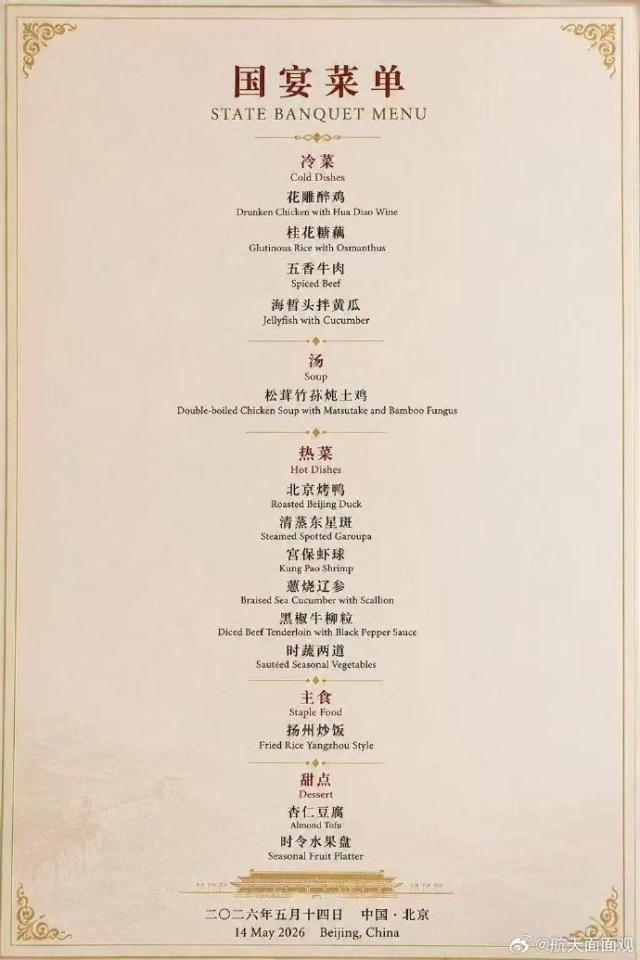
The state banquet held the previous evening at the Great Hall of the People was even more carefully designed. It was not a simple parade of Chinese classics. It preserved the dignity of Chinese cuisine while taking account of Trump’s palate, Western preferences and the habits of American hospitality.
The menu included Peking duck, one of the great emblems of Beijing. Roasted whole until the skin is crisp and the meat tender, Peking duck is not only a dish. It is a declaration of capital, court and civilization.
Alongside it came Cantonese lobster soup, crispy beef, low-temperature salmon with mustard sauce, Chinese pan-fried dumplings, conch-shaped pastries and, finally, tiramisu.
The composition was eloquent. Peking duck represented tradition and imperial memory. Cantonese seafood suggested openness and cosmopolitan refinement. Salmon with mustard sauce offered a Western note. Tiramisu gently extended the table toward Europe. Nothing was forced. East and West were not made to collide; they were arranged to converse.
In that banquet lay a miniature portrait of the U.S.-China relationship itself: rivalry, yes; but also interdependence, recognition and the impossibility of total separation.
Even the music carried meaning. American and Chinese songs were reportedly mixed in equal measure. Most strikingly, “YMCA,” a song often used at Trump’s campaign rallies, was played. Beijing had studied not only the American president’s office, but also his temperament, theater and personal symbolism.
The Art of War teaches that the highest form of victory is to win without fighting. Chinese diplomacy, at its most refined, sometimes designs a banquet table more precisely than a missile system.
Nor was this culinary diplomacy reserved for Trump alone.
When South Korean President Lee Jae-myung visited China earlier this year, Xi presented him with Beijing-style zhajiangmian. This was not the sweet, dark, Korean-style jajangmyeon familiar to Korean diners, but the saltier, earthier northern Chinese original. Xi reportedly encouraged Lee to taste the difference between the Chinese and Korean versions.
That was no casual remark. Jajangmyeon itself is a shared memory between Korea and China. It originated with Chinese migrants from Shandong and later evolved into a distinctly Korean comfort food. China knows this history. By placing the dish on the table, Xi was not merely offering noodles. He was offering a reminder that even amid rivalry and unease, the two countries share a civilizational memory.
For Russian President Vladimir Putin, the table changes again. Chinese banquets for Russian leaders tend to lean toward the hearty, the northern and the continental: richer meats, stronger flavors, lamb, duck, seafood prepared with weight and warmth, sometimes paired with Chinese baijiu and the Russian affection for vodka.
This, too, is not accidental. It conveys the symbolism of two great continental powers. The menu becomes a geography of Eurasia. It says: we are not maritime strangers; we are neighbors of the landmass.
When French President Emmanuel Macron comes to Beijing, the tone shifts once more. France treats cuisine as a pillar of national identity, and China responds accordingly. The table becomes more delicate, more aesthetic, more alert to wine, tea, seafood, dessert and the rituals of cultivated taste. China’s message to France is clear: China is not merely a factory of the world. It is also a civilization.
With German chancellors, the mood is different again. German political culture prizes order, restraint, reliability and function. Chinese hospitality in such settings often favors balance over spectacle: clean fish dishes, mushrooms, vegetables, restrained courses and structured pacing. It is a table of trust, stability and industrial seriousness.
Thus, in Chinese diplomacy, a meal is never just a meal. It is history, psychology, strategy and civilization arranged in courses.
China has long been a civilization of crossroads. Along the Silk Road passed merchants, monks, soldiers, envoys and ideas. At those crossings, China learned that to feed a guest is also to study him; to honor his taste is to measure his mind.
The Tao Te Ching says, “A great nation is like the lowland toward which all streams flow.” A truly great power must know how to receive, absorb and accommodate. At its best, China tries to enact that philosophy at the dining table.
None of this means that geopolitics has become gentle. The U.S.-China rivalry remains severe. Semiconductors, artificial intelligence, Taiwan, the South China Sea, tariffs and strategic mistrust continue to weigh heavily on the relationship. The world is not softened by duck skin, noodles or tea.
And yet, it matters that even adversaries still make room for respect at the table.
Trump eats Peking duck. Xi prepares a dish familiar to American Chinese culture. Lee tastes Beijing-style zhajiangmian. Putin is welcomed with the flavors of the northern continent. Macron is met through refinement and wine-like delicacy. German leaders are greeted with order, balance and restraint.
In the end, international politics is conducted by human beings. And human beings remember meals.
Perhaps the world order does not change only in summit halls, treaty rooms or military command centers. Perhaps it also changes quietly in the banquet rooms behind them — between a plate of Kung Pao chicken and a bowl of zhajiangmian, between Peking duck and a cup of tea, where nations still search, however cautiously, for a language more graceful than conflict.
[This column was written by AJP Special News Team -- Park Sae-jin, Kwak Joseph, Kim Dong-young, Kim Hye-jun, Han Jun-gu, and Bae In-seon reporting from Beijing]
Copyright ⓒ Aju Press All rights reserved.
