
U.S. stock indices closed mixed amid geopolitical risks in the Middle East and a sharp decline in semiconductor stocks, suggesting that the domestic market may enter a phase of increased short-term volatility. Following the KOSPI's historic breach of the 8000 mark, analysts note that profit-taking and concerns over Nvidia's earnings could limit the index's upward potential.
On May 18, the Dow Jones Industrial Average rose 0.32%, while the S&P 500 fell 0.07% and the Nasdaq dropped 0.51%. The Philadelphia Semiconductor Index plummeted 2.47%.
The market experienced significant fluctuations early in the session due to Middle Eastern risks, interest rate pressures, and profit-taking in tech stocks. However, President Donald Trump’s announcement to postpone military action against Iran helped ease the surge in U.S. Treasury yields, which in turn reduced the market's losses.
Sector-wise, weakness in technology stocks, particularly semiconductors, was prominent. Seagate's CEO highlighted at the JP Morgan conference that significant time is needed for new factories and equipment expansions, raising concerns about memory supply bottlenecks. Consequently, Seagate shares fell 6.87%, while Micron dropped 5.95%. SanDisk also declined by over 5%, reflecting widespread profit-taking in memory-related stocks.
Additionally, President Trump’s ambiguous messaging regarding Taiwan's defense during U.S.-China summit discussions has heightened concerns over the semiconductor supply chain. As pressures mount on semiconductor stocks, which had surged recently due to expectations of increased AI demand, investor sentiment in domestic semiconductor stocks may also be affected.
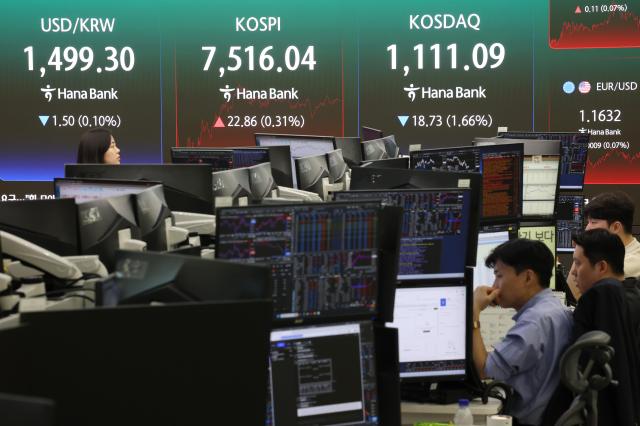
Despite the Nasdaq's sharp decline and rising U.S. Treasury yields on May 18, the domestic market showed relative resilience, recovering from early losses. The KOSPI dipped to around 7100 but closed at 7516.04, up 0.31%, bolstered by easing labor disputes at Samsung Electronics and an influx of bargain-hunting. In contrast, the KOSDAQ index fell 1.66% to 1111.09.
In the securities market, institutions and individuals net bought 1.39 trillion won and 2.21 trillion won, respectively, while foreigners net sold 3.65 trillion won. Samsung Electronics rose 3.88% following news that a court partially granted an injunction against illegal union activities, and SK Hynix increased by 1.15%. The electrical and electronics sector rose 2.01%, contributing to the index's rebound.
However, forecasts suggest that the domestic market may experience increased volatility centered around semiconductors due to the impact of the U.S. semiconductor stock decline. The MSCI Korea ETF fell 1.54%, and KOSPI night futures dropped 1.88%. The dollar-won exchange rate closed at 1500.30 won in the Seoul foreign exchange market before falling to 1492.90 won in after-hours trading.
Market observers are noting that the KOSPI's recent rapid ascent has been excessive. The KOSPI took only eight trading days to surpass the 8000 mark after breaking through the 7000 level on May 15. Given the unusually swift rise, there is a growing desire for short-term profit-taking.
Han Ji-young, a researcher at Kiwoom Securities, stated, "The market is currently sensitive to external factors such as rising U.S. 10-year Treasury yields and Middle Eastern risks, but fundamentally, the pressure from the speed of the KOSPI's rise is more significant after breaching the 8000 mark. We may frequently see increased intraday volatility for the time being."
Nevertheless, analysts largely view this adjustment as a process of speed regulation rather than a trend disruption. The KOSPI's 12-month forward price-to-earnings ratio (PER) stands at 8.1, which is not significantly burdensome compared to historical averages, and corporate profit momentum is improving. In fact, the KOSPI's 12-month forward earnings growth rate increased from 197% year-on-year in April to 214% in May.
Upcoming major events this week are expected to influence market direction. The Google I/O 2026 annual developer conference on May 19-20 and Nvidia's earnings announcement on May 21 are notable examples. If expectations for increased AI investment are reignited, the sentiment for recently adjusted semiconductor stocks could recover quickly.
Kim Ji-hyun, a researcher at Daol Investment & Securities, commented, "While profit-taking is occurring in tech stocks, the rotation within sectors is a positive sign. Although uncertainties remain regarding U.S.-Iran negotiations and interest rate pressures, the market continues to focus on earnings and AI growth potential."
Sung Han-young, a researcher at LS Securities, noted, "Global investment firms like Oppenheimer and UBS maintain that the long-term growth potential of AI semiconductors remains intact, but short-term, a portfolio strategy incorporating defensive sectors such as utilities, telecommunications, and pharmaceuticals is necessary."
While acknowledging the potential for increased volatility due to recent rapid gains, analysts advise that a strategy of gradual buying during corrections is more effective than reducing exposure to leading stocks. In particular, concerns about supply bottlenecks in the semiconductor sector may actually enhance pricing power, indicating that the trend of improving long-term performance remains valid.
* This article has been translated by AI.
Copyright ⓒ Aju Press All rights reserved.