
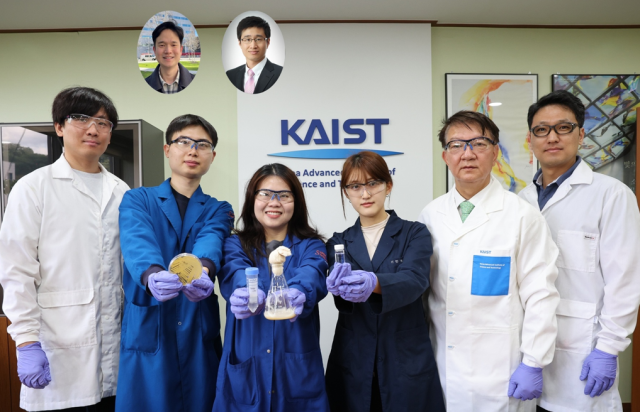
The need for alternative raw materials has increased due to soaring naphtha prices and supply instability in the petrochemical industry. This achievement is being recognized as a next-generation key technology that ensures both resource supply stability and environmental sustainability.
The technology developed by the Hanwha Solutions-KAIST Future Technology Research Institute utilizes glycerol, a byproduct of biodiesel production, as a raw material. The research team has developed high-efficiency microorganisms for producing 1,3-propanediol (1,3-PDO), a substance used in plastics and cosmetics, and has advanced the fermentation process to convert waste resources into high-value materials.
The research has progressed to the stage of practical industrial application. The team successfully demonstrated high productivity in a 300-liter pilot process, which is a precursor to large-scale production facilities. This success indicates that results achieved in the laboratory can be replicated in real-world processing environments.
Additionally, the research team applied a 'non-antibiotic process' that allows for stable raw material production without antibiotics, utilizing computer simulation-based 'digital design technology' to pre-design microbial metabolic processes. This approach has led to reduced production costs, mitigated environmental regulatory risks, and enhanced eco-friendliness.
This achievement is the result of collaboration that began in November 2015, exemplifying a successful industry-academia partnership that combines KAIST's research capabilities with Hanwha Solutions' commercialization expertise. The teams have filed six patents and published 13 papers through this eco-friendly bio-platform research.
Kim Jeong-dae, head of Hanwha Solutions' research institute, stated, "This research is significant as it confirms the potential to replace existing petrochemical processes using bio-based raw materials. We expect it to serve as an important foundation for sustainable chemical material production and industrial application in the future."
Lee Sang-yeop, a distinguished professor in the Department of Bio-Chemical Engineering at KAIST, remarked, "This research demonstrates that microbial-based chemical production can be scaled up from the laboratory to actual industrial levels, contributing to the more eco-friendly production of various chemical materials."
Meanwhile, Hanwha Solutions is collaborating with the Korea Energy Technology Institute and KAIST on key catalyst and process development as part of a national project led by the Ministry of Trade, Industry and Energy. Together with its affiliate Hanwha TotalEnergies, the company is also advancing commercialization validation and designing a commercial process with an annual capacity of 30,000 tons. In addition, it is concurrently developing bio-plastics and biodegradable materials to establish a plastic resource recycling ecosystem.
* This article has been translated by AI.
Copyright ⓒ Aju Press All rights reserved.