
Hancom has announced a special reward of up to 50 million won for employees who achieve significant work innovations using artificial intelligence (AI). This initiative goes beyond merely distributing generative AI tools; it aims to accelerate the company's overall AI transformation (AX) by providing performance bonuses and additional recognition for employees who successfully integrate AI into their work processes.
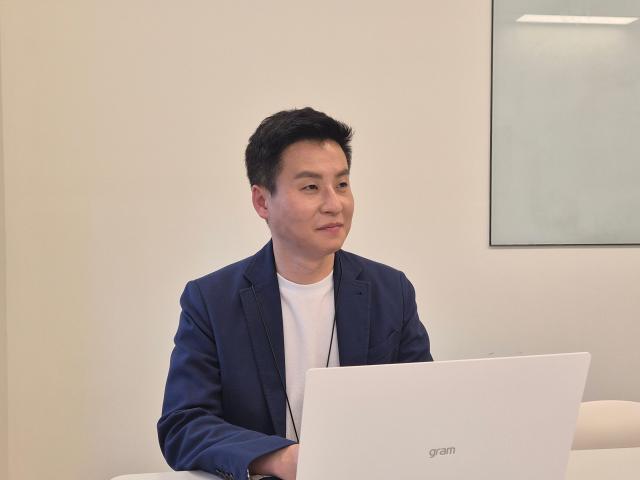
In an interview with Aju Economy at Hancom's headquarters in Seongnam, CISO Park Sang-hyung stated, "AX is not just about introducing AI tools; it represents a fundamental change in how organizations operate in the AI era. The key is to redefine how much work we delegate to AI and what roles and responsibilities we retain for ourselves."
Hancom is currently implementing a growth structure for AX that includes three stages: AI Crew, AX Challenger, and AX Champion. The first stage, AI Crew, allows anyone to freely share their AI experiences. The second stage, AX Challenger, involves executing actual work innovation projects.
The final stage, AX Champion, is awarded to employees who demonstrate outstanding AX results. Hancom provides AX Champions with a special bonus of 50 million won and additional recognition in performance evaluations. This approach is considered unusual in the industry as it integrates AI usage experience into the organizational culture and evaluation system rather than treating it as a mere internal event.
Park, who joined Hancom in 2013 as an infrastructure architect and later became a cloud architect, took on the role of CISO this year. Previously focused on designing the scalability and connectivity of infrastructure, he now also designs security and control structures suitable for the AI era.
He explained, "While the core challenge used to be how to connect systems and make processes flexible, the focus has now shifted to how to securely control those connections. In the AX environment, the priority is not to restrict AI adoption but to create a structure that allows for its safe utilization."
At the end of last year, Hancom declared a company-wide AX initiative, signaling a shift from its traditional image as an office software provider to a specialized AX company. This direction aims to redesign the entire organizational workflow and role structure around AI.
Park identified the main difference between digital transformation (DX) and AX as the "delegation of roles." He stated, "DX was about digitizing tasks previously handled manually to reduce errors and increase speed, while AX involves negotiating how much authority and responsibility can be safely transferred to AI within that DX environment."
He added, "We are currently in a transitional phase. There is still no complete societal consensus on how much decision-making and execution authority we can grant to AI. Ultimately, identifying the points where human intervention is essential is a key challenge for companies."
Within Hancom, AI is evolving from a simple assistive tool to a fundamental change in work processes. Initially, all employees were provided with the same AI chatbot environment, but now each department is developing AI agent structures tailored to their specific work characteristics.
The implementation process has not been easy. Park noted, "When we began reviewing tools, various departments were already actively using over 100 different AI tools. We believed that enforcing uniform control could lead to backlash from employees and issues with unauthorized external AI services."
As a result, Hancom opted for a hybrid strategy centered on actual business needs rather than a top-down approach. This involved first surveying employee demands and then concurrently evaluating functionality, security, cost, and corporate stability. He remarked, "The entire process from survey to actual implementation took only a month, as we recognized the importance of speed in the AI domain and made quick decisions."
"Finance Team Also Reviews Code"—AI Innovation Spreads Beyond Development Roles
Departments have adopted different approaches. The finance department focused on designing verification structures to reduce errors, prioritizing data accuracy to prevent AI from generating arbitrary outputs. In contrast, the content team approached the task by pre-designing prompts and execution structures to quickly produce desired outcomes.
Notably, changes in non-development roles have been significant. Park stated, "Tasks that previously required requests to the IT department are now being implemented directly by operational staff using AI agents. Currently, even employees in the HR and finance teams are considering which APIs to connect and how to structure workflows while reviewing code screens."
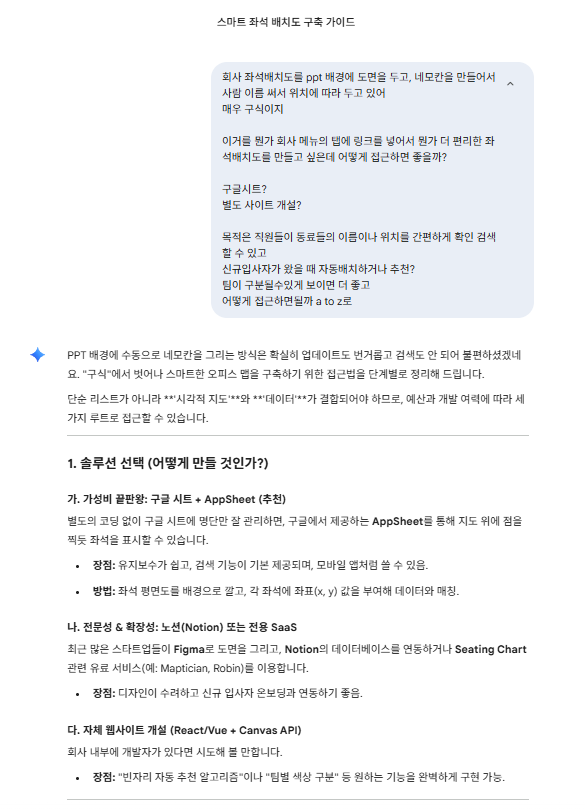
During Hancom's internal AX presentation event, known as AX Day, a case was shared where an HR team employee implemented an automated seating arrangement system using generative AI. This employee, lacking prior development experience, learned the necessary skills through extensive interaction with AI and completed the implementation without assistance from a separate development team.
Hancom is also systematically documenting employees' AX experiences through the "AX Practice Process," which has now accumulated over 750 cases. This documentation goes beyond simply stating, "AI was used"; it details how employees analyzed their work, what data they utilized, and the trials and errors they encountered throughout the process.
For instance, the documentation includes how a task that previously took 10 hours was reduced to under one hour after the introduction of an AI agent, along with potential future automation expansions.
Park emphasized, "We are not just improving productivity; we are accumulating the experience of utilizing AI as a colleague as an organizational asset. When employees in one team begin to achieve results with AX, it naturally influences other teams. Ultimately, AX is a cultural issue."
He concluded, "What matters is not which AI tools we use, but how we redefine work in the AI era. Hancom is experimenting and validating AX internally to create a new organizational culture for the AI age."
* This article has been translated by AI.
Copyright ⓒ Aju Press All rights reserved.