
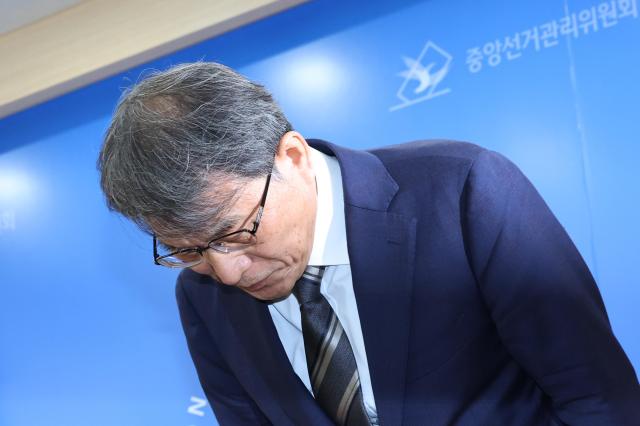
SEOUL, June 10 (AJP) - South Korea's election watchdog is facing growing scrutiny after it emerged that the minimum ballot-printing threshold for the June 3 local elections was lowered from 60 percent to 50 percent of registered voters through internal approvals without a formal commission meeting, a move that could be associated with the unprecedented ballot shortages.
The controversy has fueled calls for investigations and reforms amid ongoing blockade of a polling station in Seoul's Jamsil by hundreds of protesters demanding the invalidation of the June 3 election and a rerun, claiming they were effectively deprived of their voting rights because of a lack of ballots.
Documents submitted by the National Election Commission (NEC) to People Power Party lawmakers Kim Seung-soo and Kim Min-jeon showed that the commission revised its "Comprehensive Management Guidelines for the 9th Nationwide Local Elections" on Dec. 10 last year through approval by the secretary-general alone.
The commission also revised its "Election Procedure Manual for Public Officials Elections" on Dec. 24 through approval by the director of election policy, again without a formal meeting of commissioners.
Under the revised guidelines, the Songpa-gu Election Commission decided to print ballots equivalent to 50 percent of eligible voters in 25 neighborhoods, excluding Jamsil 3-dong and Jamsil 4-dong.
The agency denied any wrongdoing. A National Election Commission official told AJP that the decision had been made in accordance with existing regulations.
"It is true that the decision was made through the secretary-general's approval, but it was done in accordance with the regulations stated in the commission's Comprehensive Management Guidelines," the official said, adding that procedural legitimacy had been maintained.
The revelations came after ballot shortages disrupted voting at multiple polling stations during the June 3 local elections.
Songpa-gu, where some of the most severe shortages occurred, recorded a turnout of 65.8 percent, 2.2 percentage points higher than Seoul's average turnout of 63.6 percent. The district ranked fourth among Seoul's 25 districts, behind Seocho-gu, Seongdong-gu and Yangcheon-gu.
The NEC said the minimum ballot-printing threshold had been gradually reduced over the years, from 80 percent in 2009 to 70 percent in 2016 and 60 percent in 2021 before being lowered again to 50 percent for this year's election.
According to the commission, the reductions reflected rising early-voting rates, difficulties securing printing companies because of compressed production schedules, logistical challenges in inspecting and storing millions of ballots and concerns over the management of unused ballots.
The commission also argued that printing significantly more ballots than anticipated election-day turnout could fuel allegations of election fraud.
However, the commission acknowledged that it lacked detailed contingency guidelines for handling ballot shortages once they occurred, including procedures for emergency ballot redistribution and the division of responsibilities among election officials.
Ballot shortages have so far been confirmed at 91 polling stations nationwide, including 42 in Seoul, 23 in Gyeonggi Province, 11 in Incheon, four in Daegu, three in Busan, two each in Ulsan, South Gyeongsang Province and South Jeolla Province, and one each in North Chungcheong Province and North Jeolla Province.
The estimated number of insufficient ballots has also increased. The commission initially reported 4,726 missing ballots but revised the figure to 7,194 in documents submitted Tuesday to the office of People Power Party lawmaker Chung Hee-yong.
Voting was suspended for as long as 105 minutes at some affected polling stations, while authorities were unable to determine the exact duration of disruptions at three polling stations in Songpa-gu.
The controversy is now drawing judicial scrutiny.
The Seoul Eastern District Court conducted an on-site inspection Tuesday afternoon at the polling station in Jamsil 7-dong, Songpa-gu, where ballot shortages triggered one of the most serious disruptions during the June 3 election.
The court moved to secure evidence including a ballot storage box marked as containing 1,900 printed ballots and closed-circuit television footage showing ballot-box storage and handling at 10 polling stations in Songpa-gu between June 3 and June 5.
The evidence is expected to be sealed and transferred to a separate court facility for preservation.
The Jamsil 7-dong polling station became the focal point of the ballot shortage controversy after voting was disrupted by a lack of ballots, prompting an extension of voting hours and triggering a two-night, three-day blockade protest by hundreds of demonstrators demanding an investigation into the election.
The dispute is also spreading beyond the political arena.
Major university student councils plan to issue joint statements Friday condemning the ballot shortages and calling for institutional reforms.
Student councils from 16 universities, including Seoul National University Student Council, Yonsei University Student Council, Korea University Student Council and Hanyang University Student Council, are expected to release coordinated declarations on their campuses at 6 p.m. on the anniversary of the June Democratic Struggle.
The groups are expected to call for a parliamentary investigation and special counsel probe, punishment of those responsible, remedies for alleged violations of citizens' voting rights, structural reform of the National Election Commission and the establishment of a citizen-participation oversight body to monitor the reform process.
Copyright ⓒ Aju Press All rights reserved.
