
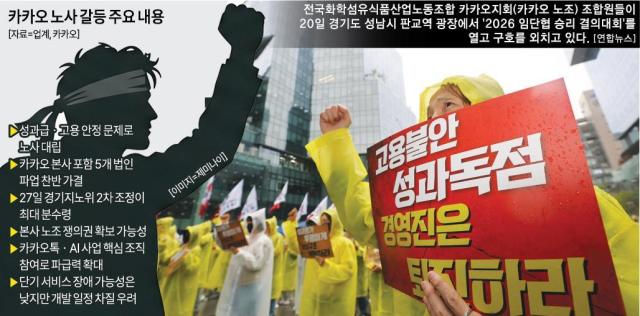
As labor disputes over bonuses and job security escalate, Kakao faces its first potential strike at its headquarters since its founding. The Kakao branch of the National Chemical Fiber Food Industry Workers' Union has approved a strike vote, increasing pressure on the company. The outcome of the second mediation session with the Gyeonggi Provincial Labor Relations Commission on May 27 is expected to be a critical turning point.
On May 21, the information technology (IT) industry reported that five Kakao subsidiaries, including Kakao Pay, Kakao Entertainment, DK Tech, and XL Games, held a "2026 Collective Bargaining Victory Rally" at Pangyo Station in Seongnam, Gyeonggi Province, where union members voted in favor of a strike.
The company and union extended the mediation period until May 27 after failing to reach an agreement during the first mediation meeting on May 18. If the second mediation also fails, the Kakao headquarters union will secure the right to strike. Some subsidiary unions have already obtained this right due to a decision to halt mediation.
The two sides remain divided over the performance compensation system and job security. The union argues that employees have significantly contributed to Kakao's profitability and therefore deserve fair performance distribution. The company, however, is cautious about increasing compensation due to uncertainties surrounding its investments in artificial intelligence (AI) and business restructuring.
During the rally, the Kakao union presented joint demands including: management reform and accountability, job security and community safety nets, fair performance compensation and profit distribution, and the establishment of universal labor conditions and welfare systems.
Industry observers note that the current actions of the Kakao union carry more weight than last year's events. The Kakao Mobility union had previously announced a phased strike following a breakdown in wage negotiations, conducting partial strikes of two and four hours. However, no further strikes occurred during the negotiation process.
In contrast, the current mobilization involves Kakao's headquarters and major subsidiaries, indicating a larger scale and potential impact. The Kakao headquarters oversees key operations related to KakaoTalk, advertising, commerce, and AI strategies, drawing significant industry attention. If a strike materializes, it could affect the stability of major services like KakaoTalk and the timeline for AI project development.
Unlike manufacturing, a strike at an IT company like Kakao is less likely to lead to immediate service disruptions. The platform operates on automated server systems and a continuous response organization, making it improbable that a short-term strike would paralyze services like KakaoTalk.
However, prolonged labor disputes could hinder the development of new services and project timelines. Kakao is currently transitioning KakaoTalk from a simple messaging app to an AI agent platform that integrates conversation, search, recommendations, and payments. A prolonged gap in development personnel could delay the rollout of new AI features and service enhancements.
Kakao Pay is also expected to maintain its payment and remittance services despite the strike. However, analysts suggest that operational stability and external trust could be affected. Kakao Enterprise and DK Tech, which handle cloud and AI-based business-to-business operations and internal development and support, may experience some impact on technical support, maintenance, and new project implementations if the strike continues.
Kakao has stated that it is focused on labor negotiations. A company representative said, "Since both sides agreed to extend the mediation period on May 18, we will continue to strive for a smooth agreement during the remaining time."
* This article has been translated by AI.
Copyright ⓒ Aju Press All rights reserved.