Impressive in isolation, the return however is paltry against the roughly 300 trillion won Koreans now hold in Wall Street, a record set this month despite migration to Seoul.
The Reshoring Investment Account, or RIA, held a cumulative 1.94 trillion won across 242,856 accounts as of Tuesday, up about 1.02 trillion won a month earlier, the association said.
The account was introduced on March 23 as part of a package of currency-stabilization measures, offering investors who sell foreign stocks and reinvest at home a temporary exemption from the 22 percent capital gains tax on overseas equities, capped at 50 million won in sale proceeds per person.
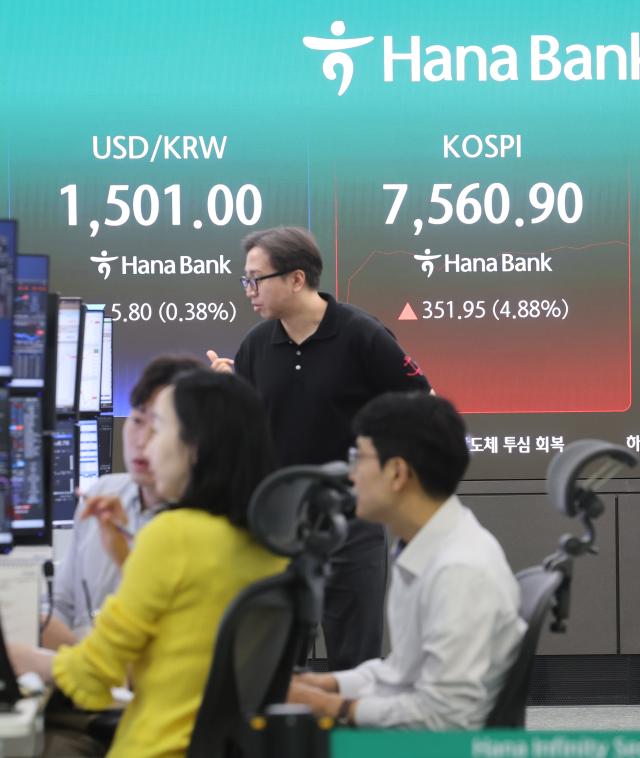
The U.S. dollar hovering above 1,500 won suggests the account scheme has helped little to bolster the local currency.
The flows show a clear rotation out of U.S. big tech and into Korean semiconductors.
From the program's launch through May 8, RIA users sold the most Nvidia, at 180.1 billion won, and Tesla, at 50.4 billion won, along with leveraged products such as the Direxion Daily Semiconductor Bull 3X fund.
Their favorites were Samsung Electronics at 78 billion won and SK hynix at 66.7 billion won, with index funds such as the KODEX 200 also among the top buys. Of the total balance, 1.21 trillion won has moved into domestic assets.
The scale relative to overseas holdings underscores how early the shift remains.
When the account held about 1.02 trillion won in late April, that represented roughly 0.38 percent of the 260 trillion won Koreans then held in U.S. stocks, and the average account balance of 6.36 million won was just 12.7 percent of the per-person cap.
By mid-May, total Korean holdings of U.S. stocks had climbed to a record $200.3 billion, or about 300 trillion won, as AI and chip strength drew fresh money back to Wall Street even as RIA channeled some of it home.
Older investors have led the inflows, reflecting larger accumulated overseas portfolios and bigger tax bills to shelter.
As of May 8, Koreans in their 40s made up 31 percent of RIA holders and those in their 50s 26 percent, together a majority, followed by investors in their 30s at 21 percent and those 60 and older at 12 percent. By balance, investors in their 50s held 32 percent and those in their 40s 27 percent, nearly 60 percent of the total between them.
The benchmark KOSPI has shot up nearly 80 percent this year, while the U.S. dollar rose nearly 5 percent to 1,506.8 won as of Wednesday from December-end.
Korean retail net purchases of U.S. stocks had fallen to about $400 million in the first 20 days of March, roughly one-tenth of January's $5 billion, before reversing again in May.
The incentive however loses appeal from next month. The capital gains deduction is 100 percent through the end of May, but they fall to to 80 percent from June through July and 50 percent from August through year-end, after which the program is set to expire.
Because overseas trades carry a gap between execution and settlement, investors seeking the full exemption must complete settlement by the end of May. Only stocks held as of December 23, 2025 qualify, and proceeds must remain in domestic stocks, equity funds or deposits within the account for one year after settlement to avoid a clawback of the benefit.
"The Reshoring Investment Account is significant in that it created an occasion for liquidity that had stayed in overseas markets to flow into the domestic capital market," said Han Jae-young, a department head at the association. He said the body would continue working with the industry to develop attractive domestic products so the account can serve as a channel for currency stability and productive finance.
Copyright ⓒ Aju Press All rights reserved.