
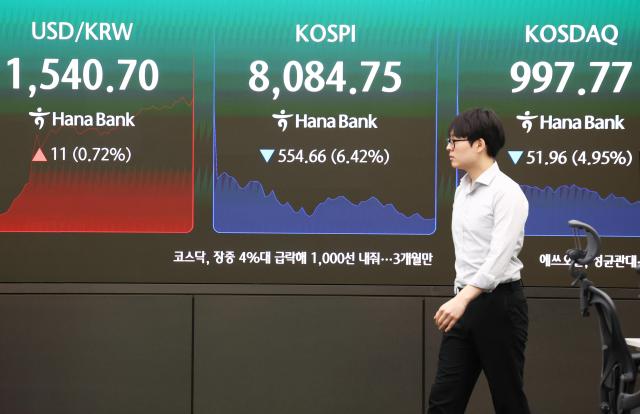
One of the most intriguing aspects of South Korea's economy in 2026 is the strange divergence between the KOSPI index and the won-dollar exchange rate. South Korea is currently regarded as the biggest beneficiary of the semiconductor supercycle. With the AI revolution in full swing, the world's largest AI companies are eagerly purchasing Korean HBM and memory semiconductors. Samsung Electronics and SK Hynix have reported record earnings, and both companies have joined the $1 trillion market capitalization club. The country's current account surplus has reached an all-time high, and the KOSPI has entered a historic upward phase.
Despite this, the won has not escaped a level of weakness akin to that seen during financial crises. This phenomenon is difficult to understand from a common-sense perspective. Typically, when exports increase and current account surpluses expand, corporate profits surge, leading to a stronger currency. Japan and Germany have experienced this, as has South Korea in the past.
However, South Korea is currently exhibiting the opposite trend. While AI semiconductor exports are at an all-time high, the won is fluctuating around 1,500 per dollar. The economy is booming, yet the exchange rate reflects a crisis-like situation.
This is the point that the Financial Times has highlighted. In a recent in-depth analysis, the FT described the weakness of the South Korean won as a "fundamental puzzle." Brad Setser, a senior fellow at the Council on Foreign Relations, also noted that it is difficult to explain why one of the biggest beneficiaries of the surge in semiconductor demand is still trading at crisis-level exchange rates.
Indeed, the question raised by the FT is crucial. One of the most pressing questions for the South Korean economy is this: Why is the won not strengthening despite selling the world's best semiconductors?
The FT identifies two key reasons for this situation.
The first is the phenomenon of global capital rebalancing. Since last fall, the South Korean stock market has seen explosive growth. Amid expectations for the AI semiconductor supercycle, the entire market surged, particularly driven by Samsung Electronics and SK Hynix. The issue is that this rise has been too rapid. Global funds are wary of excessive concentration in specific countries or stocks. When a stock exceeds its weight in global indices like MSCI, funds must sell some shares for risk management.
According to the FT, foreign investors have sold a record $79 billion worth of South Korean stocks this year. This is not due to a downturn in the South Korean economy; rather, it is because the economy has improved too much. As the KOSPI surged, it exceeded global asset allocation benchmarks, leading to a flood of portfolio adjustments.
Foreign investors who sold stocks convert their won into dollars to repatriate their funds. This naturally exerts downward pressure on the won. A paradoxical situation has emerged where the stronger the South Korean economy becomes, the weaker the won appears in the short term.
The second reason, which the FT considers even more significant, is the so-called "DRAM dollar" phenomenon.
Setser likens South Korea's situation to the petrodollars of Middle Eastern oil-exporting countries. In the past, these countries earned vast amounts of dollars from oil exports but often reinvested that money in U.S. financial markets rather than bringing it back home. This created a unique cyclical structure in international finance.
Setser believes a similar situation is occurring in South Korea today. Samsung Electronics and SK Hynix are generating substantial dollars from AI semiconductor sales. However, unlike in the past, they are not bringing all of these dollars back to the country. Instead, they are holding a significant portion in foreign currency for investments in U.S. data centers, overseas research and development, global mergers and acquisitions, and the expansion of overseas production facilities.
Previously, when export companies earned dollars, they would convert them to won and bring them back to the domestic market. This process increased demand for the won and lowered the exchange rate. However, today’s global companies operate differently. They use the dollars earned abroad directly overseas. As a result, even when a current account surplus occurs, it does not translate into a stronger won.
This is the "DRAM dollar" phenomenon mentioned by the FT.
As AI semiconductor exports increase, the dollars that remain overseas also grow. While the South Korean economy records a surplus, the won does not strengthen. This represents a new phenomenon that is difficult to explain using traditional economic textbooks.
Additionally, the ongoing conflict in the Middle East is also impacting the situation. Rising international oil prices due to the Iran conflict increase South Korea's energy import burden. Furthermore, the won has a high correlation with the yen, which has also been experiencing weakness recently. These external factors are further amplifying the downward pressure on the won.
However, as the FT points out, the current weakness of the won shows a significant disconnect from economic fundamentals. The current account is at an all-time high, semiconductor companies are earning record profits, and the growth outlook for the South Korean economy is being revised upward. Yet, the won remains at crisis-level lows, indicating that the market is grappling with an imbalance that could be corrected at any moment.
When will the won begin its recovery? Many experts predict a potential strengthening of the won in the future.
Investment professionals cited by the FT share a common view that the current exchange rate levels are unlikely to be sustainable in the long term. The reason is straightforward: the economic fundamentals are too strong.
South Korea is currently the biggest beneficiary of the AI semiconductor supercycle. As long as investments in generative AI and data centers continue, the demand for HBM and memory semiconductors is likely to structurally increase. Profits for Samsung Electronics and SK Hynix are also expected to remain high for the foreseeable future.
More importantly, there is the expectation surrounding the exchange rate. If companies believe the won will continue to weaken, they will hold onto their dollars. However, at some point, if signals of a strengthening won emerge, the situation could change dramatically. There could be a sudden movement to repatriate dollars that were previously held abroad.
This is the aspect the FT has highlighted. Once a transition to a stronger won begins, there could be a surge in dollar repatriation by large corporations like Samsung Electronics and SK Hynix, potentially leading to a self-reinforcing cycle that further strengthens the won.
This could create a reverse domino effect. Currently, the weakness of the won encourages dollar holdings, but the moment the direction shifts, there could be a simultaneous surge in dollar selling and won buying.
The Taiwanese dollar is in a similar situation. As AI semiconductor exporting countries, both South Korea and Taiwan are currently viewed as having currencies that are excessively undervalued compared to their economic fundamentals. Therefore, it is not out of the question that both the won and the Taiwanese dollar could enter a strengthening phase within the next few years.
It is now time to change the structure of the exchange rate. Financial authorities are also closely monitoring this phenomenon.
The Bank of Korea recently assessed that the won is excessively weak compared to economic fundamentals and stated that it could take decisive action if necessary. However, short-term market interventions have their limits. More importantly, structural responses are needed.
First, systems must be established to ensure that profits earned abroad are linked to domestic investment and employment.
Second, the capital market must continue to be advanced so that global investors can view the South Korean market more long-term.
Third, the internationalization of the won and the opening of the foreign exchange market must be expanded to enhance the won's status.
Fourth, strategies are needed to connect the boom in AI semiconductor exports to the overall national economy through investments in data centers, power grids, and AI infrastructure.
Ultimately, the current weakness of the won may not signal a crisis but rather a transitional phenomenon as South Korea's economy enters a new phase. In the past, South Korea was a country that earned dollars through exports. Today, it has become a nation that operates dollars as a global asset within the core supply chain of the global AI industry.
The "DRAM dollar" phenomenon mentioned by the FT may be another sign that the South Korean economy is transitioning to a developed-country structure. The key challenge is to ensure that this massive boom in AI semiconductors translates into national competitiveness and improved income for citizens, which is a more pressing task than simply achieving a stronger won.
* This article has been translated by AI.

Copyright ⓒ Aju Press All rights reserved.