
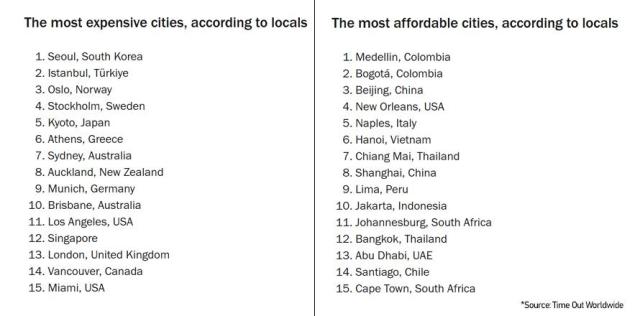
Seoul now "feels like the most expensive city in the world," ahead of Tokyo and London, according to a recent British Time Out survey that asked residents in 100 global cities to assess their cost of living. Only 30 percent of respondents in Seoul said they could afford dining out, while just 43 percent said they could comfortably buy a cup of coffee.
The ranking places Seoul above Istanbul, Türkiye, where annual inflation stood at 31 percent in November. Korea's consumer price index rose a far more modest 2.4 percent in the same month.
The won ended last year at 1,472 per U.S. dollar, sharply weaker than 1,288 at the close of 2023 and 1,264.5 in 2022, amid political turmoil and capital outflows after a disgraceful martial-law stunt.
Despite strong exports and a record current-account surplus, the currency still hovers around 1,480 per dollar and is set to average at its weakest ever for this year.
Korea's real effective exchange rate (REER) — which measures currency strength against a basket of trading partners, adjusted for inflation — fell to 87.05 in November, approaching 85.47 in the wake of the global financial crisis and 86.63 recorded during the 1998 IMF bailout.
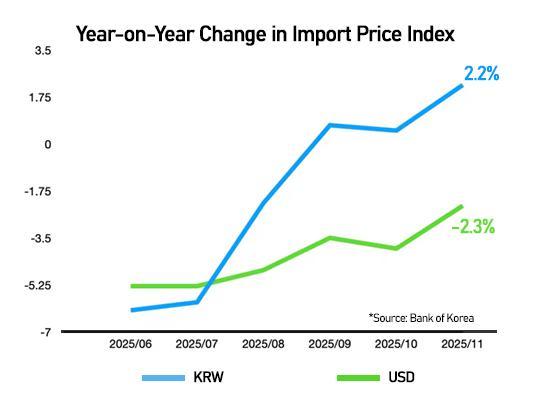
The weak currency is feeding through to import costs. The import price index rose 2.6 percent in November, the fastest increase in 19 months, according to the Bank of Korea (BOK). While import prices fell 2.3 percent year on year in U.S. dollar terms, they rose 2.2 percent in won terms.
Such price pressures are weighing on already-fragile domestic demand.
A survey by the Korea Chamber of Commerce and Industry of 300 retail companies nationwide projected retail sales growth of just 0.6 percent next year, which would mark the weakest performance in five years.
The chamber cited shrinking consumer sentiment, high inflation, intensifying competition, and heavy household debt as the main drags. Nearly 68 percent of respondents pointed to weak consumer confidence, while 46.5 percent cited inflation.
Spending data show early signs of strain. Family expenditure on education fell 0.7 percent in the third quarter, the first quarterly decline in five years. Education is typically one of the last areas that Korean households cut back on.
"The foreign exchange market is still dominated by concerns about further depreciation rather than a reversal," said Park Sang-hyun, an analyst at iM Securities.
The BOK last month raised its inflation forecast for next year from 2.0 percent to 2.1 percent, warning that if the exchange rate remains around 1,470 per dollar, inflation could reach 2.3 percent.

Copyright ⓒ Aju Press All rights reserved.
