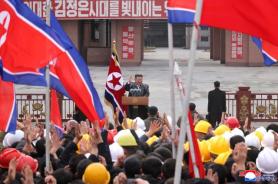
He also said the North has "nothing to discuss with [the South] and will exclude it from the category of compatriots forever."
However, Kim showed a different stance on the U.S., as state media quoted him as saying, "We have no reason not to get along with the United States if it respects our country's current status, as defined in the North Korean constitution, and drops its hostile policy toward North Korea."
"The prospects of North Korea-U.S. relations entirely depend on the attitude of the U.S.," he also said. "Whether it's peaceful coexistence or eternal confrontation, we are prepared for both, and the choice is not ours."
This appears to reflect the isolated country's typical strategy of engaging with the U.S. while sidelining the South.
But given the current Middle East conflict that began with last Saturday's U.S.-led airstrikes against Iran under the military operation dubbed "Operation Epic Fury," possible talks between the U.S. and North Korea, which many pundits had earlier speculated about ahead of U.S. President Donald Trump's planned trip to China later this month, now seem unlikely.
Justifying the military operation that killed Iran's Supreme Leader Ayatollah Ali Khamenei, Trump said, "Our objective is to defend the American people by eliminating eminent threats from the Iranian regime, a vicious group of very hard, terrible people. Its menacing activities directly endanger the United States, our troops, our bases overseas, and our allies throughout the world."
Just a day after the U.S.-led military operation, North Korea condemned the U.S. and Israel, calling it a "war of aggression" and a "shameless rogue act."
"Such acts of aggression cannot be justified by any means and can never be tolerated under any circumstances," a North Korean Foreign Ministry spokesperson was quoted as saying in a statement released by the state-run [North] Korean Central News Agency (KCNA).
Since former U.S. President George W. Bush labeled Iran, Iraq and North Korea an "axis of evil" in January 2002, the U.S. has waged a sustained war on terror. It toppled Iraq's Saddam Hussein and Libya's Muammar Gaddafi, and carried out precision strikes on three key Iranian nuclear facilities in June last year.
With Iran continuing to refuse U.S. demands to ship its enriched uranium abroad - despite having had its nuclear facilities severely damaged, Trump took the drastic measure, risking being drawn deeper into a conflict in the already volatile region.
The U.S. appears to have concluded that Iran's nuclear program had reached a point where it could no longer be left unchecked, posing a threat to both U.S. and regional security. Trump also seems to have acted swiftly to prevent the situation from escalating into an even more dangerous nuclear standoff by allowing Iran's program to advance further.
These developments are likely to heighten pressure on Kim. By removing Iran's supreme leader, just two months after detaining Venezuelan President Nicolás Maduro and his wife early this year, Trump showed that his "FAFO" warning, which stands for "fool around and find out," was not empty.
But it would be contradictory for the Trump administration to engage with North Korea while recognizing it as a nuclear-armed state, making talks between the U.S. and North Korea unlikely anytime soon.
Concerns are also growing that a military option could be considered as a last resort to address North Korea's nuclear program, as the U.S. has previously considered striking North Korean nuclear facilities.
After North Korea withdrew from the Nuclear Nonproliferation Treaty (NPT) in 1993 and appeared to be moving toward reprocessing spent fuel rods from its reactor to produce nuclear weapons in Yongbyon, the U.S. considered a "precision strike" or a "surgical strike" the following year.
William Perry, the then-Defense Secretary who reviewed the option, later recalled that it was not carried out over fears that North Korea might retaliate against South Korea, consequences that would have been difficult to call "surgical."
The U.S. would have to take different approaches to nuclear threats from Iran and North Korea, given their differing geopolitical situations and other factors. Iran lacks a major power to back it, while North Korea borders China and Russia, both of which are its traditional allies. Another factor is that North Korea can effectively hold South Korea "hostage."
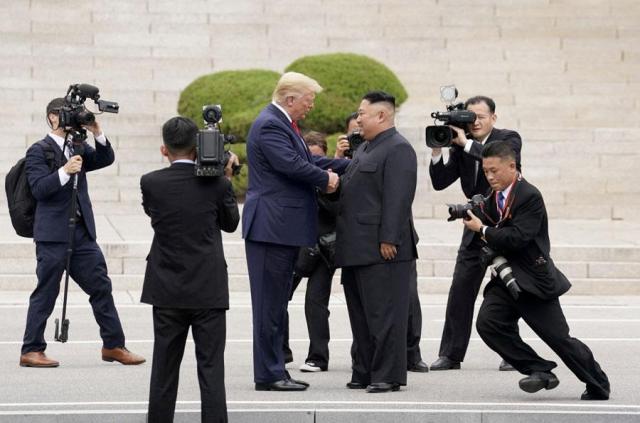
Believing an agreement could be reached through direct negotiations with North Korea's top leader, the U.S. struck deals at every nuclear crisis, helping avert military conflict on the Korean Peninsula, but failing to stop North Korea from advancing its nuclear arsenal.
Choosing a military option to denuclearize North Korea would likely trigger a full-scale war and mutual destruction. President Lee Jae Myung has said, "No matter how expensive, peace is better than war."
Both Trump and Kim adhere to "peace through strength," making diplomatic efforts essential to prevent a clash, and South Korea, as Lee suggested, may be best placed to serve as a "pacemaker" between them.
For now, as Lee said in his address marking March 1 Independence Movement Day last Sunday, South Korea should "communicate closely with the U.S. and neighboring countries so that dialogue between the U.S. and North Korea can resume as soon as possible."
With the world growing more unpredictable, South Korea cannot afford to let geopolitical risks intensify on the Korean Peninsula.

Copyright ⓒ Aju Press All rights reserved.