
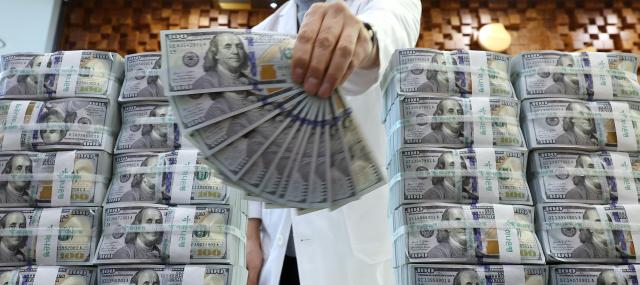
According to the Bank of Korea, foreign-currency deposits held at domestic banks totaled $103.55 billion at the end of November, up $1.71 billion from a month earlier. Dollar-denominated deposits rose $1.96 billion, while euro deposits increased $390 million. Yen deposits fell $500 million amid weakness in the Japanese currency.
The dollar strengthened to 1,470.8 late November, approaching last year's year-end high of 1,472.5 won last year amid martial-law shock. It hovered around 1,480 won throughout December before retreating to 1,440 won range from last week on dollar-selling hedging accompanied by strong verbal connection to bring down the year's closing exchange rate.
The central bank said the rise in dollar holdings reflected corporate trade settlements, inflows from foreign-currency bond issuance, and temporary placements of funds set aside for external debt repayment. Euro deposits also rose on trade-related inflows.
Market participants said the buildup of dollar and euro deposits points to expectations of prolonged weakness in the Korean won, rather than short-term hedging behavior.
The currency’s trajectory in 2025 underscores a broader structural shift. The won traded near 1,350 per dollar in June, before weakening steadily into the 1,470 range in October and November, touching 1,472 on Dec. 9. Toward year-end, a combination of verbal intervention by authorities and hedging-related flows helped pull the exchange rate back toward the 1,440 level.
The dollar closed the year at 1,445.75 won, but on an annual basis, it is projected to have averaged around 1,420 won for 2025. The previous average high of the pair was 1,394.9 won in 1998, during the Asian financial crisis and the IMF bailout period.
The renewed focus on foreign-currency holdings comes as debate intensifies over whether Korea’s liquidity conditions have contributed to the won’s structural weakness.
The Bank of Korea separately on Tuesday unveiled a comprehensive revision of its monetary and liquidity statistics, aimed at better reflecting financial-market realities and aligning with international standards.
Under the revised framework, the central bank narrowed the definition of broad money (M2) by excluding investment fund units with high price volatility, while newly including certain short-term instruments such as issuance notes and CMA products issued by large investment banks. The revision also reorganizes institutional classifications and improves data coverage to better capture actual liquidity conditions.
As a result of the methodological change, October 2025 M2 under the new standard stood at 4,056.8 trillion won, down 409.5 trillion won, or 9.2 percent, from the previous definition. The BOK said the decline reflects classification changes rather than an abrupt contraction in liquidity.
Under the revised methodology, M2 growth in October stood at 5.2 percent year on year, below its long-term average, suggesting that headline money growth in recent years may have overstated underlying monetary expansion. The central bank said the new framework better distinguishes between transactional money and investment-type assets, improving the analytical usefulness of monetary indicators.
Amid growing debate over whether rapid M2 growth is fueling asset inflation and foreign-exchange volatility, the central bank last month said it would revise its monetary statistics.

Copyright ⓒ Aju Press All rights reserved.
