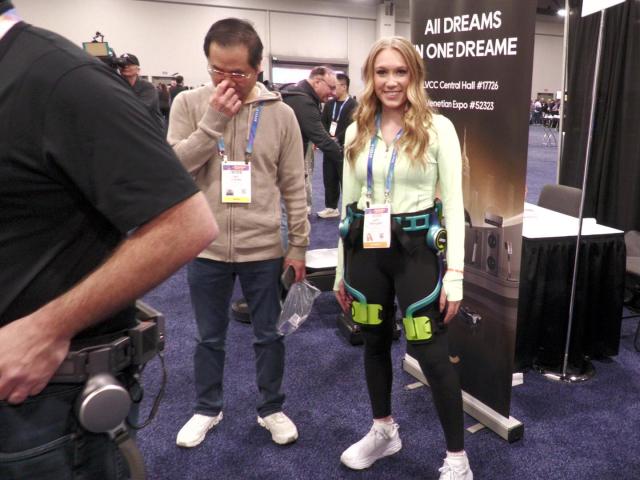
LAS VEGAS, January 04 (AJP) - As the world’s largest technology exhibition CES 2026 opens on Jan. 6 in Las Vegas, competition around robotics and physical AI is expected to intensify. With artificial intelligence expanding beyond software into hardware, robotics has moved to the center of the show’s technology landscape, and Chinese companies are set to play a more visible role this year.
According to the Korea Information and Communication Technology Association (KICTA), about 4,300 companies are participating in CES 2026. Of these, 942 are Chinese firms, accounting for roughly 22 percent of all exhibitors, the second-largest national presence after the United States. South Korea ranks third with 853 participating companies. While the overall numbers remain close, attention is increasingly shifting toward how heavily companies are concentrating on robotics-related exhibits.
Chinese firms make up 149 of the 598 exhibitors participating in the robotics category, representing nearly one quarter of the total. Their displays span humanoid robots, embodied robots, and hybrid models that combine bipedal and wheeled mobility. Many Chinese companies are presenting products intended for commercialization rather than concept demonstrations, placing emphasis on practical deployment and near-term use cases.
This momentum is closely tied to China’s industrial policy direction. The Chinese government has designated 2025 as the first year of humanoid robot commercialization and has supported the sector through national roadmaps, large-scale investment funds, tax incentives, and policy-based financial programs. CES 2026 provides a venue where these efforts are reflected through product launches and live demonstrations.
Interest is also building around individual Chinese robotics companies participating in the show. CES 2026 features firms such as UBTECH and Fourier Intelligence, alongside Unitree, which has gained attention for advancing both quadruped and humanoid robots toward commercialization. Unitree has focused on relatively lower pricing and rapid development cycles, expanding its presence in research and industrial markets overseas. The company is expected to conduct live demonstrations during the exhibition.
South Korean companies are approaching the robotics competition from a different angle. Although their overall participation level is comparable to China’s, fewer domestic firms are emphasizing complete robot hardware systems. Instead, strengths are concentrated in AI software, sensors, semiconductors, and key components. While many South Korean companies have received CES Innovation Awards, their robotics presence reflects a more selective and targeted focus.
Among major exhibitors, Samsung Electronics is taking a measured approach. Rather than competing through large-scale public demonstrations, the company plans to engage clients and partners through private exhibitions, presenting an integrated technology stack spanning AI data centers, on-device AI, and physical AI. The emphasis is placed on platforms and ecosystems rather than individual robot products.
Copyright ⓒ Aju Press All rights reserved.