
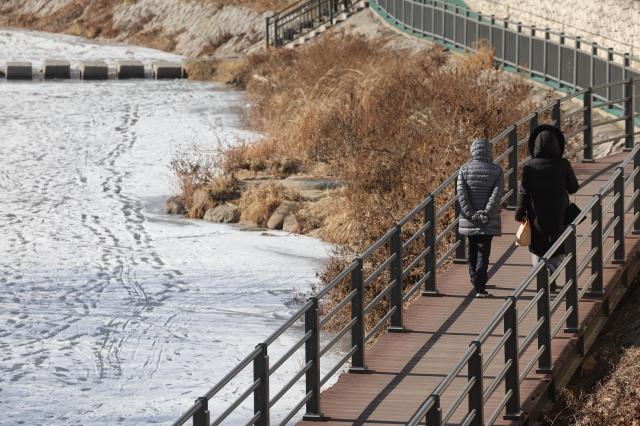
Morning lows are forecast at minus 15 to 3 degrees Celsius (5 to 37 degrees Fahrenheit), with daytime highs of minus 3 to 7 C (27 to 45 F). That is colder than seasonal averages of minus 12 to 0 C (10 to 32 F) in the morning and 1 to 8 C (34 to 46 F) in the afternoon.
Cold wave warnings remain in effect for Gyeonggi Province, inland and mountainous Gangwon Province, inland Chungcheong, and inland and northeastern mountainous areas of North Gyeongsang Province. In those areas, morning temperatures are expected to hover around minus 10 C (14 F), with daytime temperatures staying below freezing. Winds will be somewhat stronger, making it feel even colder.
Snow or rain is expected on Jeju Island from the afternoon into the night. Forecast snowfall is 1 to 5 centimeters (0.4 to 2 inches) in Jeju’s mountains and less than 1 centimeter (0.4 inch) in mid-mountain areas.
Along the west coast of North and South Jeolla provinces, some areas may see flurries from early morning through the morning. Where snow is on the ground or newly falling, roads may be slippery, with icy patches and black ice widespread. Drivers are urged to use extra caution.
Dry weather advisories are in place for Seoul; parts of inland Gyeonggi; central and southern inland Gangwon; Gangwon’s east coast and mountains; the eastern coast of South Jeolla; and the Gyeongsang region. With strong winds, officials urged heightened vigilance against fires.
Fine dust levels are expected to be “good” nationwide due to clean northwesterly airflow and favorable atmospheric dispersion. Seas are forecast at 1.0 to 3.5 meters (3.3 to 11.5 feet) in the East Sea, 0.5 to 2.0 meters (1.6 to 6.6 feet) in the Yellow Sea, and 0.5 to 1.5 meters (1.6 to 4.9 feet) in the South Sea. In offshore waters about 200 kilometers (124 miles) from the coast, waves are expected at 1.0 to 3.5 meters (3.3 to 11.5 feet) in the East and Yellow seas and 1.0 to 2.5 meters (3.3 to 8.2 feet) in the South Sea.
* This article has been translated by AI.
Copyright ⓒ Aju Press All rights reserved.