
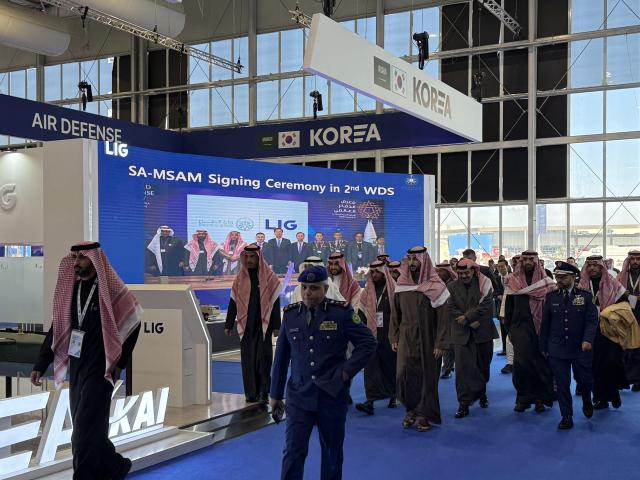
The coordinated push is centered on the World Defense Show (WDS), running from Feb. 8 to 12 in the Saudi capital. The event is the region’s largest integrated defense exhibition and a key platform for securing long-term export contracts and industrial partnerships.
This year’s show has drawn record participation from Korean companies, reflecting Seoul’s ambition to position itself as a major supplier in a region long dominated by U.S. and European arms makers.
Major manufacturers, including Hanwha Aerospace, Hyundai Rotem, LIG Nex1 and Korea Aerospace Industries (KAI), are showcasing their systems. In particular, HD Hyundai Heavy Industries, LIG Nex1, KAI and EO System have jointly operated a combined booth, highlighting what industry officials describe as a “one-team” approach.
The strong showing comes as defense budgets across the Middle East and Africa surge amid intensifying security threats and delayed modernization programs.
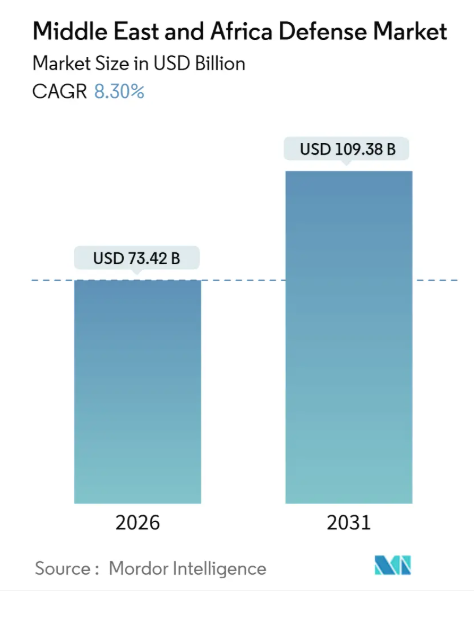
The broader Middle East and North Africa region already accounts for roughly 27 percent of global major arms imports, according to the Stockholm International Peace Research Institute (SIPRI). Qatar, Saudi Arabia, Egypt and Kuwait rank among the world’s top 10 importers.
Strategic analysts say recent regional tensions have reinforced these trends. The Israel–Hamas war, clashes between Israel and Hezbollah in Lebanon, and continued friction involving Iran and its proxies have all contributed to rising military spending.
SIPRI estimates that Middle Eastern military expenditure reached $243 billion in 2024, up 15 percent from the previous year. Demand is growing for long-range strike systems, integrated air and missile defense, and naval security—areas in which Korean firms have already built export track records in Europe and Asia.
For Korean exporters, a crucial shift is under way. Gulf and North African buyers, long dependent on U.S. and European suppliers, are increasingly diversifying their sources, pairing high-end Western platforms with more cost-effective alternatives.
At the same time, localization and technology-transfer requirements are intensifying under national strategies such as Saudi Arabia’s Saudi Vision 2030, which aims to raise domestic defense procurement to 50 percent of total spending by the end of the decade.
Korean firms, which have demonstrated co-production and technology-sharing models in Poland, are now promoting similar frameworks in the Middle East.
A notable feature of this year’s WDS is the way Korean companies are presenting themselves as integrated solution providers rather than stand-alone exporters.
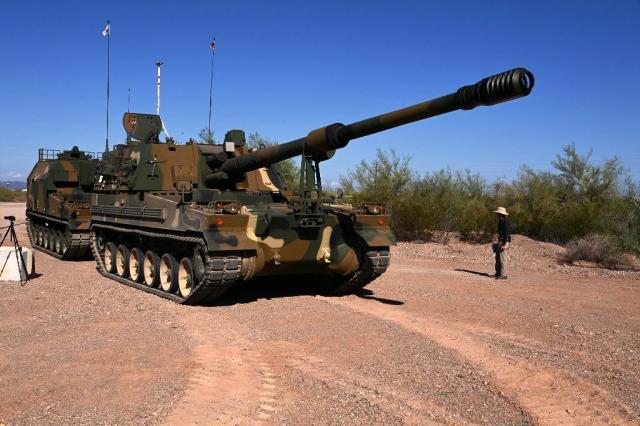
Hanwha is using the exhibition to promote localization-ready systems aligned with Vision 2030, including a K9A1 self-propelled howitzer configured for desert operations and local production.
“Discussions on exports to Saudi Arabia are under way, but it is difficult to say a deal will be finalized this year,” a Hanwha Aerospace official said.
Hyundai Rotem is seeking to build on growing interest in its K2 main battle tank, following major contracts in Poland. Regional media reported that senior Iraqi defense officials visited the company’s booth and showed interest in the platform, with officials noting that political stabilization could lead to more concrete talks.
KAI is also quietly cultivating expectations around potential exports of its KF-21 fighter, which will be introduced to partners such as the Philippines and the United Arab Emirates.
Meanwhile, Hyundai WIA, making its WDS debut, is using the event to raise its profile as a key subsystem supplier. The company is the sole producer of gun barrels for the K9 howitzer and K2 tank.
“Our defense-related revenue has more than doubled over the past three years,” a Hyundai WIA official said.
The sector’s momentum is also reflected in financial markets. Korea’s benchmark KOSPI has recently surpassed the 5,000-point mark, signaling investor confidence in the country’s transition toward high-value manufacturing and defense industries.
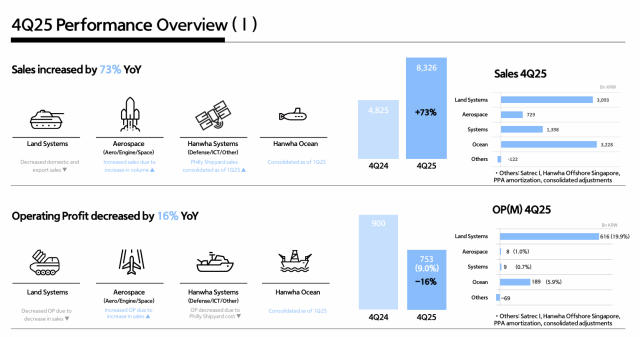
Hanwha Aerospace’s latest earnings have reinforced that trend. The company’s consolidated sales nearly doubled to 26.6 trillion won ($18.21 billion) in 2025, with operating profit jumping 75 percent year-on-year to 3.03 trillion won. Both revenue and operating profit reached all-time highs, while Hanwha Ocean also set record results for the third consecutive year since 2023.
Combined sales of Hanwha Aerospace, Hyundai Rotem, LIG Nex1 and KAI exceeded 40 trillion won for the first time, reaching about 40.9 trillion won. Operating profit totaled roughly 5.2 trillion won, ushering in what analysts describe as a “5-trillion-won operating profit era.”
The four companies’ combined order backlog is approaching 100 trillion won, effectively securing four to five years of production and signaling that the sector has entered a phase of structural growth rather than a short-term boom.
For Korea’s defense exporters, the Middle East is no longer a peripheral market. It is fast becoming a central pillar in their global strategy—where scale, localization and long-term partnerships will determine who captures the next phase of the region’s rearmament boom.

Copyright ⓒ Aju Press All rights reserved.
