
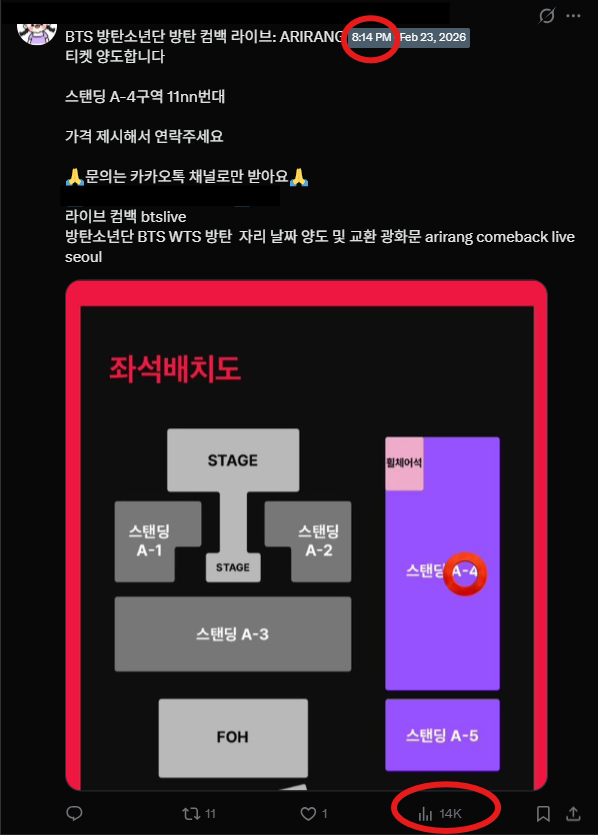
SEOUL, February 26 (AJP) - Standing, A-4 section, seat 3n. +15.”
A Wednesday search for “BTS Gwanghwamun” on X did not just surface fan updates. It revealed a marketplace.
The shorthand “+15” meant 150,000 won ($105.5) — for a ticket whose official price is zero. Dozens of similar posts appeared within hours, some already stamped “transfer completed.”
The event in question — BTS Comeback Live: ARIRANG — is scheduled for March 21 at 8 p.m. at Gwanghwamun Square, a civic landmark more commonly associated with candlelight protests and World Cup gatherings than pop spectacles.
Within 14 minutes of ticketing opening at 8 p.m. on Feb. 23, resale posts began circulating.
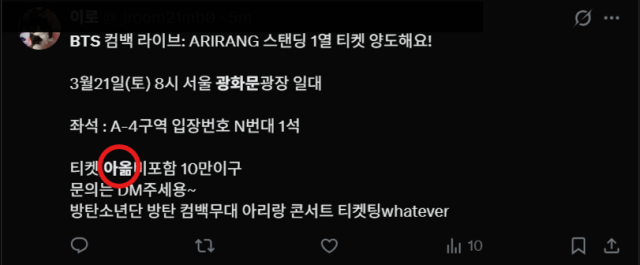
“+10.”
“Foreign OK.”
“All verification possible.”
Sellers frequently mention “a-om,” shorthand for account transfer. The method involves canceling a reservation during low-traffic hours so a buyer can attempt an immediate rebooking. The maneuver carries obvious risk: once released, tickets can be captured by bots or competing users.
Another term, “pal-om,” refers to transferring the wristband distributed after identity verification at the venue. Though designed as a safeguard, social media accounts openly advertise wristband transfer “reservations,” typically charging around 10,000 won upfront, promising refunds if unsuccessful.
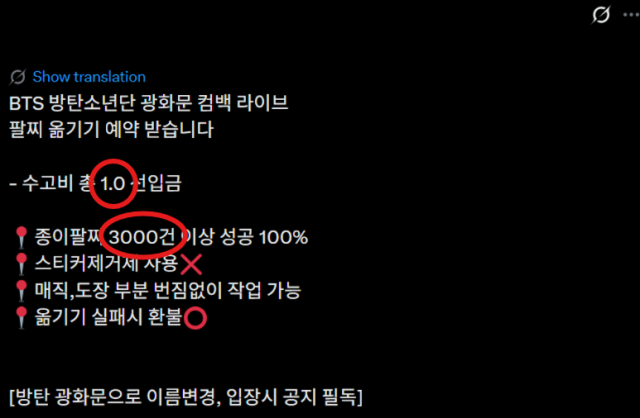
Beyond individuals, a parallel micro-economy appears to be forming. Some accounts claim more than 3,000 successful wristband transfers and advertise “99.8% success rates.” Others promote real-time cancellation monitoring, offering to secure newly released tickets for a 10,000 won deposit and an additional 40,000 won upon success.
These figures are self-reported and cannot be independently verified. But they reveal how resale services brand themselves: efficient, data-driven, near-guaranteed.
Some accounts list multiple adjacent seats despite one-ticket-per-person rules, suggesting resale activity has in some cases evolved into semi-organized brokerage operating alongside official systems.
Police have requested removal of at least 34 posts related to proxy purchasing or suspected scams. Major resale platform TicketBay has banned listings for the event. Yet most transactions unfold on decentralized social media channels, where enforcement is uneven at best.
Not uniquely Seoul
Ticket resale frenzies are hardly confined to Korea.
When Taylor Swift launched her 2022 Eras Tour, 3.5 million fans registered for Ticketmaster’s Verified Fan presale in the United States. When tickets went live on Nov. 15, the system crashed within an hour amid surging traffic, though 2.4 million tickets were sold in a single day.
Original prices ranged from $49 to $499, with VIP packages up to $899. Resale listings later climbed as high as $3,800.
The backlash triggered congressional scrutiny of Live Nation, Ticketmaster’s parent company, over antitrust concerns.
Seoul’s case differs in one essential respect: the face value was zero.
According to the Korea Creative Content Agency, scalping cases surged from 359 in 2020 to 4,224 in 2022 as live events resumed after the pandemic. Following the launch of an integrated reporting portal in 2021, reported cases declined to 2,224 in 2024 and 1,649 in 2025.
Authorities continue to warn fans against purchasing overpriced resale tickets, citing fraud risks. But private transactions conducted through messaging apps and encrypted social media channels remain difficult to police comprehensively.
Some artists have experimented with aggressive countermeasures. Singer Jang Beom-june canceled an entire concert booking in 2024 after evidence of resale prices reaching six times face value. He later tested NFT-based tickets and dynamic QR codes that refresh periodically to prevent screenshot fraud.
Such measures reflect a broader industry acknowledgment: traditional ticketing controls struggle in an era of instantaneous digital arbitrage.
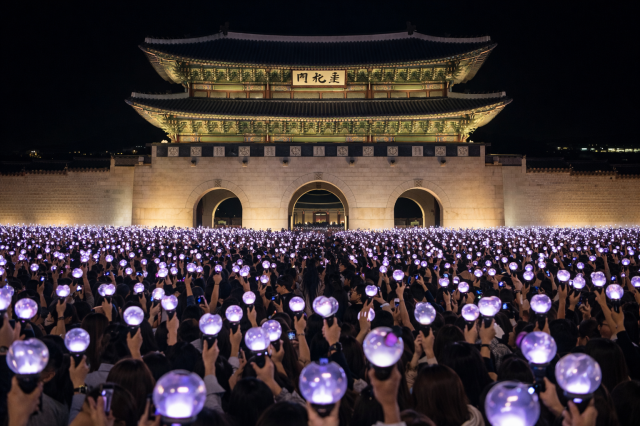
A civic square, a commercial logic
Gwanghwamun Square is not merely a venue. It is a symbolic public commons capable of hosting tens of thousands — a stage for democratic mobilization and national celebration.
By staging a free comeback concert there, organizers signaled a shared civic moment.
Yet digital marketplaces obey a different logic.
When demand is global and supply is finite, even zero acquires a shadow price.
“I love musicals, so I buy tickets quite often,” said a 32-year-old Seoul resident who asked not to be named. “I don’t think resale is entirely bad. Some people simply can’t log in at the exact ticketing time because they’re at work.”
She added: “Extreme markups feel uncomfortable. But if someone secured a ticket on my behalf, I can understand paying a premium. If both sides agree, I don’t see it as inherently wrong.”
In the age of global fandom, free is no longer free.

Copyright ⓒ Aju Press All rights reserved.
