
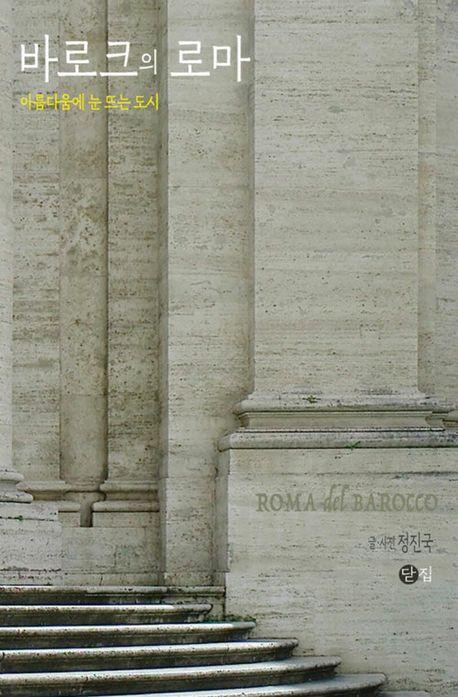
Art critic and photographer Jeong Jin-guk writes that after suffering repeated losses during the COVID-19 pandemic — family, friends and acquaintances — he traveled to Rome. The book pairs photographs he took across the city with humanities-based reflections that came to him on site, aiming to share the essence of Baroque art with friends who could not make the trip.
Jeong argues that 17th-century Baroque art shaped the Rome seen today, describing churches in the historic center as “giant museums” where architecture and art are inseparable. He writes that Baroque works foregrounding the Virgin Mary as a compassionate mother became a refuge that encompassed the worlds of masters including Bernini, Caravaggio and Borromini, and that churches touched by their hands evolved beyond religious facilities into living spaces for art. He also frames Baroque as a “visual art” strategy by the Catholic Church to win back popular support in response to the Reformation. In that context, he rereads Rome’s churches, galleries and museums, inviting readers to consider art and faith, life and the cycles of nature amid masterpieces and saints’ legends.
“Churches redeveloped in this period decided their facades to fit road conditions. The sacred axis of stubbornly aligning direction had no meaning, and they prioritized roads that made it easier for worshippers to come and go. Elders took the view, ‘What could be more sacred and important than following a path that is good for believers to repent and pray!’ It was a rational yet flexible judgment typical of Romans. They did not believe in ancient geomancy, but they also did not openly dismiss superstition, mindful of public sentiment. For these reasons, the rear and front of churches often changed to match new roads, side-aisle doors were turned into main entrances, or facades were redesigned.” (p. 273)
The book collects voices of the “invisible hands” that have supported the Korean Wave behind idol stars and hit content. Its 12 co-authors are figures who have worked over the past 30 years in fields including content exports and production, policy design, tourism and academic research. They focus on how the Korean Wave was planned and delivered, then translated and adjusted to local languages and cultures, and they describe how it seeped into fans’ daily lives around the world. The authors also examine the structure of Hallyu as it expanded into industry, tourism and business, viewing it as a layered social, historical and political landscape — what they call a “scene.”
“Changing ‘single-director’ arts institutions — where the government appointed the head and the head ran the organization alone — into ‘committees’ was also meant to block government interference and give cultural and arts experts independence and autonomy. Today we take bodies like the Korean Film Council or the Arts Council Korea for granted, but it was not that long ago they were the Korean Motion Picture Promotion Corp. and the Korea Culture and Arts Foundation. When I was a working-level official in the Culture Ministry’s arts bureau, I handled the work of converting the foundation into the Arts Council. I went to the National Assembly several times with an amendment to the Culture and Arts Promotion Act. Back then, I said countless times, ‘Support, but do not interfere.’” (p. 57)
During the COVID-19 pandemic, the author writes, he narrowly kept his job amid layoffs and began worrying, “If I get fired tomorrow, how will I make a living?” Confronted with the limits of side jobs and juggling multiple gigs, he started looking for ways to make “money work for itself,” focusing on U.S. dividend ETFs and covered-call ETFs. The book says it can create tangible cash flow in a short period without a large investment, and lays out portfolio construction and management based on the author’s chosen mix of dividend ETFs, BDCs and covered-call ETFs. It also explains ETF structures and types, basic mechanics, tax issues and risk factors to help readers design their own portfolios.
“One advantage of ETFs is that you can see very transparently where your money is and how it is invested. Most ETFs disclose their holdings and weights on a daily basis. For example, if you hold an S&P 500 ETF, you can immediately check what percentage is in Apple, what percentage is in Microsoft, and how much is allocated to sectors like health care or financials.” (p. 38)
* This article has been translated by AI.
Copyright ⓒ Aju Press All rights reserved.