
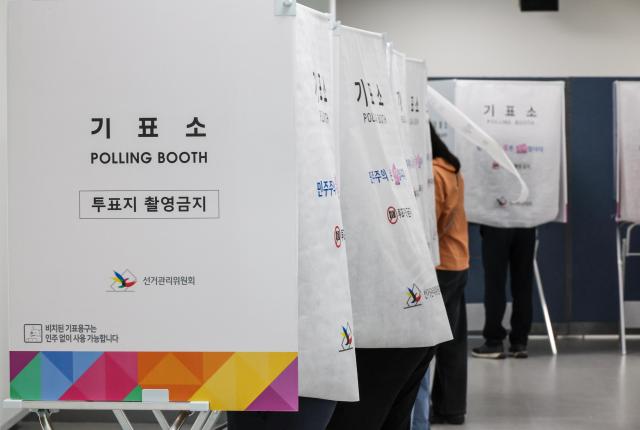
SEOUL, June 03 (AJP) - South Koreans turned out in large numbers for nationwide local elections on Wednesday, setting up a high-stakes verdict on the one-year-old administration of President Lee Jae-myung. Voting proceeded smoothly across 14,288 polling stations before ballot boxes were transferred to designated counting centers.
The election serves as a critical midterm referendum that could either grant the ruling Democratic Party of Korea total control over local and national governance or allow the opposition People Power Party to stall the administration's legislative agenda. The ruling party campaigned on a platform to judge insurrection forces, while the opposition focused on judging the government. A victory for the ruling party provides strong momentum for its second year in office, while a loss threatens to trigger severe internal party disputes over political accountability.
Data from the National Election Commission showed that voter turnout reached 48.9 percent by 2 p.m., marking an 8.2 percentage point increase from the local elections four years ago. More than 21.8 million of the country's 44.6 million eligible voters cast ballots, including those from a two-day early voting period that recorded a 23.51 percent turnout.
The election commission expects the general outline of the winners to emerge around midnight as officials count ballots across 258 centers nationwide. While clear victories may be determined by midnight, highly competitive races and concurrent parliamentary by-elections in key battlegrounds like Seoul and Busan are expected to remain unclear until 3 a.m. or 4 a.m. on Thursday.
Total counting times are expected to exceed the seven hours and 40 minutes recorded during the 2022 local elections due to a mandatory manual verification process introduced during the 2024 general elections. "In the past, we used a machine to sort the ballots and then had individuals verify them using a counter, but this time a manual inspection step has been added where the number of ballots is counted one by one by hand, which will cause the counting process to take longer," an election commission official told Yonhap News.
Regional data showed Jeonnam province recorded the highest voter turnout at 58.0 percent, followed by Gangwon province at 54.5 percent and Jeonbuk province at 54.2 percent. The capital city of Seoul recorded a 49.4 percent turnout, while the southwestern city of Gwangju saw the lowest participation rate in the country at 45.3 percent.
The highest final turnout for a South Korean local election remains the 68.4 percent recorded during the inaugural nationwide vote in 1995. Only two local elections in the country's history have surpassed the 60 percent participation mark.
Copyright ⓒ Aju Press All rights reserved.
