The Ministry of Trade, Industry and Energy said Wednesday the decision follows an emergency meeting of the International Energy Agency (IEA), where its 32 member countries agreed to release a combined 400 million barrels from emergency stockpiles.
The unprecedented move aims to cushion a severe supply shock after the Strait of Hormuz — a vital artery carrying roughly one-fifth of the world’s oil trade — was effectively closed amid the escalating conflict.
South Korea’s share amounts to 5.6 percent of the total release, calculated based on each member country's share of oil consumption among the IEA’s 32 members.
The planned release of 22.46 million barrels marks the largest drawdown in the country’s history, surpassing the 4.94 million barrels released during the 1990 Gulf War.
It is also nearly double the volume South Korea released during the coordinated IEA actions following Russia’s invasion of Ukraine in 2022, when the country contributed a total of 11.65 million barrels across two rounds.

IEA Executive Director Fatih Birol said the coordinated action reflects the scale of the disruption facing global oil markets.
“The oil market challenges we are facing are unprecedented in scale,” Birol said. “Oil markets are global, so the response to major disruptions must also be global.”
The Paris-based agency holds roughly 1.2 billion barrels in emergency reserves among its members. The coordinated release announced Wednesday will be the sixth such intervention since the IEA was founded in 1974 and the largest on record.
Seoul said the exact timing and pace of its release will be determined through consultations with the IEA secretariat, taking into account national circumstances and market conditions.
A ministry official said the move is expected to help stabilize global oil markets and mitigate the economic impact of surging energy prices.
“Through close cooperation with the IEA and major countries, the government will continue working to minimize the burden of high oil prices on the economy and consumer inflation,” the official said.
The emergency action comes as the Iran war has sent energy markets into turmoil, with tanker traffic disrupted and Middle East producers struggling to export crude without access to shipping routes.
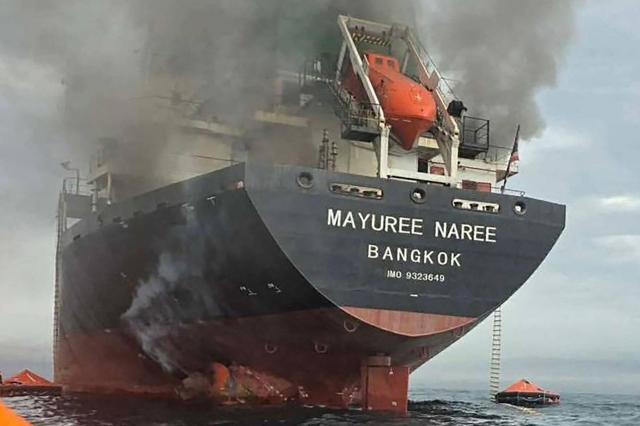
The Thai-flagged dry bulk carrier Mayuree Naree caught fire after being struck by two projectiles while transiting the strait, its operator Precious Shipping said. Three crew members were reported missing and believed trapped in the engine room, while the remaining 20 crew members were evacuated safely to Oman.
Iran’s Revolutionary Guards later said the ship had been “fired upon by Iranian fighters,” suggesting a rare direct engagement by the force.
Two other vessels sustained minor damage earlier the same day. The Japan-flagged container ship ONE Majesty was hit by an unidentified projectile while anchored in the Gulf, leaving minor damage above the waterline but no injuries among the crew, according to its owner Mitsui O.S.K. Lines and charterer Ocean Network Express.
A Marshall Islands-flagged bulk carrier, Star Gwyneth, was also struck about 50 miles northwest of Dubai, damaging its hull. Maritime risk firm Vanguard said the crew remained safe and the vessel was not in danger.
Iran’s Revolutionary Guards have warned that ships attempting to pass through the Strait of Hormuz would be targeted, while U.S. President Donald Trump has threatened to intensify attacks on Iran if it continues to block the vital shipping lane.
Despite repeated requests from shipping companies, the U.S. Navy has declined to escort civilian vessels through the strait for now, saying the risk of Iranian fire remains too high. U.S. Central Command said its current focus is destroying Iran’s missiles and drones and degrading its ability to disrupt maritime traffic.
Energy analysts warn that the reserve release can ease market pressure temporarily, but a sustained stabilization ultimately depends on reopening the Strait of Hormuz and restoring normal oil flows.
Copyright ⓒ Aju Press All rights reserved.