
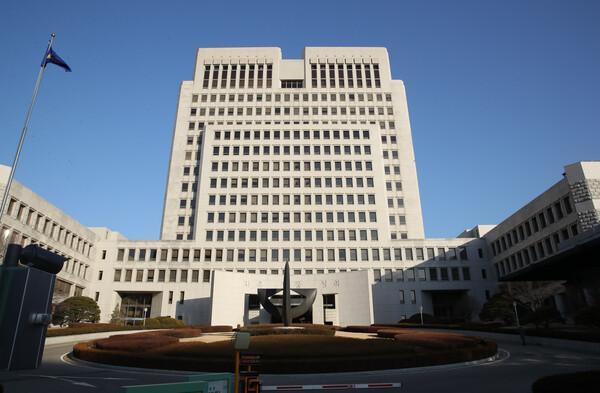
The Supreme Court said that on Feb. 12 that it upheld an appellate court decision overturning the Seoul Central District Court’s dismissal of the case.
The proceedings date back to 2015 when 85 alleged victims and their bereaved families took the action against 16 Japanese companies, including Mitsubishi Heavy Industries, Nippon Steel, Nissan Chemical and Hokkaido Colliery & Steamship Co., seeking unpaid wages and compensation for damages.
While exact figures are unavailable, it is estimated that about 1.5 million Koreans, then subjects of Japan, were mobilized to Japan, Manchuria, and other areas, and about 2 million were forcibly mobilized within the Korean Peninsula.
The Seoul Central District Court’s initial dismissal of the case in June 2021 cited the 1965 Korea-Japan Claims Agreement when the two countries normalized their relations, saying it effectively ended individual claims. This decision ran counter to a Supreme Court October 2018 ruling which upheld an earlier decision ordering Nippon Steel to compensate Korean victims of forced labor.
The Seoul High Court overturned the lower court ruling on appeal in February 2024, saying the Supreme Court’s 2018 ruling recognized Japanese companies’ liability.
Mitsubishi Heavy Industries and Hokkaido Colliery & Steamship Co. appealed, but the Supreme Court dismissed both, finding no error in the lower court’s judgment, including on legal principles concerning international jurisdiction, treaties, or the scope and effect of the Claims Agreement.
With the latest ruling by the Supreme Court, the case is to be retried at the Seoul Central District Court.
Hokkaido Colliery & Steamship Co. argued it had been discharged from liability under Japan’s former Corporate Reorganization Law and that any lawsuit based on discharged claims was inadmissible, but the Supreme Court rejected the argument, noting that under South Korea’s former Corporate Reorganization Act — which follows the principle of territoriality — such discharge does not extend to the plaintiffs’ claims.
Many of those conscripted endured brutal working conditions, with numerous deaths resulting from accidents or suicide. In 1942, for instance, 136 Koreans were killed in a mass drowning incident at the Chosei coal mine in Yamaguchi Prefecture.
After liberation, the South Korean government showed limited interest in compensating individual victims, but rather focused on national-level compensation. The 1965 Korea-Japan Basic Treaty and its supplementary Agreement on Claims and Economic Cooperation stipulated that Japan would provide $500 million — $300 million in grants and $200 million in loans — and that “the problems concerning property, rights and interests of the two countries and their nationals have been settled completely and finally.”
Copyright ⓒ Aju Press All rights reserved.
