
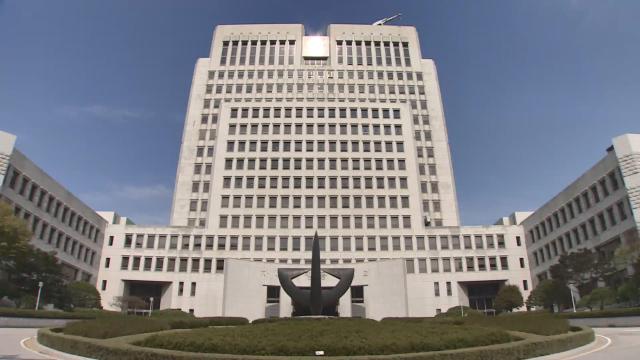
The Supreme Court has ruled that tipping over a desk does not constitute assault if it does not pose a physical threat to the victim.
On May 10, the Supreme Court's first division, led by Justice Ma Yong-joo, overturned a lower court's ruling that imposed a fine of 300,000 won on an individual identified as A, and sent the case back to the Uijeongbu District Court.
A was charged with assault after tipping over a desk during a verbal altercation with B in a residents' meeting room of an apartment complex in Goyang, Gyeonggi Province, in May 2021.
Both the first and second trials found A guilty and imposed the fine, stating that “fragments of the overturned desk flew toward the victim, and the sudden act startled and threatened the victim and others present.”
However, the Supreme Court found that the lower court had misunderstood the legal principles regarding the establishment of assault, accepting A's appeal.
The court stated, “The evidence presented by the prosecution, including the fact that fragments of the desk flew toward the victim as a secondary result of A's actions, is insufficient to conclude that A assaulted the victim or had the intent to do so.”
It further explained, “Considering that the desk was tipped over in a direction blocked by another desk, and that the victim was standing approximately at the 10 o'clock position relative to A, it does not appear that A's actions posed a physical threat to the victim. Simply startling or frightening the victim does not qualify as 'assault.'”
The court also referenced previous rulings, stating, “Assault under criminal law is intended to protect the integrity of a person's body, not to safeguard against psychological distress. Therefore, in cases where there is no physical contact with the victim, one must carefully assess whether the exertion of force against a person constitutes assault.”
The court emphasized the need to consider various factors, including the physical orientation of the act, the degree of illegality against the victim's body, the spatial proximity between the actor and the victim, the intent and purpose of the act, the nature and method of the act, the circumstances at the time, and the presence and extent of any pain inflicted on the victim.
* This article has been translated by AI.
Copyright ⓒ Aju Press All rights reserved.